Jeremy Irons in Corriere della Sera Magazine

Jeremy Irons is featured in the 7 June 2013 issue of Corriere della Sera Magazine from Italy.

corriere della sera

Here is a translation of the article:
(Thank you to Barbara Danisi for the translation!)

Jeremy Irons arrives in Italy to read Machiavelli’s The Prince together with Laura Morante.

He says that the only real Prince left is the Pope. He’s the only one who has the power to change the world and make it better. He has already begun changing the Vatican: Jeremy was very impressed seeing the Pope washing people’s feet, that’s what the Church needs. Then he compares Pope Bergoglio with the character he played in the movie Mission, Father Gabriel, they’re both of the Jesuit order.

The game of power has remained the same for years. ‘’ Whether it is better to be loved than feared, or the reverse’’ Machiavelli wrote.

Human nature hasn’t changed, and so haven’t the means to control people. Industries only care about their business, politicians in Bruxelles decide for our lives. It’s the game of power. Those who cheat will always find those who let themselves be cheated.

Jeremy has never thought of becoming a politician. To be a politician you must have great ideals, know society, without accepting compromises, which is the most difficult thing to do.

‘’I’ve always tried to organize my life, and I’ve always said to my sons that the most important thing is to find happiness in life. Even when I choose my roles I choose characters who are far away from politics.’’

In theatre he played Richard II, a man who didn’t want to rule, but found himself on the throne, as opposite to Macbeth and his lust for power and dangers. Jeremy says that in politics there have been some good men, such as Nelson Mandela or Churchill. But every politician is disappointing in the end, leading a nation is a hard task.

Bruxelles has power over almost every European nation. Last year in Italy the prime minister was not voted by people, but imposed and charged to put order in the Italian economics, but having an economist as the head of the government is not a good thing.

Ironically there was a politician in the Irons family: one of his ancestors broke into Westminster parliament riding a donkey to make a petition for democracy.

There is one man that Jeremy admires, and he is Pope Francis. Jeremy likes going to church with his Catholic wife Sinead. ‘’When I was in Colombia shooting The Mission I chose to be barefoot all the time because the Indians didn’t wear any shoes and I wanted to feel like them, feel what they felt, a strong bond with nature and the ground under their feet. You can follow the word of Christ without being influenced by the Church of Rome. Actually the Church has always been far away from people , but I think Pope Francis can change this. It will be hard but he can make it’’.

Very different from Pope Francis is Rodrigo Borgia, a dissolute libertine. ‘’I read a lot about him to play this character. He was more of a king than a pope, he wanted to be rich and powerful but in the end he stained the name of his family forever. Rodrigo is often seen as a negative man, but playing a negative character is very charming! Playing the role of someone who goes against the rule of society is very interesting! There’s this constant fight between the good and the evil inside of us’’.

Then Jeremy goes on talking about Trashed. Films, movies (Jeremy’s favourite movie is L’amour by Michael Haneke) cannot change people but can make us aware of the problems we need to solve.
Jeremy Irons says he wants to stay away from politics, but Trashed is a political film.
‘’We are sinking into trash. We are producing too much trash and it pollutes everything, the water we drink, the air we breathe, the sea. But many industries make a lot of money out of trash, so there’s little interest in facing the issue. It would be easy, starting with recycling and reducing packaging. Incinerators are very dangerous, because all goes into the air and can cause damages to people’s brain. Governments should do something about it but they don’t, they’re not interested. ‘’

In the end Jeremy talks about internet and facebook. They should be places for dialogue, instead every word you say is turned around and given the wrong meaning, as it happened recently when Irons stated his views on gay marriage.

‘’Everyone sees what they want to see, few really listen to what you say and understand what you really are’’ Machiavelli wrote 500 years ago. And so we wait for Jeremy in Florence to explain all of this.

Jeremy Irons at the 2013 Hay Festival

Jeremy Irons read Four Quartets by TS Eliot on Saturday 1 June.  He introduced a screening of Trashed and also was a part of the Poetry of the Great War readings on Sunday 2 June.

__________________________________________________________________________________________

Click HERE for audio of Jeremy Irons, Sinead Cusack and Rupert Evans reading The Poetry of the Great War. The actors read Josephine Hart’s programme featuring the work of Owen, Yeats, Sassoon and many others. Introduced by Francine Stock.
__________________________________________________________________________________________

Jeremy Irons on his love for TS Eliot – from The Telegraph

__________________________________________________________________________________

Here are some photos and feedback from the weekend (Click on the thumbnails for larger images):

This slideshow requires JavaScript.

Heal the Bay honors Jeremy Irons at Bring Back the Beach

Heal the Bay honored Jeremy Irons at their 2013 Bring Back the Beach gala, for his contribution to the short film The Majestic Plastic Bag.

Jeremy Irons to Introduce ‘Trashed’ Screening at Hay Festival

Jeremy Irons will introduce the screening: Trashed on Sunday 2 June 2013.

hay festival trashed screening

Event 489 • Sunday 2 June 2013, 10.30am • Venue: Richard Booth’s Bookshop Cinema, 44 Lion Street

In the new docu-feature Trashed, a Blenheim Films production, produced and directed by British filmmaker Candida Brady (Madam and the Dying Swan), which was selected to receive a Special Screening at the Cannes Film Festival, Irons sets out to discover the extent and effects of the global waste problem, as he travels around the world to beautiful destinations tainted by pollution. This is a meticulous, brave investigative journey that takes Irons (and us) from scepticism to sorrow and from horror to hope. Brady’s narrative is vividly propelled by an original score created by Academy Award winning composer Vangelis.

Price: £7.50

Jeremy Irons on CBS Sunday Morning

Source

Irons_garbage_244x183

Jeremy Irons talks trash

In the 1995 movie “Die Hard: With a Vengeance,” Jeremy Irons was pure evil as an urbane and elegant bad guy.

As Simon Gruber, he terrorized pre-9/11 New York City, practically in the shadow of the still-intact World Trade Center towers.

Scary stuff . . . but it’s nothing compared to Jeremy Irons’ latest film.

In the new documentary “Trashed,” Irons shows us the terrifying possibility of a future world buried in its own garbage.

“After doing the documentary, how conscious are you, when you walk down the street, of trash?” asked Smith.

“Well, I mean, this part of New York is wonderful, there’s no trash in sight,” Irons said. “And I think it’s a case of out of sight, out of mind.”

“We throw it away and it’s gone?”

“That’s right. It’s clean, it’s lovely, it’s not something we have to worry about. But where does it go?”

Where, indeed? In Indonesia, garbage goes in the nearest river, and eventually out to sea. Worldwide, according to the film, Americans could recycle 90 percent of the waste we generate, but right now we only recycle a third of that — and some of our trash eventually finds its way back into us — such as plastics leeching into our food supply.

It’s weird to see an Oscar-winning actor rooting through trash cans in New York City’s nicest neighborhood, but for Irons, garbage has become, well, personal.

He pulled out one object: “Now this is recyclable, this is great, but it’s half full, so it’s wasted food. Coconut water: Fantastic for you, 100% pure, and it’s thrown away half-full. We waste a huge amount of the food we buy.”

“You have no hesitation to just pick through the trash, Jeremy?” Smith asked.

“No, it’s rubbish. That’s all it is. It’s just dirt. A bit of dirt before you die is good.”

“Celebrities get asked to be involved in a lot of different causes; what was it about trash that made you say, ‘I have to do something’?” asked Smith.

“I wanted to make a documentary about something which I thought was important and which was curable,” he said. “It’s not rocket science. It takes a little effort, it takes a little thought. It takes a little education. I think most people want to do what is right. But they need a bit of organization.

“We make everybody wear seatbelts now. That was a bore, wasn’t it? But we do it, and we don’t think about it anymore. Very simple to do the same with how we deal with our garbage.”

It might not be easy to picture Jeremy Irons as a garbage activist: From his breakout role in 1981’s “The French Lieutenant’s Woman,” he has been in more than 40 movies, at least as many plays, and has won just about every acting award there is.

“I’ve been very lucky,” he said.

“You have a slew of awards that would say you got some talent,” Smith suggested.

“Yeah, if awards mean that. Yeah. Yeah.”

“You don’t think they mean much?”

“I do. I do. And I really don’t want to denigrate them. I think awards are fantastic. I don’t let them go to my head. I always, when I start a new piece of work, I still feel like a plumber, but I don’t know how to do it. I just sort of feel out of my depths — I’m not very good at plumbing!”

Well, he’s good at something. Born in England in 1948, Jeremy John Irons trained as a stage actor before breaking into film.

He’s been married to actress Sinead Cusack since 1978, with whom he has two sons. But on-screen he hasn’t always been such a devoted husband.

In 1990’s “Reversal of Fortune,” Irons was cast as socialite Claus von Bulow, accused of trying to kill his rich wife by giving her an overdose of insulin.

“Did you love getting in Claus von Bulow’s head?” Smith asked.

“I was slightly embarrassed,” Irons said, “and in fact fought off playing him for a while, because he was alive and I thought there was something tasteless about pretending to be someone who was still alive. And so I fought against it. Finally it was Glenn Close who persuaded me. She said, ‘If you don’t play him someone else will play him. You know, come on. Have a crack at it. It’s interesting.'”

Glenn Close was right: the performance earned him the Oscar for Best Actor.

Irons’ Claus von Bulow is a saint compared with his current role in the Showtime series, “The Borgias.” Irons is Pope Alexander VI, a man of many passions.

Off-screen, you might say Irons has become the unofficial pope of recycling — and, in what may be his most important role yet, an elegant and refined voice of caution.

Are we doomed?, Smith asked “I don’t believe we’re doomed because I believe that human nature is extraordinary,” Irons said. ” I think we will be brought to our senses eventually. I think things may have to get worse. I think, I hope we will be brought to our senses. We’re on a highway to a very expensive and unhealthy future if we do nothing.”

“And gloomy future,” Smith added.

“Well, the sun will still shine,” Irons replied.

Jeremy Irons at New York Times Energy for Tomorrow Conference

Jeremy Irons was a featured speaker at the New York Times Energy for Tomorrow Conference in New York City on Thursday, April 25, 2013.  He was interviewed by New York Times columnist Andrew Revkin about the film Trashed.

The New York Times Energy for Tomorrow conference featured Mayor Michael Bloomberg’s Food Waste Challenge announcement, where the Mayor talked for the first time about the City program with more than 100 restaurants to reduce organic waste sent to landfills; and a talk with Academy Award-winner Jeremy Irons on his documentary, “Trashed,” and the steps we can take in our daily lives to reduce waste.

You can watch the entire conference, broken up by panel, on demand at www.NYTEnergyforTomorrow.com.

Visit Andrew Revkin’s Dot Earth blog to see video of Jeremy at the conference and read more from Andrew Revkin.

This slideshow requires JavaScript.

Jeremy Irons Attends ‘Trashed’ Screening and Q&A

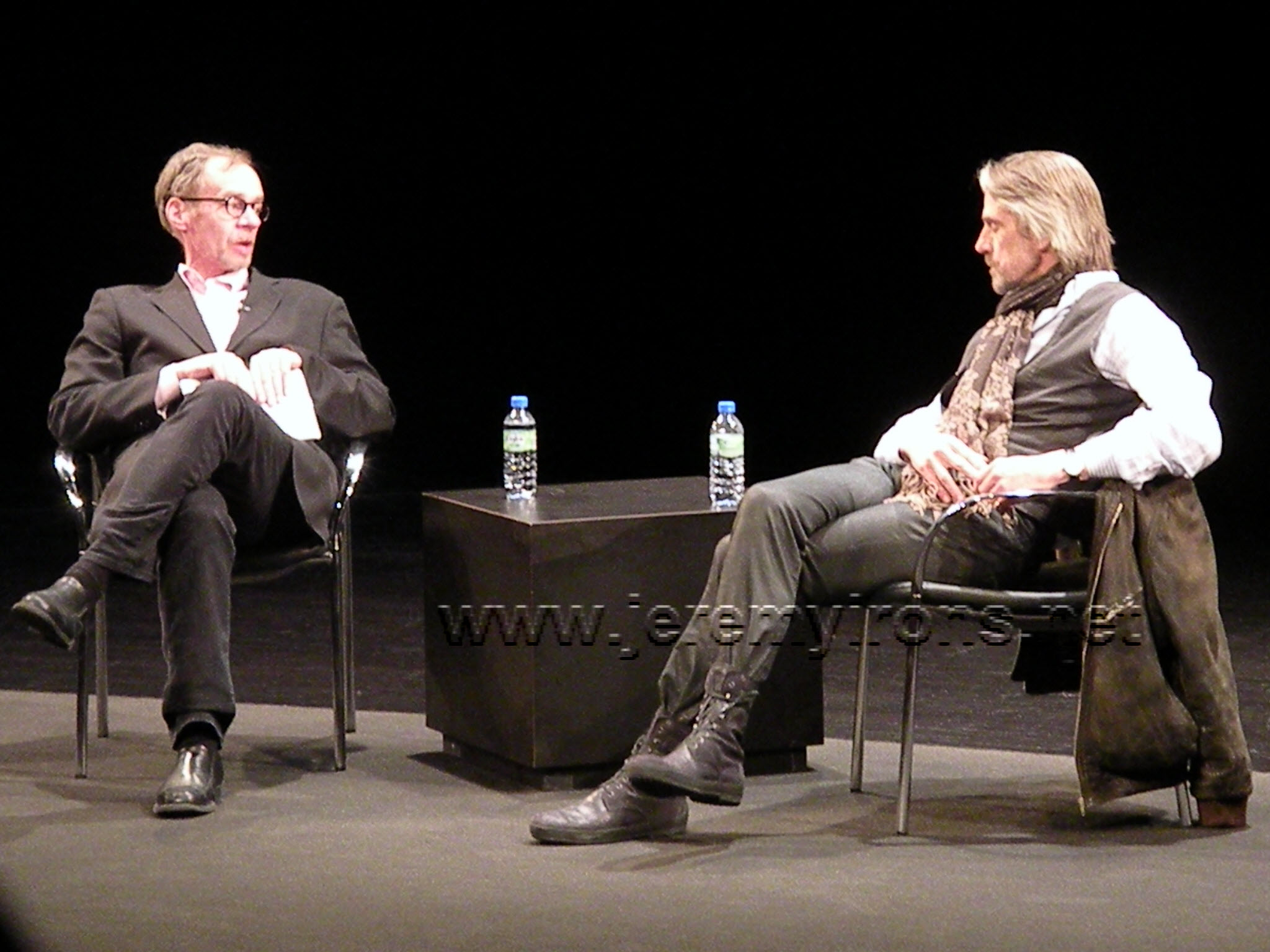
Jeremy Irons was in attendance on Wednesday, April 24, 2013, at Florence Gould Hall in New York City for a screening of Trashed, followed by a Q&A session with New York Times columnist David Carr.

carrirons1 carrirons2 carrirons3 carrirons4 carrirons5 carrirons6 carrirons7 carrirons8 carrirons9


‘Trashed’ Screenings at Documentary Edge Festival NZ

Trashed will be screened as part of the Documentary Edge Festival in New Zealand.

documentary edge festival logo

Times and locations are as follows:

Sunday 14 April  6:45 pm at the Q Theatre in Auckland, New Zealand  BOOK TICKETS

Friday 19 April 1:15 pm at the Q Theatre in Auckland,New Zealand  BOOK TICKETS

Sunday 12 May 6:30 pm at the Reading Cinemas Courtenay in Wellington, New Zealand

Friday 17 May 1:45 pm at the Reading Cinemas Courtenay in Wellington, New Zealand


Jeremy Irons to Attend ‘Trashed’ Screening at BAM

Source

Jeremy Irons will be in attendance on Sunday, April 21 at the BAM screening of Trashed and will participate in a Q & A session after the screening.

Sunday, Apr 21, 2013
  • 7PM
LOCATION:
Peter Jay Sharp Building
BAM Rose Cinemas
RUN TIME: 98min
GENERAL ADMISSION: $20
BAM CINEMA CLUB MEMBERS: $15
STUDENTS/SENIORS:  $16 (Students 29 and under with a valid ID, Mon—Thu)
+  Q&A with Jeremy Irons

The narrator of  Trashed, Academy Award-winning actor Jeremy Irons, will participate in a Q&A after the screening.

———————————————————————————————–

There will also be a School-Time Screening of Trashed on Earth Day for Schools Only
Grades 9—12   Jeremy WILL NOT be present on Monday.
Mon, Apr 22, 2013
  • 10:30AM
  • 11:15AM
LOCATION:
Peter Jay Sharp Building
BAM Rose Cinemas
RUN TIME: 2hrs 15mins (includes post-show Q&A)
+  All screenings are followed by discussion/Q&A. Post-screening guest to be announced.
If you are an educator you may make reservations HERE.

Jeremy Irons to Attend Energy for Tomorrow Conference

PROGRAM ADDITION – APRIL 24 EVENING
(THE EVE OF THE CONFERENCE)

There will be a screening of the documentary “Trashed” on the eve of the conference. Seats are limited and the screening will be open to the public. Confirmed conference participants will get priority. The screening will be followed by a conversation with the executive producer, Jeremy Irons.

The screening will be held on 7 pm, Wednesday, April 24 at Florence Gould Hall, 55 East 59th Street. No audio recording or photography will be allowed.

Public tickets can be purchased here: http://www.nytimes.com/marketing/screening/index.html

Confirmed speakers:
Jeremy Irons, actor and executive producer, “Trashed”
in conversation with David Carr, media and culture columnist, The New York Times

——————————————————————————————–

On April 25th –

10:40 – 11 a.m.
COLUMNIST CONVERSATION
Jeremy Irons, actor and executive producer, “Trashed”
in conversation with Andrew Revkin, Op-Ed columnist and author, Dot Earth blog, The New York Times

*Please note, there is a screening of “Trashed” on the eve of the conference. Seats are limited and the screening will be open to the public. Confirmed conference participants will get priority.

—————————————————————————————-

Official press release from The New York Times Company:

Mayor Michael Bloomberg, Sec. Shaun Donovan and Jeremy Irons Join Lineup for New York Times Energy for Tomorrow Conference April 25

NEW YORK, March 11, 2013 – The New York Times today announced that New York Mayor Michael Bloomberg will deliver a keynote address at its second annual Energy for Tomorrow conference on Thursday, April 25, at TheTimesCenter.  Mayor Bloomberg will address the conference’s theme of building sustainable cities and the question of what we, as global citizens, want from our cities.

Shaun Donovan, U.S. Secretary of Housing and Urban Development, will join New York Times Op-Ed columnist Thomas Friedman in conversation to discuss the Obama administration’s vision for city development as our urban populations grow worldwide.

Jeremy Irons, Academy Award-winning actor and activist, will also speak at the conference about solutions for better waste management and his documentary, “Trashed,” which looks at the challenges posed by waste to the environment and how we can enact change for a cleaner world. 

Confirmed conference attendees will be invited to a special screening of “Trashed” with free admission on the eve of the conference, Wednesday, April 24.  A talk with executive producer Jeremy Irons and New York Times media and culture columnist David Carr will follow the screening.

Additional New York Times speakers and moderators at Energy for Tomorrow will include Op-Ed columnists Mark Bittman, Bill Keller and Joe Nocera; DealBook founder and columnist Andrew Ross Sorkin; energy and environmental issues reporter John Broder; architecture critic Michael Kimmelman; Op-Ed writer for the Dot Earth blog Andrew Revkin; and international environment correspondent Elisabeth Rosenthal.

Energy for Tomorrow is by invitation only and will be available to the public via live stream, which is free to view, at www.NYTEnergyforTomorrow.com.

The conference will open at 8:00 a.m. with a New York Times newsroom panel breakfast session that explores the issues of climate change, now at the top of the political agenda.

The New York Times Energy for Tomorrow conference series brings together thought leaders from across energy and environment industries to discuss the most urgent and important issues at hand and to explore different ways of fueling our evolving, global economy.

BlackBerry joins The New York Times as presenting sponsor of the 2013 Energy for Tomorrow conference.

To request an invitation to attend and to learn more about the conference, visit www.NYTEnergyforTomorrow.com.

About The New York Times Company

The New York Times Company (NYSE:NYT), a leading global, multimedia news and information company with 2012 revenues of $2.0 billion, includes The New York Times, the International Herald Tribune, The Boston Globe, NYTimes.com, BostonGlobe.com, Boston.com and related properties. The Company’s core purpose is to enhance society by creating, collecting and distributing high-quality news and information.

Contact: Stephanie Yera, 212-556-1957, stephanie.yera@nytimes.com

This press release can be downloaded from www.nytco.com.