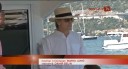
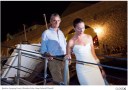
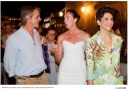
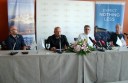
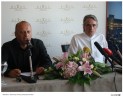
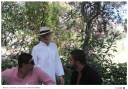
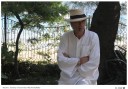
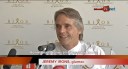
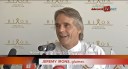
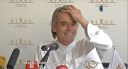
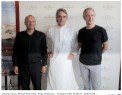
Jeremy Irons at 2012 Sarajevo Film Festival

Source

Some photos via @chrisdz and @vjosab on Twitter, @neshill and @m_juric on Instagram, Nikolina Vicelic ‏@NikolinaVicelic on Twitter, and Ranko Vucinic ‏@rankovucinic on Twitter and Sinisa Sunara / Cropix .

This slideshow requires JavaScript.

Jeremy Irons Guest of the Sarajevo Film Festival

With a great pleasure the Sarajevo Film Festival announces arrival of one of the greatest actors of today, the Oscar winner, Jeremy Irons.

Jeremy Irons returns to Sarajevo in capacity of the curator of Katrin Cartlidge Foundation, which will award one young artist this year again.

Sarajevo audience had a chance to greet this big friend of the Sarajevo Film Festival, the actor with a fascinating international career, during the Sarajevo Film Festival in 2007 when he presided the Grand Jury of the 13th Sarajevo Film Festival’s Competition Programme.

British actor realized his roles in around seventy films, among which only some to single out, “Waterland”, “The Man in the Iron Mask”, “M. Butterfly”, “The Mission”, “Reversal of Fortune” for which he won Oscar and Golden Globe for the Best Actor in the Leading Role.

On the occasion of Jeremy Irons’ arrival to Sarajevo, on Saturday a special screening of the film TRASHED, directed by Candida Brady will take place in the Meeting Point Cinema, starting at 2.30 p.m. After the screening, a Q&A with the special guest, Jeremy Irons, will take place.
________________________________________________________________________________

Jeremy was also in Dubrovnik and attended a press conference there.

Jeremy Irons goes Henry IV into battle

Liverpool Echo 30 June 2012

After almost a decade, Jeremy Irons is returning to Shakespeare, as King Henry IV in a new BBC series. Acting’s good, he tells Kate Whiting, but what he really loves doing is tinkering with his boat.

IN A snow-covered field just a stone’s throw from the M25, Jeremy Irons, Tom Hiddleston and a heavily disguised Simon Russell Beale are doing battle.

It’s a surreal sight, as Jeremy and Tom, in chain mail and red capes, charge back and forth on horses through a throng of armour-clad men, while Russell Beale, in a fat-suit and clasping a spear, runs comically away from just about everyone in his path.

On hills either side of the small valley are camps of ancient tents and, were it not for the camera crew in modern-day dress, you could almost imagine it was Medieval England. Even the sounds of the M25 have been muffled, much to director Richard Eyre’s relief, thanks to the snow.

But this is January, 2012, and the scene being filmed is the climax of Shakespeare’s Henry IV Part I, where the future Henry V, young Prince Hal, will defeat rebel leader Hotspur, ultimately taking his place in history.

Some time earlier, in the comfort of a heated modern tent, which doubles as wardrobe and canteen for the battling mob, Jeremy Irons, who’s playing the titular king, settles down to discuss his first Shakespeare play since the 2004 Merchant Of Venice film.

He looks every inch the lauded British thespian, dressed in a red woolly jumper, Middle Eastern scarf, cords and high black boots, with a backwards cap on his head – chic but cosy.

“Shakespeare is wonderful to come back to, you forget how fertile his language is,” says the 63-year-old, in those deep, familiar tones.

“You get used to working in film, where language is spare and often not well written and suddenly you get back to this language, his use of rhythm, the choice of words, the way he changes from one thought to another on a sixpence, which is glorious.

“It’s like driving an Aston Martin and you think, ‘Oh yes, this can do anything, once I get to know how to do it’. Once you’ve done some of those big roles, even though you might not have done it for a few years, you know the possibilities, you know what you’re looking for – which is to make it sound completely colloquial and understandable to an audience.”

Indeed, with their season of four Shakespeare history plays, entitled The Hollow Crown, it’s the BBC’s mission to appeal to as wide an audience as possible. As part of the Cultural Olympiad in the run-up to London 2012, the Shakespeare Unlocked season charts the rise and fall of three kings; self-indulgent Richard II (played by Ben Whishaw) who is overthrown by his cousin Bolingbroke, Henry IV, and finally his son Henry V.

The two parts of Henry IV tell of the king’s guilt over deposing his cousin and struggle to retain the crown, as his enemies rise up against him.

In recent years, Jeremy, who made his name in the 1981 ITV series Brideshead Revisited before starring in films such as Lolita, The Mission, The Lion King and the Oscar-winning Reversal Of Fortune, has returned to TV acting, with an acclaimed role in the US drama The Borgias. Next month, he’s off to Budapest to film the third series.

Television has become more appealing as film budgets dwindle, he says.

“Movies are really having a problem. The sort of pictures I make, what I call the £8m to £30m, are not made very easily now. The £200m are getting made and the £1m movies are getting made, but the ones in the middle are finding it very hard.

“I’ve been watching the series that are coming out of America and there’s such good writing happening. Mad Men, The Wire, Damages, this is really good drama, good writing.”

When he does get a break from his acting schedule, Jeremy has more than enough at home in Ireland to keep him busy.

“I love downtime because there are many other things I love doing,” he says simply. “I’ve always been a doer-upper of things. In the early days it was furniture, then it became houses. Now I have a boat and horses, which is very lucky.

“At one stage, during my 30s, I remember leaving the house thinking, ‘Why do I have to work, there’s so much I want to get done?’. Then I thought, ‘Careful, you have to work in order to support the life you want to live’.”

And with that, Jeremy is off to ride a horse – for work.

The Hollow Crown begins on BBC Two today. Jeremy Irons appears in Henry IV Parts 1 & 2 on Saturday, July 7 and Saturday, July 14

Read More http://www.liverpoolecho.co.uk/liverpool-entertainment/showbiz-news/2012/06/30/jeremy-irons-goes-henry-iv-into-battle-100252-31289207/#ixzz1zH4aizR8

Emmys 2012: Jeremy Irons is the Original Mob Boss (Q&A)

From The Hollywood Reporter

The actor channels his innate “touch of melancholia” to create an addictive crime-family patriarch in Showtime’s epic drama “The Borgias.”

11:44 AM PDT 6/6/2012

by Marisa Guthrie

This story first appeared in the June 2012 Special Emmy Issue of The Hollywood Reporter.

A rainy April afternoon in New York finds Jeremy Irons, 63, chain-smoking hand-rolled cigarettes (he buys the tobacco at airport duty free shops) in his suite at the Upper East Side boutique Lowell Hotel. He is enjoying a moment away from his peripatetic work schedule: In addition to playing the lead on Showtime’s The Borgias, which shoots in Budapest, the British Oscar winner (Reversal of Fortune) also has completed work on Bille August’s Night Train to Lisbon, shot on location in Portugal, and is shooting Richard LaGravenese’s Beautiful Creatures in New Orleans. With his signature candor, Irons shares his take on the “bullshit” of fame, how a revealing dinner at the Vatican prepped him for his role as Renaissance Pope Rodrigo Borgia and the two American actors who have intimidated him.

The Hollywood Reporter: What drives you to keep working?

Jeremy Irons: It’s a bit of a drug. But it’s important that you have a very strong life with other passions that counter balances the work so that you know why you’re working. Fame and success are valueless. We have a culture where everybody wants to be famous. And you think, why? Because we’re being told that will bring happiness. And it’s all bullshit. Admittedly, it’s very nice wandering down the street and people saying, “Hi, love your work”; and going into a restaurant and people saying, “Oh, we’ll find you a table.” The whole world’s your village. But you have to put up with everybody wanting to know your business.

THR: How long do you see yourself playing Rodrigo Borgia?

Irons: I ask myself that every day. And I ask [creator and executive producer] Neil Jordan that every day. When they originally asked me to do it, they said, “Listen, it might run for four years.” And I gasped! But Neil is a filmmaker. So in a way, he’s educating himself to write for television. This makes the series a little slower than Showtime would like. But we’ve picked it up a bit, shorter scenes and more [snaps fingers] in season two.

THR: Do you like Borgia as a character?

Irons: You can’t play someone and not like him. You are inside him, and they are you. I like Borgia’s appetite; I like that he eats life, won’t take shit and that he has flaws. He’s not a good guy, he’s not a bad guy, he’s a guy. He’s power hungry; he doesn’t want to waste his time in this life. I share that with him. I’m not power hungry, just easily bored and want to make the most of the four score years and 10, if I’m lucky, while I’m on the planet.

THR: I read somewhere that when Borgias started shooting, you had dinner with an archbishop. What was that experience like?

Irons: Yes, it was at the Vatican. When he asked me in the door, he said, “You are now safe; no one can get you here; you are diplomatically immune.” I thought, “Well, that’s nice to know; I’ll put that address in my book.” We shared a bottle of wine in his kitchen, which was pretty spartan. And around 11 o’clock, we went to the roof to have a cigarette, and he pointed over the rooftops to a cell of lighted windows and said, “There’s Rodrigo Borgias’ modern counterpart; he’s still awake, doesn’t sleep much, sits and plays his piano.” Then we went downstairs, by which time [the archbishop’s] mistress had arrived.

THR: You’re allowed to have a mistress in the Vatican?

Irons: It would seem so.

THR: Who was this person?

Irons: It would be wrong to mention names. But all I can say is that nothing really has changed. We now think that the pope is next to God. Well, in those days the pope was head of the Church but behaved as any man would behave — or most men would behave.

THR: Are you Catholic?

Irons: Not really. I was baptized Church of England. My children are Catholic; my wife is Catholic. But I’m not really a club member, never have been. I go to Mass because I enjoy times of reflection. But I’m not a regular at all.

THR: How pigeonholed have you felt as an actor?

Irons: You’re always pigeonholed a bit. I do play the occasional American character, but I’m thought of as an “English actor.” I’m tall, slim and do bring a certain thing. You can’t get away from that. I’m never going to be cast as a sort of Danny DeVito character.

THR: Well, you have done a few projects with comedic elements.

Irons: Glad you’ve noticed! I seem to be known as enigmatic: Is he good, is he bad? Can we trust him, or is he just evil?

THR: But certainly no one has accused you of being Mr. Sunshine.

Irons: No, but I can show you a few films where I was Mr. Sunshine — although there’s always a touch of melancholia. I try not to put my feet in the footsteps that I’ve been in before. All actors have a certain smell. You can say that’s a Jeremy Irons role, that’s an Al Pacino role, or that’s a De Niro role. My biggest competition for roles is maybe Alan Rickman, in a way, or Bill Hurt. It’s all about the work you’ve done that adds up to your aroma.

THR: You’ve worked opposite fellow Oscar winners Meryl Streep, Kevin Spacey and Helen Mirren. Do better actors make you better?

Irons: Yes. It’s like tennis; it ups your game if you have someone playing good tennis against you.

THR: Have you ever been intimidated by one of your co-stars?

Irons: De Niro used to intimidate me. He doesn’t give any quarter, but he’s mellowed now. And Al Pacino is quite intimidating.

THR: Any leading ladies?

Irons: Intimidated me? No.

Email: Marisa.Guthrie@thr.com; Twitter: @MarisaGuthrie

Oscar Dailies: Jeremy Irons Video Interview

Jeremy Irons was interviewed by Shira Lazar for Oscar Dailies, from one of the filming locations for Henry IV. He spoke about winning his Oscar and his thoughts on what he values in a director.

SOURCE No copyright infringement intended.

Click here for a version of this video viewable in all countries.
Vodpod videos no longer available.

Click here for a version of this video viewable in all countries.

Vodpod videos no longer available.

Jeremy Irons Interviewed by Scott Feinberg with Audio

From The Hollywood Reporter and Scott Feinberg’s Blog “The Race”

[Follow Scott Feinberg on Twitter @ScottFeinberg and @THR_TheRace]

  • jeremy_irons_interview_podcast.mp3
jeremy_irons_2011_H.jpg
 photo from Roadside Attractions

On Thursday morning, I had the privilege of speaking for about 30 minutes with the great London-based stage and screen actor Jeremy Irons, just minutes after his name was announced as a best actor (in a TV drama) Golden Globe nominee for his work on the critically-acclaimed Showtime series The Borgias.

Irons, 63, has already won just about every acting award that exists: an Oscar, a Golden Globe, a SAG Award, an Emmy, a Tony, an Annie, and prizes from all of the major critics groups, including the Los Angeles Film Critics Association, New York Film Critics Circle, and National Society of Film Critics. He mentions during our chat that he recently loaned his inimitable voice to a recorded reading of T.S. Eliot‘s The Waste Land, which could, hypothetically, earn him a Grammy, as well, which would make him just the 11th member of the elite EGOT club!

But, as Irons notes during our conversation, it is neither a desire for awards, nor a fondness for fame, nor even a particular passion for acting (he’s appeared in only 40 movies since his big screen debut 30 years ago) that keeps him in the game at this point in his life. Instead, it is a deep connection that he feels to certain characters that he reads, as well as a need for the creative companionship of other actors, that periodically draws him away from his various homes and hobbies and back into the fray.

The most memorable of his film roles include a lovestruck victorian in Karel Reisz‘s The French Lieutenant’s Woman (1981); a Jesuit missionary in Roland Joffe‘s The Mission (1986); a pair of twisted twins in David Cronenberg‘s Dead Ringers (1988); a murder suspect in Steven Soderbergh‘s Kafka (1991); a shady spouse in Barbet Schroeder‘s Reversal of Fortune (1991); a Machiavellian lion in Roger Allers and Rob Minkoff‘s The Lion King (1994); a child predator in Adrian Lyne‘s Lolita (1997); a cheating/cheated-upon husband in Istvan Szabo‘s Being Julia (2004); and a debtor in Michael Radford‘s The Merchant of Venice (2004).

And now comes another: the slithery corporate titan John Tuld — which sounds to me a lot like Dick Fuld, the disgraced former chair of Lehman Brothers — in first-time filmmaker J.C. Chandor‘s timely Wall Street drama Margin Call. The star-studded indie that debuted at Sundance in Jan. was released on Oct. 21 and has been very warmly received by critics and VOD consumers. Irons only enters the film in its third act, but he absolutely dominates it during every subsequent moment in which he appears onscreen. Consequently, he is receiving his loudest awards buzz in years and could — despite being passed over by the BFCA, SAG, and HFPA last week (probably because he’s part of such a large and impressive ensemble from which it is hard to single out only one or two individuals) — earn his first invitation to the Academy Awards since he won the best actor Oscar 21 years ago.

Irons and I discussed all of the above — and more — during our time together, and I hope that you’ll tune in to our conversation at the top of this post.

Q&A: Jeremy Irons Talks About The Borgias

Q&A: Jeremy Irons Talks About The Borgias
By Anna Carugati
Published: September 21, 2011

With a voice that is rich, deep, mellow, sometimes unsettling, always convincing, and smooth as a glass of good cognac, Jeremy Irons is a prolific and versatile actor who won the Academy Award for Best Actor for his performance as Claus von Bülow in Reversal of Fortune. He has often played complex, conflicted, sometimes less-than-ethical characters, most recently Rodrigo Borgia, Pope Alexander VI, patriarch of the infamous and powerful family at the height of the Renaissance, in Showtime’s series The Borgias. Irons, who has also won two Golden Globe Awards, a Primetime Emmy and a Tony, took time out from filming the second season of the series to speak with World Screen.

WS: How did you become involved in the project?

IRONS: I was approached by [the director] Neil Jordan, who told me he was writing a series. He’d had a film for a long time he was trying to get made about the Borgias; finally, he decided he would offer it to a television company as a series. So for the first time in his life he was writing a television series and he asked me if I would be interested in playing Rodrigo, who becomes Pope Alexander VI. I said, “Let me think about it,” and I did some research and discovered that Rodrigo was an immigrant from Spain. He was a very large man. I’m not a large man, so I said to Neil, “You really should get somebody who looks more like him,” He said, “No, no, no, no, it’s all about power and the abuse and use of power. You know all about that. You can do that. No one knows what Rodrigo looked like.” So I thought, I’d love to work with Neil. We had talked about it a lot in the past; he is a consummate filmmaker. In the past I had done a program about F. Scott Fitzgerald for Showtime and they had aired Lolita and I’d been very affected by the way they show their product—they take a lot of care about it. So that was all good. The idea of a five-month stint [it takes five months to shoot a complete season of The Borgias] and doing something possibly for future years worried me a little bit, but I had been watching how better and better work was being done on American television. Some of the series are really splendid in the way they are made. So I thought, why not? Let’s go for it. That’s how it came about.WS: Rodrigo Borgia is nothing if not complex. What appealed to you about his character?
IRONS: It’s interesting, he was a newcomer amongst the Roman families. He was very powerful and, like many of the rulers of that time, very Machiavellian, as we would now call it. When Rodrigo died he was vilified by a succeeding pope and [then developed] a bad reputation, not only Rodrigo as a pope, but the whole family. When you delve into the history books and the biographies, you discover that that was not necessarily the truth. One book in particular I was researching listed all the adjectives that had been used to describe Rodrigo. They were extraordinarily broad in spectrum. He was a great church organizer. He was quite concerned and quite successful about strengthening the Vatican, which was in a very weak position when he became pope. He was wonderful company, great bon viveur, a man of great appetite for food and for women and for all of life, really, in that Spanish and Mediterranean way. And on the other end there was the fornicator, the murderer and the assassin and a lot of very negative adjectives. And I thought, this is very interesting, let’s try and find out what makes this man—either good or bad—[behave the way he does]. A man who, while being head of the church with an explicit belief in God, a man of his time, also managed to have 12 children and many lovers. I thought that is a very interesting character to try to weave through. From my research, reading as widely as I could, a lot of it writing that was written while he was alive, Neil and I together really tried to create this powerful man who loved and lived hard, and who I suppose in modern eyes, probably behaved quite badly on occasion.

WS: Are there still parallels from the Borgia reign to certain realities in our world today?
IRONS: I certainly see them. The seat of power is a very complicated place, whether it be Washington or Brussels or wherever. I don’t think people change. I’ve always felt that [throughout] history, reading what people have said and what people have thought, their ideas may change as they build on each other’s, but I don’t think people are any different, and the way power is used and abused is really no different. The methods may be different but still, if we decide from a seat of power to get rid of somebody, that person is got rid of. We still spin or lie, however you’d like to call it, to cover our tracks. I don’t think the wielding of power has changed at all.

WS: What challenges does a TV series present to you as an actor that are different from the challenges that shooting a feature film would present?
IRONS: Well, one of the great gifts of television is that one has more time. We’ve had nine hours to tell the story that we have transmitted [in the first season]. We are going to have ten hours to transmit the second. If it goes to four seasons, which it might well do, there will be 39 hours to tell the story of 12 years, which means that you can go into much greater depth. You can play the inconsistencies. You can have the luxury that you don’t have in a feature film—which in a way is more like a short story—to go into depth of character and depth of story. And although with The Borgias there are many stories happening and so everybody gets their allotted time, you are still able to have the luxury of a greater amount of time than you do in a film. So that is one of the main advantages. The challenge is that it’s a long haul; it’s five months. Fortunately, we are shooting in Budapest, which is a very nice place to shoot. I like that I have the occasional couple of days to sort out my life. So I would say that the challenges are just keeping your concentration up, keeping your enthusiasm up. One of the great things is that over [the course of a season] we have four directors, so one of the challenges is adapting to the new way the director will work. But all in all it’s a very pleasurable job, actually.

WS: Throughout your career you have often played roles that were conflicted or not completely ethical. What sort of roles appeal to you?
IRONS: I’ve had some great opportunities but I’ve always known that I wanted characters that really interest me, who don’t necessarily add up immediately, who have enigmatic qualities, who have the complications which we as human beings have. It’s very rare, apart from people like Shakespeare or Harold Pinter or some of the great dramas, that you get characters who are flawed as we all are and yet possibly good at times, who have many layers. That’s what I always try to look for, people who interest me…. It’s sort of a gut instinct that I have when I read something. In a way, one of the joys of acting is you have an opportunity to explore someone else, and it’s quite nice to explore someone who is a fascinating character. That’s what I’ve always looked for, apart, of course, from always wanting good directors and good production, so that one’s work is backed up. And then, of course, good sales at the end, so that hopefully one’s work is seen. Too much drama is made, especially in film, which is really interesting and which never really gets out there, unfortunately. With DVDs we have a longer run, but it’s terribly important that the work we do does get seen, otherwise we are wasting our time.

WS: Can you reveal anything to us about season two of The Borgias or is it a guarded secret?
IRONS: Season two will probably move a bit faster. We’ve spent a long time in season one setting up the whole situation, and now the characters are off and flying. You’ll see new characters, but that’s probably about all I can say.

WS: What other projects are you involved in?
IRONS: The picture Margin Call, which I made with Kevin Spacey, is based loosely around the Lehman Brothers collapse, which I think will be an interesting film. I have a picture I just finished called The Words, which will probably be coming out next spring. I’m looking forward to the re-release in 3D of The Lion King [Irons was the voice of Scar], which will be fun for everybody.

And after this I’m going off to make Henry IV parts one and two, which will be for British television, directed by Richard Eyre. It will be nice to get back to some Shakespeare. And then I’m off to make a picture with Bille August, the director I worked with in The House of the Spirits, and then a picture called Night Train to Lisbon. That’s what I have in store. I can’t see a lot of time out, but that’s how I like it.


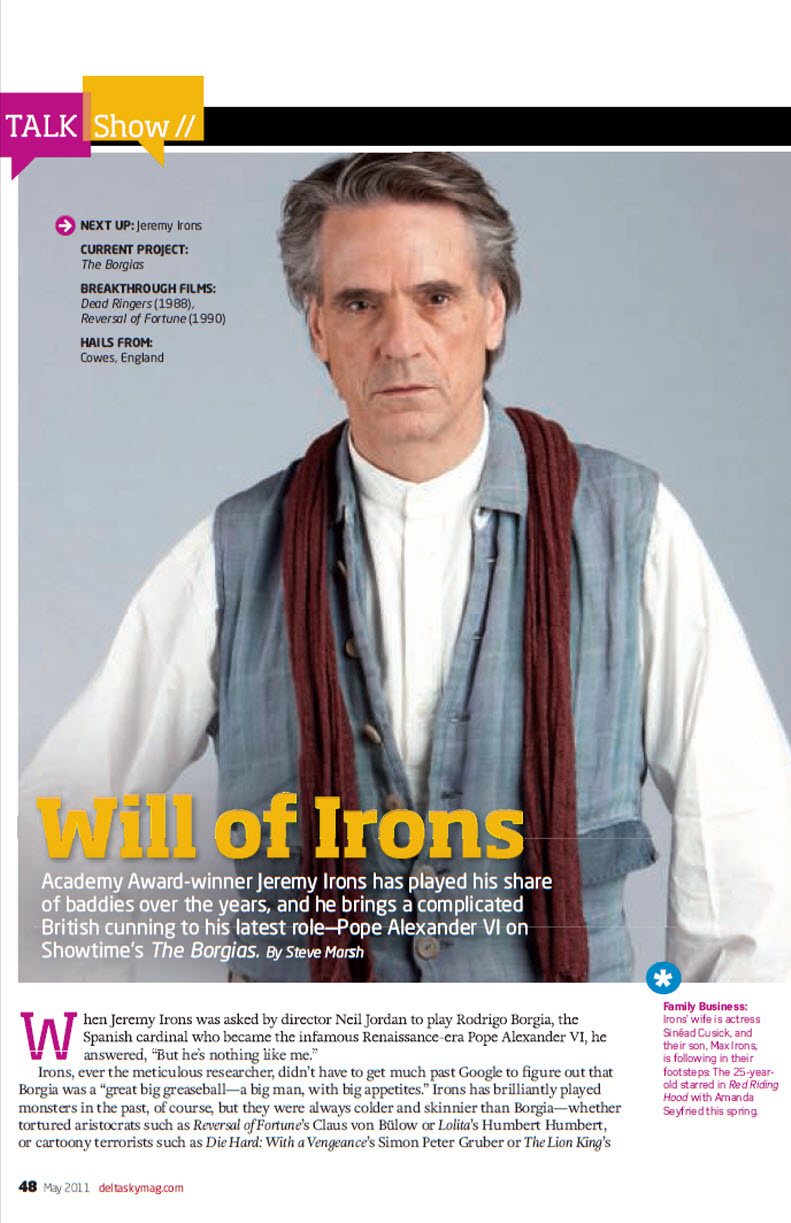
Jeremy Irons in Delta Sky Magazine

Click on each page for a larger view:


Jeremy Irons in Parade Magazine

Read the full, original article at Parade.com, complete with a link back to the Kilcoe Castle page at jeremyirons.net!

Here’s how the article appears in Parade Magazine in newspapers: (Click for a much larger high-res image…)

If there’s a cad or a creep to be played, Jeremy Irons’s antennae shoot up. “Characters who live on the outer edge of acceptable behavior have always been to my taste,” says the Oscar winner, now starring as the power-mad patriarch of Showtime’s series The Borgias (Sundays, 10 p.m. ET/PT). Irons, 62, chats with Steve Daly about his affinity for sinners.

Why are scandalous families like the Borgias so fascinating?
Whether it be in The Borgias or Shakespeare or The Godfather, we love watching people doing what we don’t dare do. Murder and mayhem, from the safe position of our armchairs, can be delightful.

What will audiences make of Rodrigo Borgia, who became Pope Alexander VI in 1492 but kept multiple mistresses?
He wouldn’t see that as hypocritical. He wasn’t a god—he was a man, and man was born a sinner. He’s rather endearing, in a strange way. He’s as pathetic as all men are. They want everything, don’t they?

Will people be surprised at the brutal Vatican politics?
The Vatican at that time was nothing like it is now. In a way, it was a medieval West Wing—the center of power in the known world.

Sundays have changed since Borgia days. What do they mean for you?

I’m a bit sorry we have all the shops open. But we all have to be encouraged to buy, buy, buy, to keep society going, so I suppose one has to accept that. For me, it’s a day I can have a lie-in and a relaxed brunch. I think we need a down day. Otherwise we’d just go bananas.

Your 25-year-old son, Max, is co-starring in Red Riding Hood. What’s it been like watching him deal with the publicity?
Well, it fills me with concern. I’m very happy he’s doing what he loves. But my nightmare as a young actor was to be taken up too quickly. A plant needs to get its roots into the soil before it can withstand the wind and the ice and the cold. Nowadays, the business has a huge appetite for youth and tends, when it’s tired of it, to spit it out. But I think he’s got his head screwed on quite straight.

You’ve played some very dark roles. Which gave you the most pause before saying yes?
I think Reversal of Fortune, because the protagonists [Claus and Sunny von Bülow] were still alive—or partly alive, anyway. But Glenn Close persuaded me that if I didn’t do it, someone else would. And I knew Lolita would cause fireworks. I said to my agent, “You’d better get me a wage that will keep me the next three years, because I don’t think I’ll work much after this.” That was indeed what happened.

You’re skilled at sailing the ocean and riding horses and motorcycles fast—not the safest activities. Are you a daredevil?

Living on the edge, for me, has always been one of life’s great pleasures. It’s not really the speed; it’s the fact that you have to do it well in order to survive.

Ever pushed it too far?
Oh, I have. At any time, you can tumble, but that adds to the frisson. It reminds you there is an edge. And I think we need constant reminders: The edge is there. Don’t fall over it.

Acclaimed actor Jeremy Irons talks about the Irish castle he’s renovated. Plus, Irons gets passionate about the controversial ban on smoking in New York City.

On the 15th century castle in Ireland he owns and has renovated.
“Renovating scared the wits off me. I didn’t know what it was going to cost or how long it would take, or that I’d manage to do it. People were sort of surprised, ‘cause they think I’m an extremely wealthy actor. They thought, ‘You’ll get architects in, you’ll get builders, and they’ll do it.’ But I didn’t want to do it that way. I wanted to be as hands-on as I could.

“It was open to the sky, but structurally sound. The walls had stood for 500 years, despite people’s attempts to pull them down for the stone they contained. They’re 100 feet tall, 9 feet thick at the bottom and 4 feet thick at the top. All the fine carving around the windows had either been eroded or stolen. No heating, no plumbing, no electricity.

“When we were going flat-out on it, I had 40 guys working there every day. I was the main contractor, so my job was to make sure that those guys, who were getting paid by the hour, were fully occupied, that they had all the equipment and materials they needed.

“I didn’t put a lift [elevator] in. The purist inside me said, ‘You’ve got to earn that height. If you want to get up there, you’ve got to walk.’ I’m sort of glad about that, even though when I’m 80 I may be cursing that decision.”

On the unusual color the castle is painted.
“It’s a sort of orange terra cotta—the color of newly-born seaweed. It’s a color that’s found a lot around the castle, and also in strands of the [local] rock that has copper in it. I think it fits [the setting] quite well, but it did surprise everybody when we first took the scaffolding down. There was a sort of sharp intake of breath from those in the neighborhood. I once asked my direct neighbor, who’s a farmer, ‘What color would you have done it?’ He said, ‘I suppose grey.’ Because of course it had been grey for the last 400 years. However, he said, ‘It’s yours! You can paint it whatever color you like.’ And now they rather like it. The fishermen and the ferrymen use it as a landmark. And I have to say it looks stunning, especially in low morning or evening light.

See photos of Jeremy’s stunning castle in Ireland

On the public-area no-smoking regulations he hates.
“I think they’re appalling. It’s what I call bullying a minority. Because if you say, ‘I really think I should have the right to smoke in the street or in the park or at the beach,’ people will say, ‘You shouldn’t be smoking at all. It’s bad for you.’ Well, I think we can choose what’s bad for us. I mean, there are many other things in life that are bad for us. Being surrounded by boring people is very bad for us—it attacks the heart. And being surrounded by mass consumerism, as one is in most urban areas, is bad for you, making you believe that if you buy something, it’ll make you happy. But all those things people are allowed to get away with.”

Jeremy Irons Wall Street Journal Interview

The Wall Street Journal

ARTS & ENTERTAINMENT
MARCH 25, 2011

Feeling Wrong for the Role, at First
By AMY CHOZICK

Read the original article here – Wall Street Journal Online

Thirty years after he played Charles Ryder in the British miniseries “Brideshead Revisited,” actor Jeremy Irons takes on another TV role that involves Catholicism, opulence and distrust: Rodrigo Borgia, the scheming patriarch and corrupt Pope Alexander VI in Showtime’s “The Borgias,” premiering April 3.

Watch a scene from Showtime’s new drama ‘The Borgias.’ The series stars Jeremy Irons as Pope Alexander VI. Courtesy Showtime.

Mr. Irons, 62, is perhaps best known for film roles including Claus von Bülow in “Reversal of Fortune,” for which he won an Oscar, and Humbert Humbert in “Lolita.” He also starred in TV miniseries like the 2009 Lifetime biopic “Georgia O’Keeffe” with Joan Allen and “Elizabeth I,” with Helen Mirren.

His deep, languid voice is currently in theaters as the narrator of wildlife documentary “The Last Lions.” (He voiced the villain Scar in “The Lion King.”) In “Margin Call,” an upcoming film about the financial crisis, Mr. Irons plays an embattled Wall Street CEO based on Lehman Brothers’ Richard Fuld.

Mr. Irons was reluctant to commit to an ongoing TV series, but the nine-episode cable run and the fact that Irish director Neil Jordan (“The Crying Game”) would write and direct “The Borgias,” convinced him.

The Wall Street Journal: Why is “The Borgias” being touted as a kind of medieval version of “The Godfather”?

Mr. Irons: There’s an element in common in that Don Corleone was an Italian in America. Rodrigo is a Spaniard in Rome. Yes, that element of the manipulator and the immigrant trying to find power and how to hold onto it and influence people as the head of the family. But those parallels don’t run very deep. I think it’s sort of a marketing idea Showtime had. [Mario] Puzo wrote a novel [“The Family”] about the Borgias, of course.

You’ve said you don’t think you’re right for the role of Rodrigo. Why not?

Neil [Jordan] said “Do you want to play Rodrigo Borgia?” I got home and Googled him and I told him “Christ, you don’t want me. You need James Gandolfini.” I could think of four or five actors who would physically be right for the role. I said “I can’t play that guy.” I have an aesthetic quality that is expected from a pope, whereas this guy was a big, sweaty Spaniard with a big appetite—a lot of food, a lot of women.

So why did you change your mind?

Neil said “No, it’s all about power and how power corrupts you and how you manipulate it. No one knows what he really looked like.” So he convinced me.

Even though Rodrigo is an evil megalomaniac, there’s some humor in him. Did you bring that to it?

I think it’s all in Neil’s writing. There’s sort of a natural amusingness about the situation which one doesn’t have to play. You just do what you do and it brushes off on somebody and there’s a smile there.

Speaking of humor, why wasn’t the 1997 film version of “Lolita” you starred in funnier? The book is very funny.

That book is full of irony. I think we were so nervous about the subject when we were making it that we were walking on egg shells. We could have used a lot more irony. The Kubrick version had more irony but it missed a lot of other things.

In addition to “The Borgias,” you’ve recently done a couple of episodes of “Law & Order: Special Victims Unit.” How did that come about?

Well, “SVU” is a different kettle of fish. I was in Budapest finishing “The Borgias” and they asked and I said I don’t know the show. They sent me an episode with Robin Williams and one with Isabelle Huppert. I said “This is good, it’s fine. It is what it is.” For an actor it feels a little like you’ve just finished reading Proust and you think “I’m going to read a Dick Francis novel and it will take me a day and be great.”

“The Tudors” did very well for Showtime but it got criticism for being soft porn in costumes. Will “The Borgias” have as much sex and nudity?

No. There are a lot of channels doing that. I think we can do better than that. This adaptation, for example, and there have been loads, doesn’t fall into the trap of writing all these stories about incest. In those days whole families used to sleep in the same bed. It’s better to get inside characters, who they are and why they do what they do than to make it sensationalist.

You seem to regularly go from film to TV to theater. Which do you prefer?

It’s just the material. They all have good things about them and they all have bad things about them. Theater is great because you can really stay in one place and work on the character in depth over a long period. It doesn’t pay as much as movies, but is often better written. The problem with TV is people are watching soccer at the same time. I’m really lucky to hop around. I’m a jobbing actor.

How is developing a character for TV different from one for film?

The huge luxury is time. A two-hour movie—and, if you’re lucky, it’s two hours—you can tell a story but it’s hard to develop the inconsistencies of a character and have time to bring all those inconsistencies together.

Are you Catholic?

My wife is. My children are. I don’t belong to clubs.

It may shock a lot of Catholics to see a Pope who behaves like Rodrigo Borgia.

Well, the medieval mind would’ve had no problem with a pope who has a mistress. Why do you expect him to be a God? He’s not a God. He’s a man, with all the weaknesses and failures. [Today] we expect our leaders to be squeaky clean and when they turn out to be normal people with normal desires, we say this person shouldn’t be our leader. Man is just doing his best.

Have you discussed a second season with Showtime?

We have a little. Neil has talked to me about some ideas. It’s hard to get the Pope out of the Vatican. I’m very grateful Showtime was hands-off when we were shooting. They left us alone. I hope that will continue because I don’t think you can make movies or TV series by committee.

Printed in The Wall Street Journal, page D5

Copyright 2011 Dow Jones & Company, Inc. All Rights Reserved

Jeremy Irons to Narrate ‘The Final Coronation’

Oscar winner joins choir in Warwick

07 March 2011 – from the Stratford Observer

OSCAR-WINNING actor Jeremy Irons joins Armonico Consort in Warwick on March 26.
The star of stage and screen will be at St Mary’s Church to launch the choir’s tenth anniversary year, which aims to raise a further £100,000 for their Big Mouth Appeal – creating children’s choirs and training teachers as choir leaders.
In a programme called ‘The Final Coronation’ narrated by the actor, the award-winning choir will recreate elements of the ceremony from 1963 when the pope was last ‘crowned’, singing music performed at every coronation for 400 years by Palestrina and Orlando di Lasso.
Irons  is a familiar with the area having trod the boards at the RSC in Stratford on numerous occasions. He is also a well-known face on the big and small screen. He won an Oscar for his portrayal of Claus von Bülow lies in the 1990 film Reversal of Fortune. He is best known to television viewers for playing Charles Ryder in the classic adaptation of Brideshead Revisited.
Tickets are available from the Ticket Factory on 0844 581 0750 or via www.armonico.org.uk