Jeremy Irons at the EU Commission

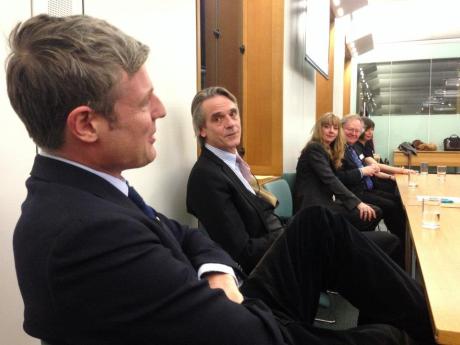
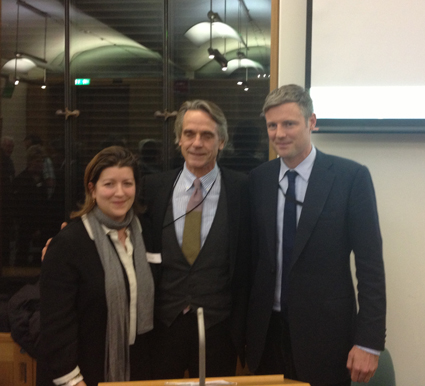
Brussels, Belgium. 7th March 2013 — British actor Jeremy Irons participated in a talk about plastic waste at the EU Commission. Jeremy was invited by EU Commissioner Januz Potonik to talk about plastic waste in the world. He added his voice to an EU campaign to ban non-recylable plastics, including plastic bags.


This slideshow requires JavaScript.

From The New Age

British actor Jeremy Irons brought a rare touch of glamour to the European Union’s headquarters in Brussels on Thursday to talk about an issue close to his heart: Trash disposal.

“I refuse to call it waste. ‘Waste’ is a verb, it is what we do. We are wasting our resources,” he said.

His appearance at the European Commission, the bloc’s executive, was in support of a drive to find ways of reducing the mountains of plastic rubbish generated annually, much of which ends up in the world’s oceans.

“What I’ve tried to do is glamourize trash,” Irons said, conceding that it was not an issue that won many votes.

Irons dismissed the tendency to shelve recycling as a matter to be dealt with after resolving more pressing issues, such as the economic crisis.

He said it didn’t take much effort for people to separate their rubbish, adding, “It doesn’t cost me anything to put out my separate bins and I get rather a pleasure out of it.”

The actor said: “We can make money out of recycling,” adding that it also generated jobs.

He referred to the 12 million euros (15.6 million dollars) that Ireland had made by introducing a 15-cent charge on plastic bags, which he said had also reduced the use of new bags by 92 per cent.

Irons said that by contrast his country, Britain, was doing “spectacularly little” on recycling, failing for example to tax plastic bags – “a symbol of waste.”

He said disorganization and vested interests – specifically those of the companies earning money off rubbish disposal and incineration – stood in the way of progress towards better trash management.

Ultimately, however, Irons said it was up to individuals to bring about change – by refusing to buy plastic water bottles, reusing and repairing old goods or by composting, as he did.

“I’m just a bloke,” the actor said. “There are a lot of blokes and women around in the world,” adding that it was their behaviour that would help bring about change.

“Politicians will therefore, in their normal fashion, be able to follow the current mood,” he added.

Last year, Irons produced and featured in a documentary film, Trashed, highlighting the issue of rubbish disposal and the need for more recycling.

________________________________________________________________

Getting Trashed with Jeremy Irons – from the Wall Street Journal

________________________________________________________________

Jeremy Irons to Attend ‘Trashed’ Screening in Brussels, Belgium

Source

LOGO CE_Vertical_EN_quadri

The event:

What: 12.30 Joint press conference by European Commissioner for Environment, Janez Potočnik and Jeremy Irons, Narrator and Executive Producer the documentary film Trashed.

The launch will be followed by the projection of the film Trashed in the European Parliament.

When: Thursday 7th March 2013

Where: Berlaymont Press Room, in Brussels
———————————————————————————

The news:

The European Commission is publishing a Green Paper on plastic waste to launch a structured discussion about how to make plastic products more sustainable throughout their life cycle and reduce the impact of plastic waste on the environment. The current EU environmental legislation doesn’t specifically address the particular challenges posed by plastic waste. The Green Paper aims to collect facts and stakeholders’ views on the impacts of plastic waste and a way of mitigating them through a European strategy. The consultation consists of 26 questions and will last until end of May 2013. The result will feed into further policy action in 2014 as part of a broader waste policy review, which will look in particular at the existing targets for waste recovery and landfill as well as an ex-post evaluation of five directives covering various waste streams.

The background:

Once in the environment, particularly in the marine environment, plastic waste can persist for hundreds of years. Up to 10 million tons of litter, mostly plastic, end up in the world’s oceans and seas annually, turning them into the world’s biggest plastic dump. The presence of plastic residues, even in the most remote areas of world seas and shores shows that there is a price to pay for unhampered proliferation of plastic waste. Conventional plastic also contains a large number, and sometimes a large proportion of chemical additives which can be carcinogenic, provoke other toxic reactions or act as endocrine disruptors.

Jeremy Irons to be Honored by Heal the Bay

Source

heal the bay logo

Jeremy Irons Voices the Fight Against Plastic Pollution

On May 16, Heal the Bay honors three supporters who’ve lent their formidable voices to protecting the ocean from plastic pollution at our annual benefit gala Bring Back the Beach.

In 2010, Oscar-winner Jeremy Irons narrated our mockumentary “The Majestic Plastic Bag”, lending gravitas to the story of a single-use plastic bag as it migrates to the Great Pacific Garbage Patch. The film screened at the Sundance film festival and remains popular on the film festival circuit. To date, The Majestic Plastic Bag has been viewed more than 1.8 million times on Heal the Bay’s YouTube channel.

We honor Jeremy Irons, not merely for sharing his rich, haunting voice with us, but for his ongoing work to stop the proliferation of trash. In his new feature documentary “Trashed: No Place for Waste,” Irons takes a different journey, this one following the migration of rubbish, the tons of waste that goes unaccounted for each year. Irons serves as the film’s chief investigator as well as the executive producer.

Heal the Bay will also honor our longtime champion Mark Gold for his years of laser-like focus and tireless advocacy in support of clean water. Mark was Heal the Bay’s first employee and served with our organization for 25 years, leading and inspiring our work as our executive director and president. He continues to support us as a researcher, fundraiser and board member. We can count on Mark as a sounding board, resource and guiding force as we tackle future attacks on clean water.

Philanthropist Dr. Howard Murad will be honored on May 16 for raising awareness for environmental issues and causes. Employees from Dr. Murad’s skincare company Murad, Inc. have joined us on numerous beach cleanups, as well as solidly supporting our efforts in curtailing marine debris.

You’re invited to join our celebration of these eco warriors on May 16, 2013 at the Jonathan Beach Club.

‘Trashed’ Screening for Parliament

Trashed was screened for Members of Parliament at Portcullis House on Thursday 7 February 2013.

Trashed documentary highlights wastefulness – from resource.co.uk

Trashed documentary shown at House of Commons review from letsrecycle.com

trashedparliament8

Photo via @FreegleBrighton on Twitter

Photo via Trashed Film on facebook

Photo via Trashed Film on facebook

Photo via Trashed Film on facebook

Photo via Trashed Film on facebook

Photo via Candida Brady on Twitter

Photo via Candida Brady on Twitter

trashedparliament7

‘Trashed’ DVD Release Date

Trashed will be released on DVD (Region 2) on April 22, 2013.

Pre-order your copy from Amazon.co.uk

trashed film logo 2

Product details:

Actors: Jeremy Irons
Directors: Candida Brady
Format: PAL, Widescreen
Region: Region 2 (This DVD may not be viewable outside Europe)
Number of discs: 1
Studio: Blenheim Films
DVD Release Date: 22 April 2013
Run Time: 97 minutes

Review
TRASHED– 5 stars – New York Daily News – Jeremy Irons takes us through a tour of the world s grotesque garbage consumption and failure to dispose of its trash, which inspires horrified reactions from both him and us. This is appalling , our Oscar-winning guide says, sitting on a debris-strewn beach in Lebanon. Seem bleak? It s supposed to, as director Candida Brady uses a thriller-ish tone to show the state of the planet. And if facts about 150 years of plastics, dioxins and dangerous castoffs don t jolt you, a visit to a hospital for malformed children will. Yet for all the poisonous truths in Trashed, there are also solid grass-roots solutions that, as presented, feel do-able and politically digestible. That helps, because everything Irons finds puts you off food. Crucial viewing for realists and alarmists both. —http://www.laweekly.com/movies/trashed-1494726/

This is appalling, says the actor Jeremy Irons, surveying a reeking mountain of consumer waste fouling a once glorious beach in Lebanon. That spoiled shoreline is only one of many revolting sights in Trashed, Candida Brady s down-and-dirty documentary about our inability to neutralize safely much of what we throw away. Taking us on a global tour of escalating rubbish and toxic disposal options, Ms. Brady rubs our faces in the poisonous consequences of littering the planet with substances that, like bedbugs and French mimes, are almost impossible to get rid of. But if we must talk trash, Mr. Irons assisted by a scientist or two and Vangelis’s doomy score is an inspired choice of guide. Soothing and sensitive, his liquid gaze alighting on oozing landfills and belching incinerators, he moves through the film with a tragic dignity that belies his whimsical neckwear and jaunty hats. Every sterile whale and plastic-choked turtle is a dagger in his heart (and will be in yours too), to say nothing of the farmers ruined by chemically contaminated livestock. By the time Mr. Irons visits a Vietnamese hospital for children with severe birth defects the legacy of Agent Orange that plastic water bottle in your hand will feel as dangerous as a Molotov cocktail. –www.nytimes.com

The world is in a heap of trouble — make that heaps: giant, toxic mountains of garbage that endanger our oceans, marine life, the atmosphere and humanity in general — without an end in sight. That is, unless citizens, industry and governments get deadly serious about such solutions as mass recycling, composting, plastics reduction and more. Such is the global crisis that’s vividly, relentlessly detailed in the vital documentary starring dulcet-voiced zero waste advocate, actor Jeremy Irons. Guided by writer-director Candida Brady, Irons (genial, studious) travels the globe visiting some of the most egregious, noxious examples of trash disposal and waste mismanagement; vast, open-air garbage dumps in Lebanon and Indonesia that infect its waterways and coastlines are particularly horrendous. It’s not a pretty picture, to say the least, with a stop in Vietnam to examine birth defects linked to wartime Agent Orange spraying proving a deeply grim offshoot of the film’s central thrust. Then there’s the garbage calamity’s most insidious culprit: non-recycled, non-biodegradable plastic. The movie, as have other eco-documentaries, chillingly examines how endless bits of the toxic material routinely flood our oceans, harm its inhabitants and find their way into the fish we eat. Scientists, doctors and academics weigh in as well, though flipside input from corporate interests and government policymakers would have added welcome dimension to this crucial discussion. —www.latimes.com/entertainment/movies/moviesnow/la-et-mn-trashed-capsule-20121214,0,7515915.story

‘Trashed’ to be Screened at the Houses of Parliament

Jeremy Irons will join a host of MPs and campaigners at a special screening of Trashed at Portcullis House, on Thursday 7 February 2013.

The filmmakers of Trashed are sponsoring a contest to win two tickets to the screening. See all of the details HERE.

Entries must be made as soon as possible. The winner will be announced on 28th January.

7 Questions with Jeremy Irons – ‘Trashed’

Read the original article HERE.

7 Questions With Jeremy Irons – Trashed

By on December 16th, 2012


In the Candida Brady directed documentary, Trashed, actor Jeremy Irons turns civilian as he ventures across the globe in search of solutions to the ecological crisis, while uniquely casting himself as a protagonist. And Irons also ponders during this exclusive interview when phoning from a set in Budapest, what the ultimate responsibility of an actor’s voice should be in the real world. Here’s Jeremy Irons, talking Trashed.

1. Do you recall when you first became alarmed about the harmful and destructive problem of waste on the planet, and decided to do something about it?

It didn’t happen quite like that. I wanted to make a documentary about an important subject. A subject which I thought should be brought to people’s attention. And Candida Brady, the director of Trashed, imparted some information to me. So I thought, this is an amazing subject. This is something we have to get on the screen, to make people aware of the situation. So it was really from her that I got the idea. You know, I always think of myself, I’m an actor and a storyteller. I normally tell fictional stories. But I see no reason why it isn’t a logical progression, to tell real stories. And I think the story of Trashed is worth telling.

2. And what led you to be part of this film as not only the narrator, but the very unusual position of protagonist in a documentary?

Well, I narrate many documentaries. But now to be there in a way, as an audience member, somebody who knows nothing about the situation. Although I did of course know a little bit about it. But I wanted to ask the questions that the audience would have asked, had they had a chance. And I felt it was very important to be meshed into it, in that way.

3. And how would you compare and contrast your very different roles as actor and activist?

Well, inquiry is needed in both. If I’m playing a character in a drama, I have to inquire about the world he lives in. And the sort of person he is, and what he’s done with his life. So I have to discover all of that. And the great advantage I have as an actor, is that I’m known. And therefore people will listen to me and watch me. And I feel in a way, that’s a responsibility.  I have a voice. I should use it. And not just with drama.

4. Jeremy, talk about the most horrific part of Trashed, the deformed children even decades later in post-war Vietnam.

As far as all those deformed fetuses in the bottles there, which was very upsetting, it was important to show that. And war I think, is something we have to fight against. You know, it’s hard to see the upside of any war. It may seem like a good idea at the beginning, but by the time you finish you think really, we shouldn’t have done that.

5. How does it feel to make that major switchup personally, from celebrity to just another civilian venturing out into the world among people, to talk about environmental issues. Rather than say, people venturing into theaters to see you?

I love it. I’ve always believed that to be an artist, an interesting artist, you have to be involved in life. You have to care about life. It’s an enormous privilege, doing the work I do. It brings me into people’s lives, sometimes into people’s hearts. And not to use that intimacy that I have with my audience, to tell them something that I believe is important, would seem a terrible thing. And an abuse of my position.

6. And how do you feel your activism concerning the environment has changed you?

When I see how people are amazed by this film, it gives me some of the joy maybe a teacher gets, when he sees people being really affected. And of course it’s the people in the audience who will get things changed. These big changes that we have to make to the way we behave and the way we live, they take time. And they build on themselves. And I see our film as being part of that process.

7. What about the challenge of opposing the huge corporations, and their stranglehold on the government?

 I think it’s an enormous shame, that governments have seem to lost the voice of the people. And who don’t want to be controlled by vast, amoral corporations. We cannot live in that way. And I think our governments have to fight corporations on our behalf. For instance, plastic makes money for a lot of people. But nobody has discovered a way to get rid of it. Our governments should be our guardians. We elect them to look after us. And not just to make people rich.

Jeremy Irons at 92Y to Discuss ‘Trashed’

Actor Jeremy Irons appeared in Reel Pieces with Annette Insdorf on December 11, 2012. In this clip, Irons speaks about his new documentary film Trashed and what practical things we can do to improve our environment. Irons says we can find out from our legislators where out trash goes as well as get them to mark clearly what can and can’t be recycled.

Q. and A.: Jeremy Irons and ‘Trashed’ from The New York Times

Q. and A.: Jeremy Irons and ‘Trashed’
By JOANNA M. FOSTER
Read the original post HERE.

Green: Living

A new documentary about the ultimate fate of just about everything we lug home from the mall opens on Friday in limited release in the United States. “Trashed,” directed by Candida Brady and starring Jeremy Irons, delves into the less festive side of consumerism and waste disposal — overflowing landfills in England, a toxic trash incinerator in Iceland, a hospital for children with birth defects in Vietnam.

We sat down recently with Mr. Irons to talk trash. Following are excerpts, edited for brevity and clarity.

Q. “Trashed” opens with a powerful image from Lebanon of a mountain of trash stacked high next to the ocean. Can you describe what it was like sitting on that trash mountain?

A. It was appalling. I’ve never been so grateful to leave the “set” of a film. It is certainly something to look at, but what people who see the film don’t experience is the smell of dead animals and wafting chemicals that make you gag. There are flies and fleas everywhere, stray dogs tripping over rubbish and yapping furiously at the scavenging birds circling overhead.

What really made my stomach turn was watching the steady stream of evil-looking runoff oozing from the bottom of the mountain of garbage straight into the sea. It looks and smells like poison, and there are still fishermen out there, although far fewer than there used to be.

What fish they do catch certainly aren’t eating what you or I would care to eat. It was all just horrific, but what’s happening there is what happens if you do nothing, and it’s an illustration of what we are all doing only they haven’t bothered to hide it.

Q. Has making “Trashed” led you to change any of your personal habits?

A.Yes. And I don’t consider myself an environmentalist or activist — I’m hardly an expert on green living. But what I’ve started doing since making the film is that I take packaging off at the point of purchase.

I consider myself quite capable of getting my tomatoes home safely without sitting on them, so why must they come packaged in plastic armor? And I think I can even get a pair of scissors home without chopping off my hand so I really don’t need that damned impenetrable plastic shell.

So I take it off and leave it on the counter and ask the person who sold it to me to deal with it themselves, because I didn’t want it in the first place. That way we push it back toward the manufacturers because the supermarkets will say: “Look, we can’t deal with all of this. Can you please provide less or take it back and reuse it?”

Q.How do you think waste compares with climate change as an issue? Shouldn’t trash be an even more obvious problem that no one can dispute?

A.It seems pretty obvious when you see a landfill or a the insides of a seabird bursting with plastic fragments. But so much of that is so removed from our everyday lives that it’s a bit like climate change and Bangladesh — out of sight, out of mind.

And just like there are those who dispute the scientific evidence behind climate change, there are those who argue there is no connection between environmental toxins and health. In the documentary we talk to villagers in France living near an incinerator who saw cancer rates spike in their community. They took the government to court over it and were told that there was no proof of any connection. Just like some of the effects of climate change, some of these health effects are still down the pipeline.

Finally, there’s also a lot of money in trash, as there is in the fossil fuel industry. In places like New York, it’s not just a lack of organization that results in so little being recycled, it’s also that there is a huge amount of money in trash disposal. The people who are getting rid of our waste at the moment have a fine industry and have no incentive to change that.

Q.What practical steps would you recommend to anyone who sees “Trashed” and wants to do something?

A.Find out in an intelligent way what happens to the waste that leaves your home, and decide whether this is something you approve of. You might be surprised to learn that, especially around New York, much of it is incinerated in areas with poor, disadvantaged communities. Are you O.K. with the poor getting your toxic ash?

If you’re not, become a little motivated and write to your Congressman to ask if they think this is acceptable.

I also would like to encourage people to actually buy something. If you don’t have a reusable shopping bag, please get one and get a second for a friend or family member. There are kinds that fold up as small as a Ping Pong ball and you can keep it in your purse or briefcase and never have to take a pointless plastic bag home again.

And although you might get a few dirty looks, see what happens if you start taking the packaging off at the point of purchase. Retailers are very sensitive to their customers — you have the power to let them know what you do and don’t like, and they will listen.

Q.What was the most surprising thing you learned while making the documentary?

A.I didn’t realize that all this nondegradable rubbish and consumerism is in large part thanks to World War II and the massive war production apparatus that needed to be developed for peaceful purposes after the days of making weapons had ended. I was born in 1948, so it’s really only in my lifetime that this throwaway society has emerged.

I do remember a time before plastic bags when there was just a lot less of everything. I’m still a bit shocked when I walk down Main Street and see all this stuff in the windows. Who buys it all? How could you ever find the time to wear or use it all?

Maybe I’m just getting old, and I know that buying things doesn’t make you happy. But I feel like there’s a new social mood, maybe because of the economic crisis, more of us are reflecting on what we really need and what we can do without.

Q.The Christmas shopping season is in full swing. What would you like to say to people as they head out to the mall or load up their Amazon shopping cart?

A.Don’t buy people something they don’t need, let alone don’t want. Send them a kind message. I know we’re all supposed to keep on buying to get the economy going, but most of us don’t need very much — and in my opinion there is nothing like a lovely pair of warm socks or a good bar of soap.

Jeremy Irons on “Say Anything!” with Joy Behar

Jeremy Irons was interviewed on Joy Behar’s show “Say Anything!” on the Current television network, on Thursday 13 December 2012.

Here are a couple of clips:

Here’s a Behind the Scenes clip with Eliot Spitzer and Jeremy discussing the Claus von Bulow case:
http://current.com/shows/joy-behar/videos/behind-the-scenes-jeremy-irons-and-eliot-spitzer-on-the-claus-von-bulow-reversal-of-fortune-case/

current1

current2