www.jeremyirons.net is not owned or updated by Jeremy Irons.
No copyright infringement is intended by the use of any of the photos, articles, or other information on this website. All articles, photos, audio clips and video belong to their rightful owners.
------------------------------------------------------------------------------------------
Jeremy Irons will introduce the screening: Trashed on Sunday 2 June 2013.
Event 489 • Sunday 2 June 2013, 10.30am • Venue: Richard Booth’s Bookshop Cinema, 44 Lion Street
In the new docu-feature Trashed, a Blenheim Films production, produced and directed by British filmmaker Candida Brady (Madam and the Dying Swan), which was selected to receive a Special Screening at the Cannes Film Festival, Irons sets out to discover the extent and effects of the global waste problem, as he travels around the world to beautiful destinations tainted by pollution. This is a meticulous, brave investigative journey that takes Irons (and us) from scepticism to sorrow and from horror to hope. Brady’s narrative is vividly propelled by an original score created by Academy Award winning composer Vangelis.
Sunday 26th May
Benjamin Britten Tribute
Michael Berkeley, Ronald Blythe, Jeremy Irons and Nicholas Kenyon
7:30pm
Tickets £18 (Returns Only) For ticket inquiries for Jeremy’s reading: Give the Charleston Festival a ring on the Office number- 01323 811626- They’ve got a waiting list going.
Benjamin Britten visited Charleston and was painted by Duncan Grant. In his centenary year, we have assembled a unique gathering of speakers to celebrate his work and life. Michael Berkeley, composer and Britten’s godson, presents BBC Radio 3’s long-running Private Passions. Ronald Blythe, author of Akenfield, worked with Britten in the 1950s. His new memoir, The Time by The Sea: Aldeburgh 1956-1958, describes this period. Nicholas Kenyon is Managing Director of the Barbican Centre. He was previously controller of BBC Radio 3 and responsible for the Proms from 1996-2007. Jeremy Irons, one of our major stage and screen actors, from The French Lieutenant’s Woman to last year’s BBC 2’s Hollow Crown, reads poems – principally Auden’s – that inspired Britten’s songs.
Jeremy Irons participated in rider training technical sessions with BMW Motorrad in Hungary. Jeremy completed the basic level of the BMW Motorrad Rider Training course at Kiskunlacháza Airport in Hungary.
LONDON, ENGLAND – MAY 04: Jeremy Irons at ‘The Borgias’ Press Conference at the Corinthia Hotel on May 4, 2013 in London, England. (Photo by Vera Anderson/WireImage)
In the 1995 movie “Die Hard: With a Vengeance,” Jeremy Irons was pure evil as an urbane and elegant bad guy.
As Simon Gruber, he terrorized pre-9/11 New York City, practically in the shadow of the still-intact World Trade Center towers.
Scary stuff . . . but it’s nothing compared to Jeremy Irons’ latest film.
In the new documentary “Trashed,” Irons shows us the terrifying possibility of a future world buried in its own garbage.
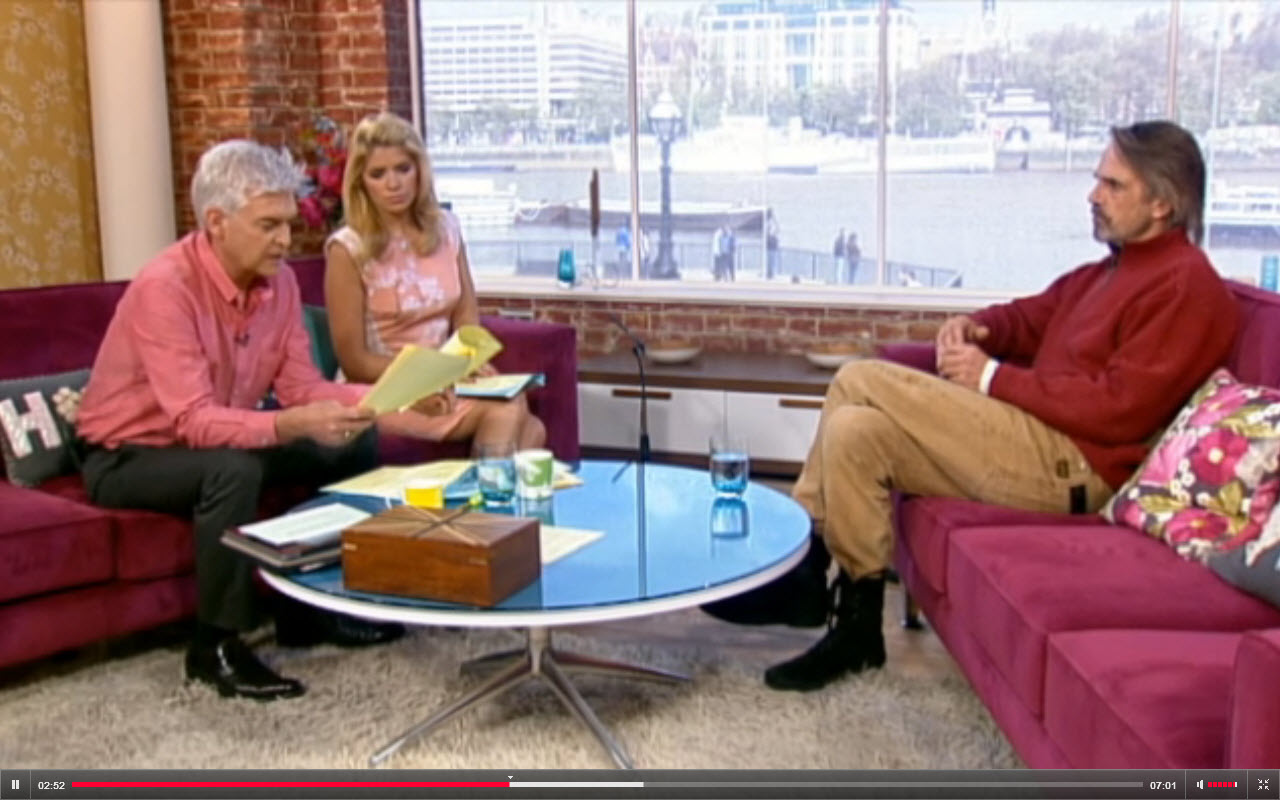
“After doing the documentary, how conscious are you, when you walk down the street, of trash?” asked Smith.
“Well, I mean, this part of New York is wonderful, there’s no trash in sight,” Irons said. “And I think it’s a case of out of sight, out of mind.”
“We throw it away and it’s gone?”
“That’s right. It’s clean, it’s lovely, it’s not something we have to worry about. But where does it go?”
Where, indeed? In Indonesia, garbage goes in the nearest river, and eventually out to sea. Worldwide, according to the film, Americans could recycle 90 percent of the waste we generate, but right now we only recycle a third of that — and some of our trash eventually finds its way back into us — such as plastics leeching into our food supply.
It’s weird to see an Oscar-winning actor rooting through trash cans in New York City’s nicest neighborhood, but for Irons, garbage has become, well, personal.
He pulled out one object: “Now this is recyclable, this is great, but it’s half full, so it’s wasted food. Coconut water: Fantastic for you, 100% pure, and it’s thrown away half-full. We waste a huge amount of the food we buy.”
“You have no hesitation to just pick through the trash, Jeremy?” Smith asked.
“No, it’s rubbish. That’s all it is. It’s just dirt. A bit of dirt before you die is good.”
“Celebrities get asked to be involved in a lot of different causes; what was it about trash that made you say, ‘I have to do something’?” asked Smith.
“I wanted to make a documentary about something which I thought was important and which was curable,” he said. “It’s not rocket science. It takes a little effort, it takes a little thought. It takes a little education. I think most people want to do what is right. But they need a bit of organization.
“We make everybody wear seatbelts now. That was a bore, wasn’t it? But we do it, and we don’t think about it anymore. Very simple to do the same with how we deal with our garbage.”
It might not be easy to picture Jeremy Irons as a garbage activist: From his breakout role in 1981’s “The French Lieutenant’s Woman,” he has been in more than 40 movies, at least as many plays, and has won just about every acting award there is.
“I’ve been very lucky,” he said.
“You have a slew of awards that would say you got some talent,” Smith suggested.
“Yeah, if awards mean that. Yeah. Yeah.”
“You don’t think they mean much?”
“I do. I do. And I really don’t want to denigrate them. I think awards are fantastic. I don’t let them go to my head. I always, when I start a new piece of work, I still feel like a plumber, but I don’t know how to do it. I just sort of feel out of my depths — I’m not very good at plumbing!”
Well, he’s good at something. Born in England in 1948, Jeremy John Irons trained as a stage actor before breaking into film.
He’s been married to actress Sinead Cusack since 1978, with whom he has two sons. But on-screen he hasn’t always been such a devoted husband.
In 1990’s “Reversal of Fortune,” Irons was cast as socialite Claus von Bulow, accused of trying to kill his rich wife by giving her an overdose of insulin.
“Did you love getting in Claus von Bulow’s head?” Smith asked.
“I was slightly embarrassed,” Irons said, “and in fact fought off playing him for a while, because he was alive and I thought there was something tasteless about pretending to be someone who was still alive. And so I fought against it. Finally it was Glenn Close who persuaded me. She said, ‘If you don’t play him someone else will play him. You know, come on. Have a crack at it. It’s interesting.'”
Glenn Close was right: the performance earned him the Oscar for Best Actor.
Irons’ Claus von Bulow is a saint compared with his current role in the Showtime series, “The Borgias.” Irons is Pope Alexander VI, a man of many passions.
Off-screen, you might say Irons has become the unofficial pope of recycling — and, in what may be his most important role yet, an elegant and refined voice of caution.
Are we doomed?, Smith asked “I don’t believe we’re doomed because I believe that human nature is extraordinary,” Irons said. ” I think we will be brought to our senses eventually. I think things may have to get worse. I think, I hope we will be brought to our senses. We’re on a highway to a very expensive and unhealthy future if we do nothing.”





























 jeremyirons.net
You must be logged in to post a comment.