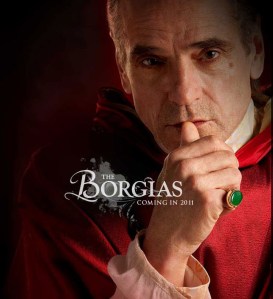
Plum Role: History’s Ultimate Godfather – NY Times

Read the full original article at: http://www.nytimes.com/2011/03/27/arts/television/the-borgias-a-showtime-mini-series-starring-jeremy-irons.html
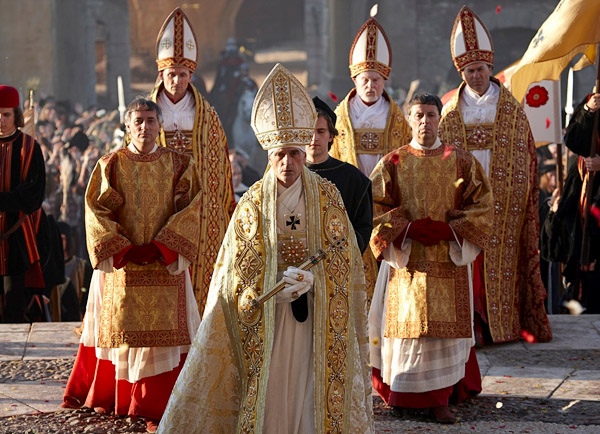
20110325-043925.jpg

March 25, 2011

Plum Role: History’s Ultimate Godfather

By CHARLES McGRATH

ALTHOUGH they lived in the 15th and 16th centuries, the Borgias, the subject of a new nine-part Showtime mini-series that begins next Sunday, were a family made for TV. The Borgias were rich, ruthless, scheming and corrupt, and so sexually voracious that, if you believe the rumors, they slept with everyone, including one another. Mario Puzo, who worked on a novel about them, called the Borgias the Corleones of the Renaissance. They also resemble “The Sopranos” a little. Imagine if Tony, instead of running a garbage hauling business, had bought himself the papacy.

“The Borgias,” which cost $45 million to make, was created, written and produced by the film director Neil Jordan, who also directed several episodes. It is Showtime’s latest entry in what is becoming a high-stakes game on cable TV now that it’s no longer enough merely to show Hollywood movies or the odd sporting event. If you want to sell cable subscriptions these days, you need not just original programming but a long-running, franchise-defining series like “The Tudors,” Showtime’s recent hit.

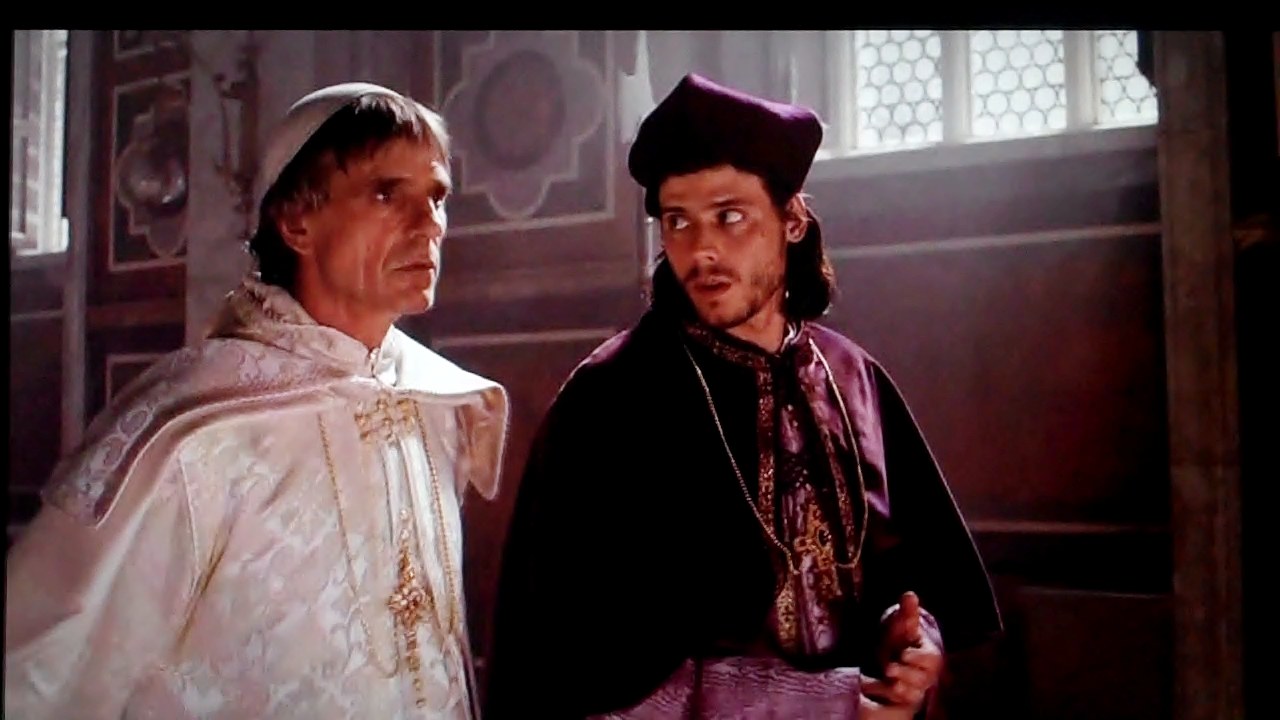
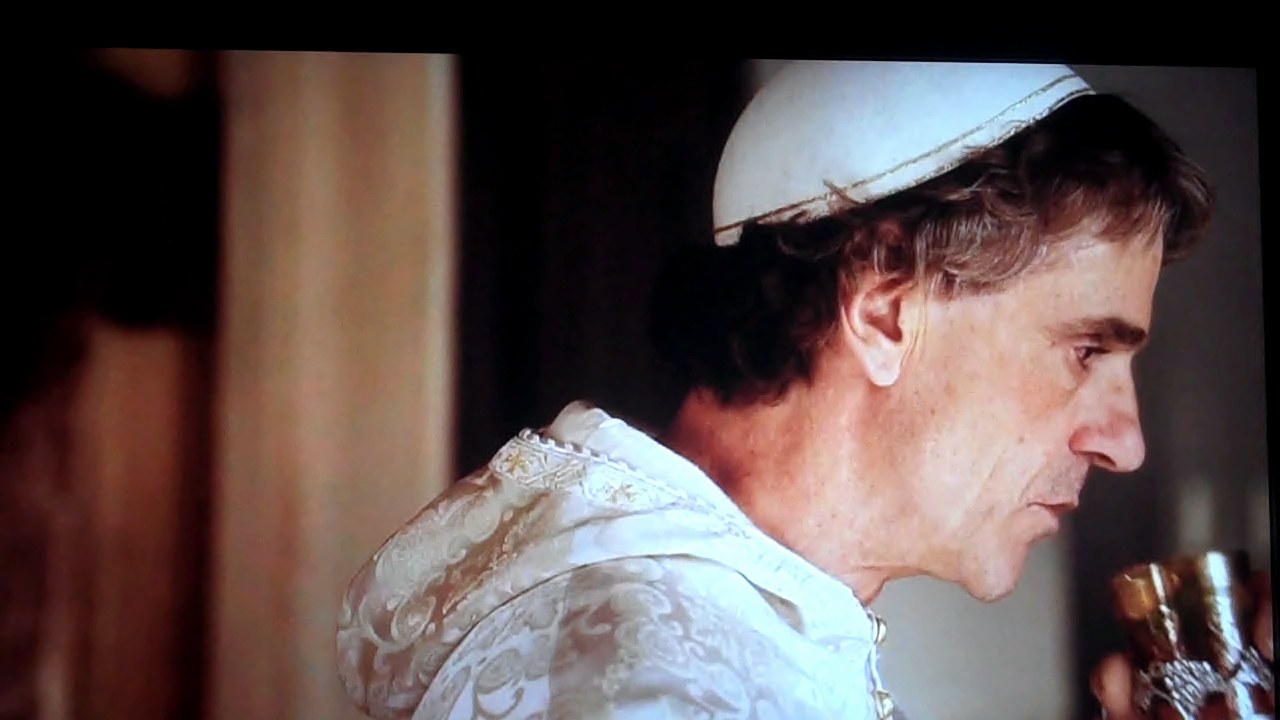
A bankable star doesn’t hurt either, and in the new series the Borgia paterfamilias, Rodrigo, who became Pope Alexander VI, is played by Jeremy Irons, not exactly typecast. To judge from his famous portrait by Cristofano dell’Altissimo, the historical Rodrigo, corpulent and hatchet nosed, looked as if he had been inflated with a tire pump. At the time of his death, or so the legend goes, he was so bloated and debauched that when his body was inserted into the coffin, someone had to jump on the lid to get it shut.

“When we first talked about the part, Jeremy was worried that he didn’t have that bulbous weight,” Mr. Jordan said recently, speaking by phone from his house in Ireland. “I told him that if we can get this guy properly situated, torn between God and politics, the weight wouldn’t matter.” He added: “I wanted someone who would understand the kind of history here. ‘The Borgias’ isn’t just a saga of poisoning and nubile women, like a Ken Russell movie. Well, we do have all that, but we also put this figure in historical context.”

Mr. Irons, still elegantly handsome at 62, doesn’t look much like Pope Alexander. He nevertheless has, both on screen and in person, a slightly detached, regal quality, a darting, glinting intelligence, and occasionally an air of weary melancholy, all very useful papal attributes. He also has a long history of playing characters who are morally ambiguous if not outright villainous: Humbert Humbert in “Lolita”; the deranged twin gynecologists in David Cronenberg’s “Dead Ringers”; the accused wife poisoner Claus von Bülow in “Reversal of Fortune” (for which he won an Academy Award); even Scar in “The Lion King.” And with that deep, rumbling voice, like an organ echoing in a cathedral, he sounds the way a Renaissance pope should sound: the sibilant S’s, the luxurious drawn-out vowels suggesting knowledge acquired outside the seminary.

Mr. Irons speaks this way in real life too, and in New York recently, draped over a chair in his suite at the Lowell hotel, he employed that same voice to say, “We don’t talk about my voice.” He doesn’t like to be made conscious of it, he explained, recalling a conversation he had years ago with the actor John Hurt. “You know all these young actors coming up, 18, 19, 20 — rather good, aren’t they?” Mr. Hurt said. “You know what I do? I go up and say, ‘You’re a great actor, with such a fantastic voice. Have you ever listened to it?’ ”

And then they’re finished, Mr. Hurt said gleefully.

Mr. Irons was a late bloomer. He grew up well to do, on the Isle of Wight in England and went to Sherborne, a midlevel boys’ boarding school, where he was a good athlete but such an indifferent student that the headmaster predicted he would wind up as a paratrooper. He tried being a social worker before becoming an actor and then had such trouble finding parts that for a while he supported himself as a home remodeler. His breakthrough didn’t come along until 1981, when he was cast as the earnest, proper Charles Ryder in the 11-part television adaptation of Evelyn Waugh’s “Brideshead Revisited.”

“We had just come through the ‘Look Back in Anger’ phase, and actors like Tom Courtenay and Albert Finney were sort of fashionable — what I call the kitchen-sink actors, actors with local accents,” he said. “It was ‘Brideshead’ that made it acceptable to have someone who was tall and English and spoke properly as a hero.”

Nevertheless he mostly sees his archetypal Englishness as a liability rather than a strength. “The American version of the Englishman is rather like the English version of the American — sort of one-dimensional and not very attractive,” he said. “I’ve tried not to capitalize on my Englishness. If I had the charm of David Niven or Hugh Grant, then maybe I would, but I don’t. I’m dirtier and more odd.”

The roles of characters who are strange or morally enigmatic have come to him, he went on, partly by accident, or because he has a reputation for playing them, and partly because he has sought them out. “Certainly they attract me,” he said. “I’m always interested in good and evil, who’s a good person, who’s a bad person, believing, really, that we’re all rather gray.”

No one is grayer than Rodrigo Borgia, who bought the papacy in a rigged election, had numerous mistresses and fathered four children yet was also a skilled diplomat and renowned patron of the arts. Mr. Jordan said he thought the whole family has suffered from bad press: “A lot of the history was written by Rodrigo’s successors, especially by Cardinal Giuliano della Rovere, who became Pope Julius II. There was no Gibbon or Niall Ferguson to write about the Borgias, and so they become a little demonized.”

He added that what he found interesting in writing the script was that once Rodrigo was put in the context of his family, he remained attractive no matter how evil he became. Oddly, the villain of “The Borgias” is Rodrigo’s rival, della Rovere (played by Colm Feore), a model of probity and holiness.

Mr. Irons said that in researching the part he made a list of all the qualities attributed to Rodrigo Borgia. “It was like a rainbow,” he said. “The list goes all the way from ‘generous man,’ ‘wonderful company,’ ‘a great organizer’ to ‘poisoner,’ ‘cruel’ and ‘despotic,’ all the worst adjectives you can think of. I thought: ‘That’s very interesting. Maybe it’s all true. Maybe from different vantage points all those adjectives could be seen to be the truth.’ Film is always a kind of patchwork anyway, and my hope is that Rodrigo will emerge as a man of many different colors and many different behaviors. He’s completely different when he’s being persuaded by his daughter or bullied by the mother of his children or negotiating with the Spanish ambassador. I never judge. That’s not my job. I just try to link all those attributes.”

Mr. Jordan said: “Jeremy does manage to humanize the monster, doesn’t he? I loved him as Claus von Bülow. You had absolutely no idea what that character was thinking.”

About playing the pope, a character who is always being deferred to while being lugged around on a throne or gliding through his palace in robes, Mr. Irons said, “It’s daft, really, but someone’s got to do it.” Then he became serious and went on, “I hope the Vatican doesn’t go down the obvious path of creating a great controversy over this, though I’m sure Showtime would love that.”

He added: “I think the great strength of Neil’s script is that because he’s a very bright man and a historian who reads very widely, he’s found something possibly nearer the truth about the Borgias, though God knows what the truth really is. I’m hoping that the audience will be totally confused about whether to root for this man. It’s a bit like von Bülow, you know. Did he do it or not?”

Jeremy Irons Wall Street Journal Interview

The Wall Street Journal

ARTS & ENTERTAINMENT
MARCH 25, 2011

Feeling Wrong for the Role, at First
By AMY CHOZICK

Read the original article here – Wall Street Journal Online

Thirty years after he played Charles Ryder in the British miniseries “Brideshead Revisited,” actor Jeremy Irons takes on another TV role that involves Catholicism, opulence and distrust: Rodrigo Borgia, the scheming patriarch and corrupt Pope Alexander VI in Showtime’s “The Borgias,” premiering April 3.

Watch a scene from Showtime’s new drama ‘The Borgias.’ The series stars Jeremy Irons as Pope Alexander VI. Courtesy Showtime.

Mr. Irons, 62, is perhaps best known for film roles including Claus von Bülow in “Reversal of Fortune,” for which he won an Oscar, and Humbert Humbert in “Lolita.” He also starred in TV miniseries like the 2009 Lifetime biopic “Georgia O’Keeffe” with Joan Allen and “Elizabeth I,” with Helen Mirren.

His deep, languid voice is currently in theaters as the narrator of wildlife documentary “The Last Lions.” (He voiced the villain Scar in “The Lion King.”) In “Margin Call,” an upcoming film about the financial crisis, Mr. Irons plays an embattled Wall Street CEO based on Lehman Brothers’ Richard Fuld.

Mr. Irons was reluctant to commit to an ongoing TV series, but the nine-episode cable run and the fact that Irish director Neil Jordan (“The Crying Game”) would write and direct “The Borgias,” convinced him.

The Wall Street Journal: Why is “The Borgias” being touted as a kind of medieval version of “The Godfather”?

Mr. Irons: There’s an element in common in that Don Corleone was an Italian in America. Rodrigo is a Spaniard in Rome. Yes, that element of the manipulator and the immigrant trying to find power and how to hold onto it and influence people as the head of the family. But those parallels don’t run very deep. I think it’s sort of a marketing idea Showtime had. [Mario] Puzo wrote a novel [“The Family”] about the Borgias, of course.

You’ve said you don’t think you’re right for the role of Rodrigo. Why not?

Neil [Jordan] said “Do you want to play Rodrigo Borgia?” I got home and Googled him and I told him “Christ, you don’t want me. You need James Gandolfini.” I could think of four or five actors who would physically be right for the role. I said “I can’t play that guy.” I have an aesthetic quality that is expected from a pope, whereas this guy was a big, sweaty Spaniard with a big appetite—a lot of food, a lot of women.

So why did you change your mind?

Neil said “No, it’s all about power and how power corrupts you and how you manipulate it. No one knows what he really looked like.” So he convinced me.

Even though Rodrigo is an evil megalomaniac, there’s some humor in him. Did you bring that to it?

I think it’s all in Neil’s writing. There’s sort of a natural amusingness about the situation which one doesn’t have to play. You just do what you do and it brushes off on somebody and there’s a smile there.

Speaking of humor, why wasn’t the 1997 film version of “Lolita” you starred in funnier? The book is very funny.

That book is full of irony. I think we were so nervous about the subject when we were making it that we were walking on egg shells. We could have used a lot more irony. The Kubrick version had more irony but it missed a lot of other things.

In addition to “The Borgias,” you’ve recently done a couple of episodes of “Law & Order: Special Victims Unit.” How did that come about?

Well, “SVU” is a different kettle of fish. I was in Budapest finishing “The Borgias” and they asked and I said I don’t know the show. They sent me an episode with Robin Williams and one with Isabelle Huppert. I said “This is good, it’s fine. It is what it is.” For an actor it feels a little like you’ve just finished reading Proust and you think “I’m going to read a Dick Francis novel and it will take me a day and be great.”

“The Tudors” did very well for Showtime but it got criticism for being soft porn in costumes. Will “The Borgias” have as much sex and nudity?

No. There are a lot of channels doing that. I think we can do better than that. This adaptation, for example, and there have been loads, doesn’t fall into the trap of writing all these stories about incest. In those days whole families used to sleep in the same bed. It’s better to get inside characters, who they are and why they do what they do than to make it sensationalist.

You seem to regularly go from film to TV to theater. Which do you prefer?

It’s just the material. They all have good things about them and they all have bad things about them. Theater is great because you can really stay in one place and work on the character in depth over a long period. It doesn’t pay as much as movies, but is often better written. The problem with TV is people are watching soccer at the same time. I’m really lucky to hop around. I’m a jobbing actor.

How is developing a character for TV different from one for film?

The huge luxury is time. A two-hour movie—and, if you’re lucky, it’s two hours—you can tell a story but it’s hard to develop the inconsistencies of a character and have time to bring all those inconsistencies together.

Are you Catholic?

My wife is. My children are. I don’t belong to clubs.

It may shock a lot of Catholics to see a Pope who behaves like Rodrigo Borgia.

Well, the medieval mind would’ve had no problem with a pope who has a mistress. Why do you expect him to be a God? He’s not a God. He’s a man, with all the weaknesses and failures. [Today] we expect our leaders to be squeaky clean and when they turn out to be normal people with normal desires, we say this person shouldn’t be our leader. Man is just doing his best.

Have you discussed a second season with Showtime?

We have a little. Neil has talked to me about some ideas. It’s hard to get the Pope out of the Vatican. I’m very grateful Showtime was hands-off when we were shooting. They left us alone. I hope that will continue because I don’t think you can make movies or TV series by committee.

Printed in The Wall Street Journal, page D5

Copyright 2011 Dow Jones & Company, Inc. All Rights Reserved

The enduring charm of the Borgias

The enduring charm of the Borgias

http://www.independent.co.uk/arts-entertainment/tv/reviews/the-enduring-charm-of-the-borgias-2247598.html

One of history’s most notorious families is returning to TV – this time with a class cast. Sarah Hughes has a preview…

Monday 21, March 2011

When in Rome: Jeremy Irons stars in the costume drama 'The Borgias' When in Rome: Jeremy Irons stars in the costume drama ‘The Borgias’.

As The Tudors rollicks towards its final episodes, complete with extra wheezing from Jonathan Rhys Myers as the declining Henry VIII, fans of ludicrous yet oddly addictive historical dramas are feeling a slow-burning sense of loss. How will we spend our Saturday nights now that Rhys Meyers, his incredible cheekbones and his distinctly odd way of Declaiming. Each. Sentence. As. Though. He. Was. Learning. To. Read. For. The. First. Time. are no longer with us?

Luckily there is hope on the horizon, for Showtime, the channel that originally commissioned The Tudors, is clearly aware that some of us can never have too much frippery, flouncing and fornication on our television shows, provided that is that they come accompanied with suitably ripe dialogue and the weight of history on their side.

So it is that the US cable channel has headed to 15th-century Rome for its latest drama, a new take on one of history’s most notorious families, the ambitious, murderous Borgias. On paper this is a brilliant idea with the potential for much mayhem, blood, guts, poisoning and heaving of breasts – and Showtime’s extended trailer for the new show, which begins in the US on 3 April before coming to Sky Atlantic in July, certainly plays up to the family’s reputation with rousing music, close-ups of a sorrowful yet sinister Jeremy Irons, the suggestion of dark deeds afoot, and the snappy tagline: “The Original Crime Family”.

So far, so satisfying. However, any new version of the Borgias raises an old spectre: will it be as bad as the infamous 1981 BBC adaptation, which was reckoned to have killed costume drama at the BBC for the best part of a decade?

That 10-part series was infamous for the graphic (for its time) nudity and violence and for a particularly memorable scene where half-naked actors crawled across the floor picking up chestnuts with their mouths. By the time the Vatican issued an edict condemning the BBC’s The Borgias the only question asked by anyone with any taste was what on earth took them so long?

Thankfully, the new Borgias looks like it will actually be rather good. Jeremy Irons, who plays the power-crazed Cardinal Rodrigo Borgia later to become one of history’s most infamous Popes, has a whale of time. His Rodrigo, all hissing sibilants and subtle suggestions, wields his power quietly yet absolutely, more Godfather Part II-era Michael Corleone than Tony Soprano.

While Irons dominates, the rest of the cast, which includes Derek Jacobi and Colm Feore as Rodrigo’s rivals, Joanne Whalley as his principal mistress, Vanozza dei Cattanei, and a couple of brooding bruisers (François Arnaud and David Oakes) as his murderous sons Cesare and Juan Borgia, are no slouches and manage to sell some fairly baroque moments involving the campaign for the new Pope, which could easily teeter into Monty Python-esque parody.

That they don’t is also thanks to the involvement of the idiosyncratic Irish director Neil Jordan, who is the series’ co-creator and will direct the first two episodes. The Borgias is something of a pet project for Jordan who has been trying to make a film about the family, described as “The Godfather set in the Vatican” since 2000.

That said The Borgias is also the work of Michael Hirst, the man behind The Tudors and the scriptwriter for Elizabeth and Elizabeth: the Golden Age. Hirst, a man who never met a period of history he couldn’t joyfully sex up, is the sort of wilfully over-the-top writer whom you either love or despise.

Should historical drama be accurate? The only sane answer is yes but Hirst has so much fun proving the opposite that it’s hard not to get swept along. His involvement suggests that this Borgias might be more Rome than I, Claudius, more Tudors than Elizabeth R but it’s also the case that even if the series does turn out to be tosh, it will be lavishly shot, lovely to look at and completely addictive tosh.

Sex, violence and the Church: On set with The Borgias

Sex, violence and the Church: On set with The Borgias.

ETYEK, Hungary — Pope Alexander VI, the most notorious man to head the Vatican due to his enthusiasm for sex orgies, bribery, murder and military conquest, has just placed a magnificent jewelled crown on the head of French King Charles VIII and declared him king of Naples.

Alexander’s powerful, haunting voice, backed, as he says, by “the authority of the almighty God,” echoes through the jam-packed St. Peter’s Basilica. He declares that Charles will “reign forever with Jesus Christ.”

“Cut!” shouts the floor director, a signal to the young Hungarian boys lip-synching a Latin hymn that they can stop popping open their mouths every few seconds like blowfish.

Oscar-winning British actor Jeremy Irons is playing the scheming, manipulative, and sexually incontinent pope — who reigned from 1492 to 1503 and was the inspiration for Mario Puzo’s The Godfather — in this new $45-million Canadian-Irish-Hungarian production called The Borgias.

The nine-part series, potentially controversial, given the Vatican’s ongoing woes over the sex-abuse scandal, will premiere on April 3 on Bravo! and on Showtime in the U.S.

Irons’ performance in the scene as Alexander — formerly known as Rodrigo Borgia, before he bribed his way into the Catholic Church’s top job — appears flawless. But Irons is a noted perfectionist.

He bolts to the nearby curtained-off monitors and leans over the shoulder of Jeremy Podeswa, the Canadian director of the final three episodes of the series.

Podeswa, in a casual shirt and blue jeans, and Irons, wearing heavy, flowing red vestments and a towering papal cap, watch replays on a monitor and ponder possible changes, while $50-a-day Hungarian extras — outfitted as cardinals, French and Vatican generals, Swiss Guards, soldiers, local nobles, friars, nuns and commoners — relax, head out for a smoke, or reach for their mobile phones.

As Irons leaves, he passes Zoltan Rihmer, a young Hungarian academic hired to be the production’s “papal and Latin adviser.”

Irons wants to make sure he hasn’t committed any liturgical gaffes at the altar.

“Happy?” Irons deadpans.

“Absolutely,” replies a beaming Rihmer. “It’s fabulous.”

The producers are hoping audiences and critics will be just as glowing about The Borgias, a creation of Irish writer-director Neil Jordan, who won an Oscar for the screenplay for the 1992 film The Crying Game.

Showtime picked up The Borgias to fill the gap left by The Tudors, an Irish-Canadian co-production loosely based on the reign of England’s Henry VIII in the early 1500s. The Tudors ran for four seasons on Showtime before its finale last spring, and built steadily larger audiences.

Jordan, who recruited a third Oscar winner (Gabriella Pescucci, the costume designer, who won an Oscar for Age of Innocence) to the production, will bring a big-screen feel to viewers’ living rooms, according to the production team.

“Neil thinks cinematically,” Podeswa told Postmedia News during a brief break in shooting at a massive studio on the outskirts of Budapest.

“This is the first television show Neil’s done, and it will have a more cinematic esthetic — a broad canvas,” he said, paraphrasing Jordan’s directive: “‘You don’t have to think small screen, you don’t have to always be close, you can do things in a less obvious way.'”

While the script takes some liberties with history, those decisions were driven primarily by the need to build a flowing narrative, rather than to dramatize.

The history of the Borgia family, in fact, needs no embellishment.

“(Alexander’s) morals were widely held to be deeply corrupt,” wrote the late British historian Christopher Hibbert in his 2009 book, The House of Borgia.

The book recounts one incident when 50 prostitutes were brought to a party at his Vatican apartment to dance naked before him, his adult children, and other guests. The evening culminated with prizes for those who had the most sex with the prostitutes.

Perhaps more notorious was Alexander’s son Cesare, a cardinal and one of the inspirations for Italian bureaucrat-philosopher Machiavelli’s The Prince.

Cesare used violence, war and deception to keep his father in power. He was also a hot-tempered sadist who would assemble prisoners outside his Vatican balcony to shoot for fun, according to Hibbert.

One man arrested for insulting Cesare had his hand cut off and his tongue ripped out and attached to the finger of the severed hand.

“The whole grisly ensemble was hung out of the prison window for all to see,” he wrote.

Francois Arnaud, the handsome young Montrealer playing Cesare in The Borgias, is one of the actors brought in to give the series some sex appeal. So while he’s at times ruthless and manipulative, his character is intended to be rather more sympathetic than the psychopath from history.

The Cesare character in The Borgias “does horrible things, but he always finds a way to justify them, at least to himself,” Arnaud said in his cluttered private studio room, adorned with half-eaten food and dumbbells on the floor.

“I kill people to protect my family, to protect my sister, to remain in a position of power. It’s kill or be killed. I don’t take pleasure in killing people.”

In some areas, Jordan only hints at some of the more outrageous claims about the Borgia family, including unsubstantiated rumours that the pope and Cesare both had incestuous liaisons with Lucrezia.

“They (Cesare and Lucrezia) are very close and very tactile with each other, and a lot of people will watch that and think, ‘Oh, what a lovely brother and sister, look how close they are,'” said Holliday Grainger, the pretty blond British actress who plays Lucrezia.

“But there are a few scenes where you can very easily read in something more, if you want to.”

Producer James Flynn said the TV series will bear a closer resemblance to The Sopranos than The Tudors.

“This is the original crime family,” Flynn said in his office at a massive studio on the outskirts of Budapest.

The TV series juxtaposes the violence, sexual escapades and scheming with intense family love and devotion between Alexander and his children.

“This is clearly The Godfather, in the sense that it’s all about family,” said Canadian actor Colm Feore, who plays Alexander’s archrival, Cardinal Giuliano Della Rovere.

“But it’s also about the Renaissance, explosions of greed, power, art, desires, and how they all fit within the context of the Catholic Church.”

The producers say there is no deliberate attempt to exploit the Catholic Church’s ongoing child sex scandal, noting that Jordan first conceived the idea more than a decade ago.

But they acknowledge that the heightened public of, and interest in, the Vatican could draw more viewers curious about the pre-Reformation Vatican.

What viewers will quickly discover is that the Vatican of today, which represents the world’s smallest state, is vastly different from the institution that ruled over Italy’s papal states and headed a powerful army.

“In those days, the pope was not only the supreme pontiff of the Catholic Church; he was a secular ruler, as well,” said the academic adviser, Zoltan Rihmer.

“This led him into Italian and world politics of the day, and that was a very turbulent period. He had to fight his way through the nobility of Rome and of these papal states.”

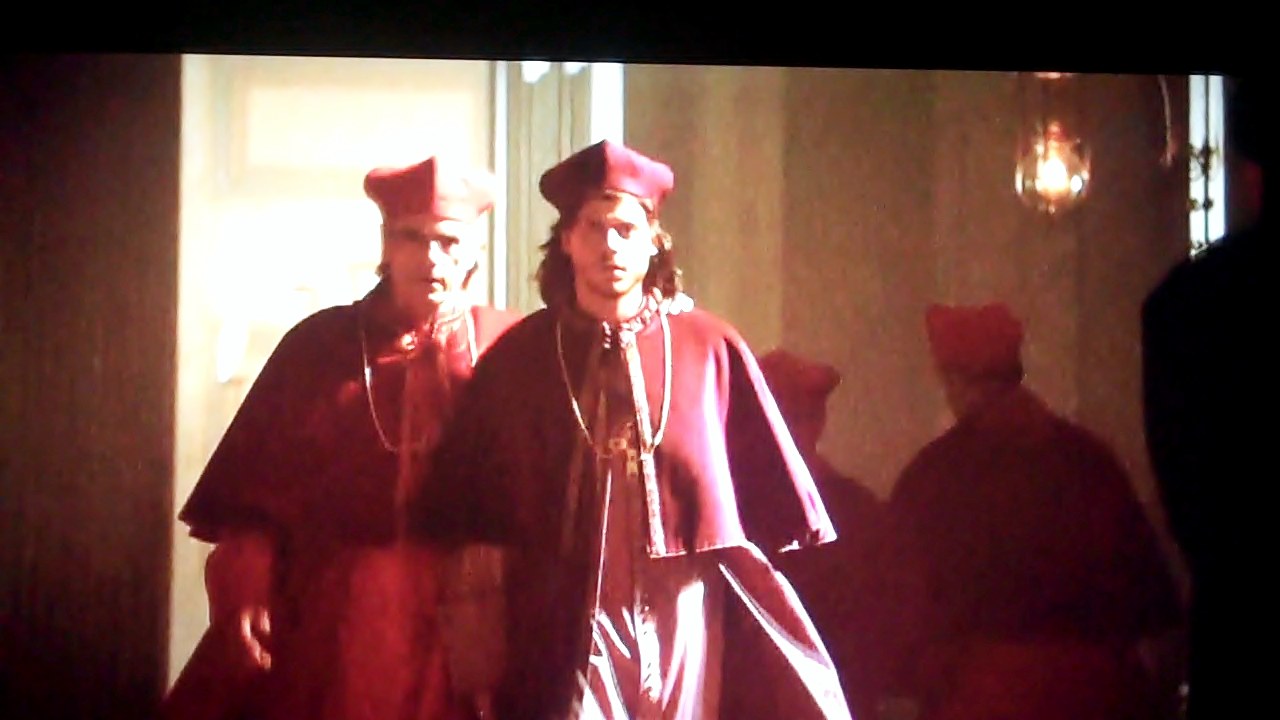
The series premiere begins with Cardinal Rodrigo Borgia, working with his 18-year-old Cesare to bribe and scheme their way to victory in the papal conclave. A Spaniard viewed with suspicion by Rome’s elite, Borgia is able to afford the hefty bribes, due to the considerable wealth he accumulated as a senior Vatican administrator.

But it’s clear, after his victory, that the new pope’s rivals, including Della Rovere, will not take defeat easily. Cesare, in a Machiavellian twist, uses an assassination attempt against his father to the family’s advantage.

The series naturally focuses on Alexander’s ruthlessness and his personal and moral flaws, though historians say the more sensational accounts of the Borgia dynasty are one-sided.

“It could be noted that there were positive sides to Alexander’s rule,” noted University of Glasgow historian Christopher Black.

“Besides administrative and financial reforms, he made moves to reform the monastic orders, and was a respected patron of artists and humanist scholars, who respected him.”

Feore said the complexity of Alexander’s character, and the context in which he ruled, can’t be ignored. The pope was in many ways like a warlord, but his goal was to sustain the Catholic Church — and what he hoped would be a family dynasty — in a hostile environment.

“In this world, you have to promise things you’re not going to deliver on, you have to keep your friends close and your enemies closer, you have to understand that people are corruptible, venal, horrible, maniacal, and self-centred. If you can recognize that and use it to your advantage, then you might be doing God’s work,” Feore told Postmedia News.

“Now, if that circular kind of thinking works for you, boy, have we got a show for you.”

The Borgias’ two-hour premiere airs Sunday, April 3 on Bravo! at 10 ET/ 7 PT.

poneil@postmedia.com

© Copyright (c) The Vancouver Sun

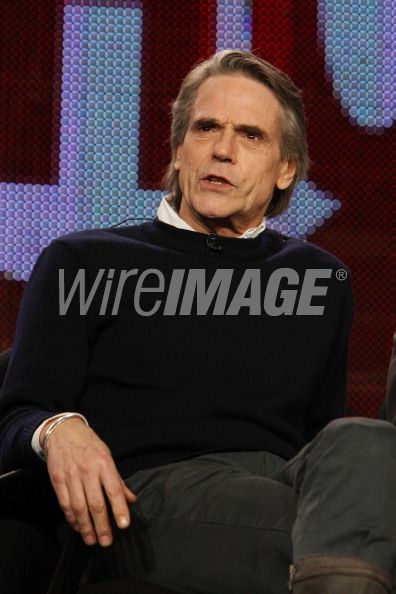
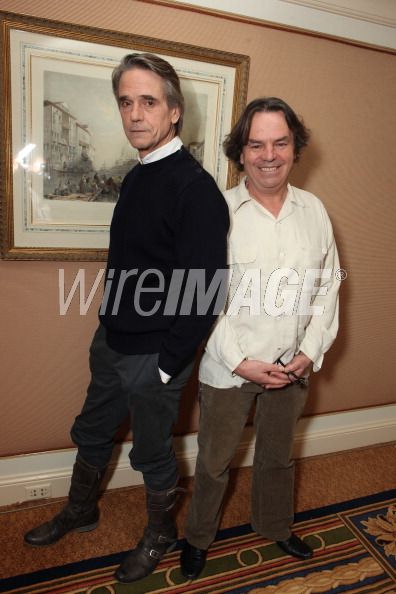
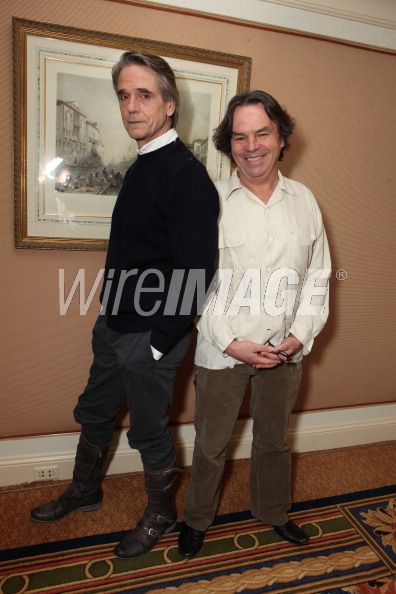
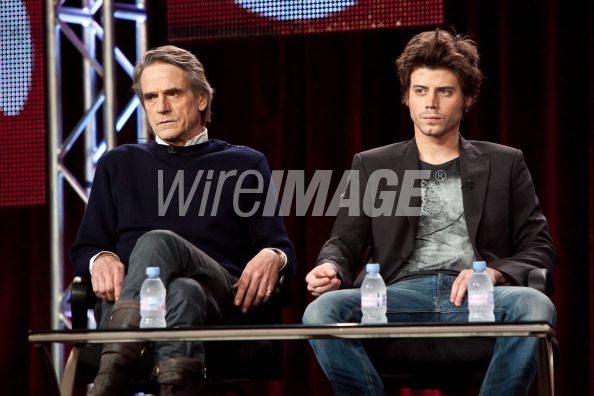
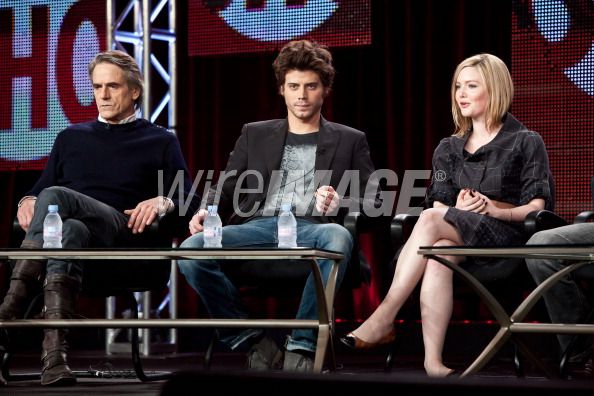
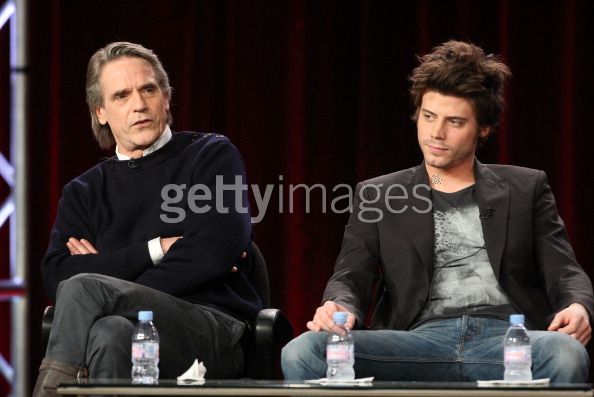
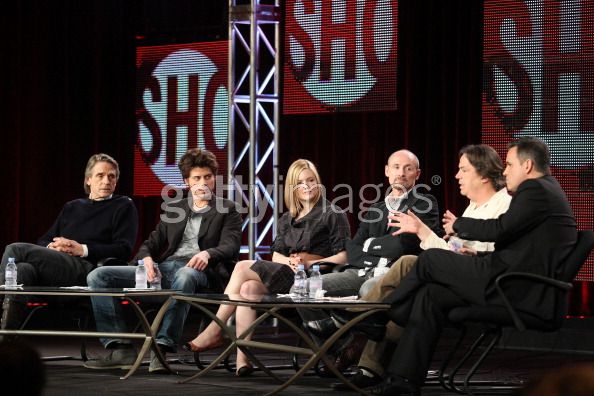
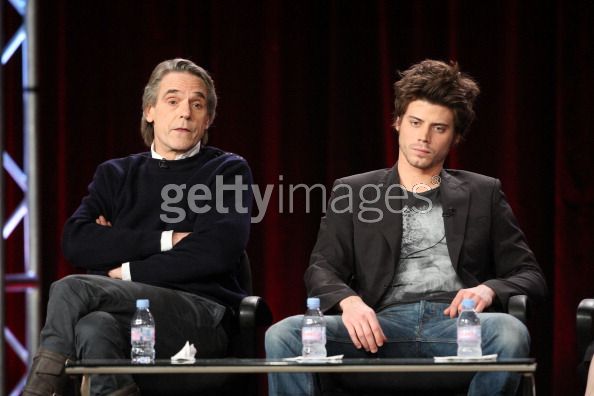
TCA Press Event Photos and News

The Borgias will premiere on Showtime on Sunday, April 3, 2011, from 9:00 to 11:00 pm EST.  It will move to its regular time slot of 10:00 pm, the following week.

This slideshow requires JavaScript.

From Elise Crane Derby via Twitter

Click on any of the thumbnails for a larger image:

Jeremy is not in this video, but Colm Feore, who plays Cardinal Della Rovere in “The Borgias”, speaks about working with Jeremy and he gives a lot of interesting details about the filming of the series.

__________________________________________________________________________________________

From Brittany’s TCA 2011 Blog:

The Borgias

Please stop calling Showtime’s The Borgias a sequel to its wildly successful The Tudors. According to Borgias star Jeremy Irons, the shows are alike “as much as Hamlet is the same as MacBeth.”

Borgias-010511-0001.jpg

Billed by Showtime as “the original crime family,” the series depicts the titular family as Rodrigo Borgia (Irons) “builds an empire through the corruption of the Catholic Church and orchestrates a relentless reign of power and flamboyant cruelty” once he begins Pope Alexander the Sixth. The same qualities are seen in his children as Juan (David Oakes) becomes head of the papal armies and Cesare (Francois Arnaud) is made a Cardinal, while Rodrigo plots to marry off daughter Lucrezia (Holliday Grainger) as a means of further improving the family’s political position. Sex, violence, and chaos abounds.

“The series is about power and God and how they interact,” creator, writer, director (of the first two episodes) and executive producer Neil Jordan said. Co-star Colm Feore added that it’s a “very difficult problem. Maybe they don’t work together.”

Yet with all the sin, debauchery and cruelty perpetuated by the Borgias, are they going to repel some viewers who find them too objectionable? It’s possible, but no one seemed particularly bothered. Asked that question, Irons replied, “It’s for us to judge them, and wonder how much has changed [since then].” He added that the fact that people are afraid of skeletons in closets may have something to do with ‘why we have such boring people as leaders” – because they don’t want their misdeeds inevitably exposed by their candidacy.

On top of that, The Borgias faces another hurdle. With religion involved, controversy sometimes follows. Jordan doesn’t expect a backlash, however, saying that “these events are so well-documented and [Rodrigo] did try and protect the institution [of the Catholic Church]. I don’t think the Church will be unhappy.” Yet there’s only so far history can take the fictional Borgias. Asked how much research the actors did, Fiore said that it doesn’t matter as much as we might think, since “you’re only going to be doing the bit selected for the story.” Arnaud concurred: “It’s not about history so much anymore as it is about what we’re telling you.” In other words (mine, not theirs), die-hard history buffs should expect some dramatic license.

If there’s one thing in common between The Borgias and The Tudors, it’s that once again there’s no shortage of salacious content, with plenty of nudity and implied sex acts in the clip reel alone. However, unlike how it became a marketing point for The Tudors, it “just happened to be part of the story” of The Borgias, Jordan said. Yet that’s where the similarities end.

__________________________________________________________________________________________

Memorable quotes from The Borgias TCA panel discussion:

1. I read something about Pope John the Pope John Paul, is it, the Polish Pope. And it was from a Catholic theologian who said he wrote, actually, ‘Habet duos testiculos et bene pendentes.’ He said, ‘This man is well hung. That’s why he deserved to be Pope.’ Now, certain things the Vatican will not reveal to all of us, but there is a chair, apparently, a Porphyry Chair, with a large circular hole in it to so these examinations can be made. Now, many people will deny that, but I’ve read I read reputable historians who says it happens, okay? Perhaps no longer, but then it did.” – Neil Jordan, “The Borgias” (Showtime)

2. “I think (Rodrigo Borgia) is a pretty good guy just doing the best he can. I mean, power corrupts, you know. It was a time quite unlike the time we live in today. There were murders in Rome every night, poisonings most weekends. There was incest here and sodomy there. You know, it was a good old rolling, rollicking society. And if you’ve got to try and run that, which the Pope attempts to do, then, of course, you’ve got to play by some of the games, by some of the rules that society follows. I didn’t judge him at all. I just tried to hang on by the…hang onto the position and do what he wanted too. I think it’s up to the audience to say what is good, what is wrong, what is right, and then think how much… wonder how much has changed as you look at present day Italy or present day almost anywhere of power. I think there are huge parallels about what people get up to in order to hang on to power and in order to get their way. I don’t think anything has changed, and perhaps those thoughts will go through our minds when we judge these people. I played him. I thought I was quite a good guy. But George W. Bush probably thought he was quite a good guy, too. Stalin probably liked himself.” – Jeremy Irons, “The Borgias” (Showtime)

3. “As a director, (’The Borgias’) is a nightmare because (the actors) all come with the books about their character. ‘Hang on, I didn’t do that. Look, it says here he did this. It says here he did that.’ Stop, please.” – Neil Jordan, “The Borgias” (Showtime)
__________________________________________________________________________________________

From Ray Richmond, who is contributing to Deadline Hollywood’s TCA coverage:

There’s no mystery where Showtime is taking its marketing orders from in promoting its forthcoming historical costume drama series The Borgias that premieres April 3. The tagline hypes it as “the original crime family,” documenting life in the Italian Renaissance of the late 1400s and the corrupt rule of Rodrigo Borgia, who would become Pope in 1492. As he described during a TCA session this afternoon, the man playing the Borgia patriarch, Jeremy Irons, saw the notorious Rodrigo as “a pretty good guy doing the best he can.”

Irons continued, “It was an interesting time. There were murders every night. Poisonings most weekends. Incest here, sodomy there. It was a good old rolling, rollicking society. If you’re going to run that as a Pope tends to do, you’re going to have to play by some set of rules. I don’t judge him at all. I think it’s up to the audience to say what is good, what is wrong, what’s right. There are huge parallels today to how things were back then as far as what people get up to and what they do to get their way. I don’t think anything has changed really. I played him as someone who thought he was a pretty good guy. I’m sure George W. Bush thought he was a good guy, too. Stalin probably liked himself.”

Share

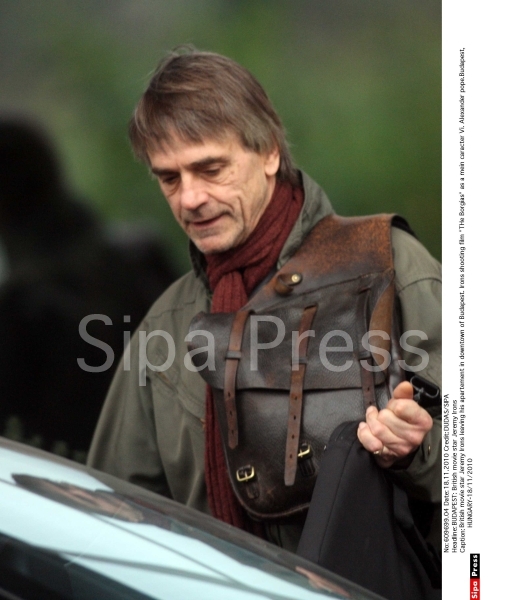
New Photos of Jeremy in Budapest

British movie star Jeremy Irons leaving his hotel in downtown  Budapest.
Budapest, HUNGARY-18/11/2010
Credit:DUDAS/SIPA

This slideshow requires JavaScript.

Share

Screencaps from The Borgias Preview!

This slideshow requires JavaScript.


Share

The Borgias: 15th-century Sopranos for a 21st-century audience

From the Toronto Globe and Mail
(Photos follow the article)

The Borgias: 15th-century Sopranos for a 21st-century audience
ELIZABETH RENZETTI
BUDAPEST— From Saturday’s Globe and Mail

‘Put down your hot dogs and put on your helmets!” the first assistant director barks, an order relayed in Hungarian to two hundred lunching extras who have grabbed a very quick break on the set of the upcoming miniseries The Borgias. Dutifully, the Hungarians – who are dressed as 15th-century French soldiers – put away their cellphones, cigarettes and frankfurters, take up their helmets and pikes, and march haphazardly toward one of history’s wickedest women.

Except that Lucrezia Borgia, as played by British actress Holliday Grainger, looks less like an (allegedly) murderous, incestuous schemer than a 20th-century pop princess, all pink cheeks and lush blonde hair. Lucrezia sits on her black horse, looking across a Hungarian field which, thanks to the miracles of CGI, will be filled on television screens with thousands of soldiers of the Papal army, led by Lucrezia’s brother Juan (whose minor crimes, including military incompetence and seducing his brother’s wife, make him the good Borgia.)

The Borgias were the Sopranos of the 15th century, and the producers of the nine-part miniseries are clearly hoping, come next spring, to fill the gaping hole in torture, sex, historical semi-accuracy and codpieces left when The Tudors finished its hugely successful run. But mention the T-word on the set of the Canadian co-production and you run the risk of being run through.

“I’m not allowed to say it’s more tasteful than the Tudors,” says David Oakes, the British actor who plays Juan Borgia, with an impish smile. “It’s very different. If The Tudors started to make period drama accessible to Americans on television, then this is a step up again. This is film quality.”

Of course, that includes the odd hot poker and heaving bosom. Producer James Flynn worked on both shows and while he acknowledges The Borgias is trying to replicate The Tudors’ appeal to a young, male audience, he insists the new show is painted on a wider canvas: “There’s intrigue and sex and violence, it’s a heady cocktail that should attract a large audience. But it’s really about the journey of a ruthless man with huge ambition … It’s about family, it’s about loyalty.”

At the head of the family is Rodrigo Borgia, later Pope Alexander VI, the first pope to openly acknowledge his illegitimate children. (He especially favoured the useless Juan: You could say he put all his ego in one bastard.) As wily as he is licentious, Borgia was once described by Alexandre Dumas as “the most perfect incarnation of the devil that perhaps ever existed.”

“Well, yes,” says Jeremy Irons, who plays Rodrigo, with a not entirely pious smile. “But history belongs to the winners, doesn’t it? And the Borgias had many enemies, because they were Spanish interlopers.”

The Borgias is the baby of Irish director Neil Jordan, who has dreamed for 20 years of making a movie about the Spanish upstarts who arrived like a hurricane in Rome, and came to rule the Catholic church through a recipe of murder, intimidation, bribery and the occasional orgy. It is said that Mario Puzo based The Godfather on the family of Rodrigo Borgia and his bloodthirsty children.

Jordan wrote all nine episodes and directed the first four. The quality of the series extends to the high Canadian content in cast and crew, including director Jeremy Podeswa, Montreal actor François Arnaud as the diabolical Cesare, and, as the Borgia nemesis Cardinal Giuliano della Rovere, Stratford’s Colm Feore.

Della Rovere, who went on to become Pope Julius II, is only moderately corrupt and ambitious, which makes him the good guy of the piece. “The Borgias are heinous, no question, but so was everybody at this period,” says Feore, dressed in severe black vestments, an anachronistic plastic cup of apple cider in hand. “There was a lot of truly corrupt, horrible stuff going on. My guy wasn’t a whole lot better but he did have perhaps a stronger moral centre.”

Feore and the other actors have been shooting near Budapest since July. The $45-million production, which will debut on Showtime in the United States in early April and then Bravo and CTV shortly after, is an American-Irish-Hungarian-Canadian co-production, cobbled together with talent and financing from those countries. Hungary has become a magnet for large-scale miniseries like The Borgias and The Pillars of the Earth because it offers tax breaks, medieval landscapes largely free from cell-phone towers, and crews that are technically knowledgeable while not requiring the same concessions as their North American counterparts.

On this cool October day, for example, the crew don’t actually stop for a lunch break but grab hot dogs or buns that are, quite literally, tossed their way. As with any ambitious television production, they’re racing the clock and hoping to wrap the outdoor scenes while the weather is good. On a nearby soundstage, two hundred carpenters have built a miniature Rome, not in a day, but in a few months.

At that time, everybody who could hold a paintbrush or write a treatise passed through Rome, which allows The Borgias to indulge in a type of storytelling you might call Hits of the Renaissance. The script contains roles for Whore Number One and Arrogant Young Nephew, but also for Savonarola and Leonardo da Vinci and Machiavelli, who based his political treatise The Prince on Cesare Borgia. “I had dinner with Machiavelli and Medici the other day,” Feore says. “Fabulous guys, really fun.”

While not attempting to bury nor praise the Borgias, Feore points out that in the late 15th century, Rome was in tatters, ruined and crime-ridden, and perhaps needed a strong arm like Rodrigo’s to make things run smoothly. And, of course, to bring God’s word to the infidels, by force if necessary.

The strong man always makes enemies, and sometimes war: This entire morning Feore’s been on his horse shooting a scene where della Rovere, the French King Charles VIII and their hostage Lucrezia prepare to battle Juan and the papal army. Two weeks before he left to join the production, Feore got a call: “Um … can you ride?” He took a few lessons in Stratford and discovered a professional affinity with horses: “They’re like actors,” he says. “They’re sort of pretty, most of them, but they’re stupid.”

On cue, Holliday Grainger gallops from the French King’s side and crosses the battlefield to convince her brother to surrender before he gets a holy drubbing. This is not actually how it happened in history; Rodrigo Borgia’s mistress and her companion were taken captive, not his daughter. But then, loins are already being girded against challenges of historical inaccuracy.

“There is poetic licence,” allows producer Flynn. “If they filmed what actually happened,” says Feore, “it would be condemned as an improbable fiction.” Oakes, the young actor playing Juan, offers just one example: The Chestnut Ball, a party organized by Pope Alexander VI, who hired all the courtesans in Rome to surround a field of chestnuts and pick them up … without using their hands. “If we showed that,” says Oakes, “people wouldn’t believe it.”

This slideshow requires JavaScript.


Share

The Borgias – Behind the Scenes and Promotional Photos!


This slideshow requires JavaScript.


Share

The Borgias Wines

Showtime Signs Wine Licensing Deal With Votto Vines

Press Release: 7 September 2010 –

HAMDEN, Conn. – Showtime Networks Inc., in partnership with CBS Consumer Products, has entered into a licensing agreement with Votto Vines Importing (Votto Vines) for a line of Italian wines based on the upcoming SHOWTIME series The Borgias. This will be the first imported wine licensing venture for Showtime Networks and CBS Consumer Products.

“We are thrilled to be working with Showtime and CBS Consumer Products on this unique opportunity,” says Votto Vines President and CEO Michael Votto.  He adds, “This is a tremendous opportunity, and we look forward to developing a successful initiative together.”

In keeping with the setting of The Borgias, the red and white varietals will be imported from the northern Italian region of Veneto.  Each wine will retail for under $15/bottle and will be produced by an award-winning family winery located in the heart of the Bianco di Custoza zone, on the outskirts of the historic center of Verona.  The target release date for The Borgias wines is the spring of 2011, in advance of the show’s premiere.

“In this economy, wine consumers are seeking high-quality wines at great price points,” says Votto Vines SVP of Sales Jeremy Jerome.  “That is what The Borgias wine brand will represent.  Traditional Italian varietals from the region of Veneto at a price point that will appeal to both the novice and experienced wine consumer alike.  Having nearly finalized the selection process for The Borgias wines, we are confident that wine consumers will be very excited about these wines.”

THE BORGIAS, a one-hour drama series based on the infamous Italian Renaissance family, will premiere on SHOWTIME in spring 2011 with nine episodes. Oscar®-winning actor Jeremy Irons will star in the epic drama as Rodrigo Borgia, the cunning, manipulative patriarch of the Borgia family who ascends to the highest circles of power within Renaissance-era Italy.   Additionally, Academy Award®-winning director Neil Jordan (“The Crying Game”) will create and executive produce the series and will direct the first two episodes.  The series is currently in production in Budapest.

Share