New, recent photos of Kilcoe Castle taken during the Heir Island Regatta 2010, during the third week of August. (Photos copyright Heir Island Images)
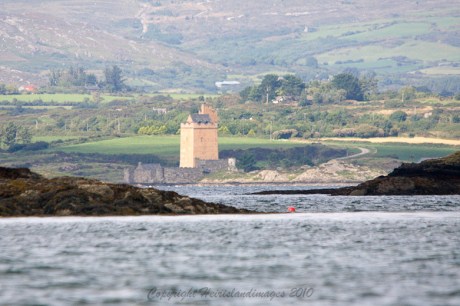
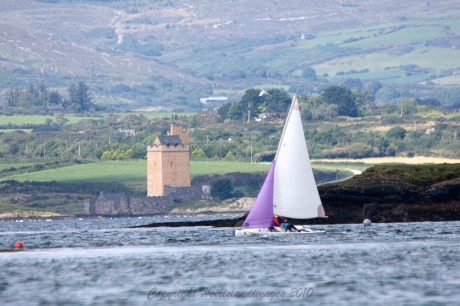


New, recent photos of Kilcoe Castle taken during the Heir Island Regatta 2010, during the third week of August. (Photos copyright Heir Island Images)
A better way to mental health

Joan Hamilton with Jeremy Irons and Harry Gijbels at the launch of fundraising for Slí Eile farm project. Photograph: Michael Mac Sweeney/Provision
From The Irish Times 27 April 2010
by ROSE DOYLE
A decade of hard work has come to fruition for Joan Hamilton with the establishment of the Slí Eile farm project
IT’S TAKEN 10 full-on years – longer if you count the heartbreaking years of a daughter’s illness – but Joan Hamilton’s dream of a residential, farming community where people with mental health difficulties can work to rebuild their lives is about to become a reality.
A force of nature when it comes to getting things done, Hamilton is the woman behind the Slí Eile farm project, behind Villa Maria (the Slí Eile pilot venture running in Charleville, Co Cork for three years now) and behind the venture’s vision of “an Irish society which accepts people’s mental illness and confusion and supports their unique journey to recovery”.
The Slí Eile farm fund was launched last week by the project’s patron, actor Jeremy Irons. Speakers at the event included Healthplus columnist Tony Bates, Prof Ivor Browne and Carmel Fox of the Cork County Development Board.
Irons, in a heartfelt speech, spoke of everyone’s right to self-respect and a sense of worth, about the importance of mental healthcare, his belief that Slí Eile Farm was both “terribly important and made sense” and his conviction that it would succeed “because of our fantastic leader, Joan Hamilton”.
Similar farm communities in Massachusetts and Ohio have been guiding influences in the development of the Slí Eile model. There is support, too, from Jersey in the Channel Isles, where Joan Hamilton was born and lived until she met Gerry Hamilton, the Irishman she married and came to live with in the Co Cork village of Dromina more than 40 years ago.
She spoke about it on a recent sunny day at Villa Maria, where the pilot project is now providing accommodation for five tenants and one support staff. The cared-for gardens were ready to bud if not bloom, tenants were engaged in the daily schedule of work (including baking bread and scones which are supplied to the local community) and the house cat was stalking this reporter.
When did she start, and why? “I set up a lobby network group around 2000. The why had to do with a lifetime watching my daughter Geraldine’s steady deterioration in the traditional psychiatric system. Figures from the mental health inspectors show that three out of four psychiatric admissions are readmissions – soul destroying for the person as well as for her/his family. I’d been banging on doors forever and felt helpless, frustrated and that there had to be another way, a better way.” She smiles. “A Slí eile.”
The germ of the idea goes back even further. Geraldine is the third of Joan and Gerry Hamilton’s six grown children and her mental health difficulties began as a teenager in the 1980s.
“Her situation, in the traditional system, was pretty appalling at times,” her mother says with gentle understatement. “I didn’t think things could get worse, so I went public and did an interview with RTÉ Cork and that connected me to like-minded souls and that, basically, is how it started.”
In 2001, as co-founder of Cork Advocacy Network, she organised a stake-holders conference entitled Is There Another Way? in Cork city. “Vincent Browne chaired the day and more than 700 people turned up. It was a great success. From a reading of Toxic Psychiatry by Peter Breggin I’d learned about therapeutic communities, so the idea took root, but I didn’t know how to go about setting one up.
“I’d studied choice theory/reality therapy with the William Glasser Institute and what I learned came together in therapeutic community ideals of respect for one another and regaining control of lives lost. I returned to adult education in UCC, studied community development, disability studies, interpersonal communications and applied social studies. It all helped me see how others worked to bring about change and gave me real belief in the possibility that those with mental health difficulties could both recover and regain control of their lives.”
She set about the difficult task of getting funding for social housing. “Villa Maria was achieved after a series of abortive attempts due to problems caused by the stigma and attitudes to those with mental health difficulties.
“But it happened,” she smiles again, “and Villa Maria has been successfully running since 2006. The present five tenants are all growing in self-sufficiency, self-knowledge and self-worth. Everyone’s responsible for their own medication and the role of staff is to help tenants regain life skills.”
With a larger community, “something that’s going to continue long after me” in mind, she spent two weeks last year working as a volunteer at Hopewell community farm in Cleveland, Ohio.
“I saw how it was set up and how it worked. I loved the sense of calm, the reality of structures impacting on people’s lives. I saw the evidence before my eyes of lives recovered and being lived. I came back energised and enthused.”
There’s been the recent, added momentum of enthusiastic support from Gould Farm in Massachusetts too, a community which dates from 1913 and is the oldest such in the US.
Slí Eile farm will provide a supportive living environment for up to 16 people with mental health difficulties. Everyone will be involved with the daily running of the farm, which will provide housing for at least two residential staff, four volunteers, a residential events venue and farm shop. Allotments will be available to families in the area, all of which will make for social interaction and revenue.
The Slí Eile farm fund aims to raise money for the purchase of 80-100 acres as well as for staff, buildings and more.
Joan Hamilton has developed and managed her own food processing business, been involved with local tourism, small businesses and administered EU Leader funding. As executive director and founder of Slí Eile farm she projects it will break even by 2014. The projection that it will bring hope and inspiration to the area of mental health care in Ireland is a given.
| Irons backing Sli Eile |  |
| Written by Christine Allen | |
| Thursday, 15 April 2010 | |
Multi-award winning actor Jeremy Irons will this week offer his support to the launch of a €3 million housing project for people with mental health difficulties.
 The plan to extend the Sli Eile Farm Project, a housing project that helps people using psychiatric services to regain independence, will be launched by the celebrity patron on Friday 23 April at 11am at the Charleville Park Hotel.According to the project’s founder, Joan Hamilton, three out of four of all admissions to psychiatric services remain re-admissions. “The experience of psychiatric breakdown affects a person on many levels,” she said. “Most of all, people say they feel vulnerable and cut off from normal relations with family, friends and the wider community.” BreakdownFollowing the first breakdown of her own daughter at the age of 16, Ms Hamilton established the organisation in 2001 to help people with mental health difficulties to have control of their lives within an accepting and supportive living environment. //
// “We, her family, witnessed her many admissions and steady deterioration over many years and I felt their had to be another way, that what was needed was a living environment where a person was accepted and supported in their journey to regain their place in society, to achieve whatever they want to achieve,” she said. As part of the project, residents participate in weekly rotas, with each tenant paying just €60 weekly for everyday costs of shopping, heating and maintenance. FutureThe founder said that the Slí Eile project is now ready to expand and proposes to establish a community farm of 80 to120 acres under the National Mental Health Policy Document Vision for Change. “It will provide a supportive living environment for 16 people who are experiencing mental health difficulties and the tenants will participate in the daily tasks of community farm life which will provide a structure that offers support for people working to regain control of their lives,” said Ms Hamilton. She told the Cork Independent that the private project would be relying on donations but had benefited from the high profile of Jeremy Irons. “He has a house in West Cork and we were delighted that he accepted our offer to come onboard last January,” she said. |
The Chronoscope is a mocumentary about a beautiful scientist in the 1930s who invents a machine that can see into the past. It was written and directed by Andrew Legge and premiered in Ireland in July 2009.

The 20 minute short film was screened at The Flat Lake Literary and Arts Festival on 16 August 2009, at Hilton Park, Clones Co. Monaghan, Ireland.
The Chronoscope tells the story of a female inventor who is kidnapped by the Third Reich after she invents a camera with the power to see into the past. The short film was written and directed by Andrew Legge and produced by Fastnet Films. The film was funded under the Wicklow County Council’s Per Cent scheme and is narrated by Jeremy Irons.
The Chronoscope combines archive and shot footage which was manipulated in Post to evoke the style and atmosphere of the era. Post Production took place at Screen Scene where Allen Sillery worked on the pictures in flame “The director wanted the main character to interact with Hitler, DeValera, Einstein & the Queen. Other newsreel footage from Ireland in the 1930’s had to be doctored by compositing artists, banners & signs relevant to our story. Various chromo-key plates were shot with on set vision-mixers to aid registration & mimic our actors movements to that of whomever they were meant to be interacting with.” Colourist Angella McLellen then graded the pictures on the Nucoda and Simon Thornton finished the project in Online.
The Chronsocope
Company: Fastnet Films
Writer/Director: Andrew Legge
Producer: Ben Keenan/ Morgan Bushe
DOP: Eleanor Bowman
Editor: Eoin McGuirk
Additional Photography and Graphics: Andrew Legge
Online Editor: Simon Thornton
Colourist: Angela McLellan
Flame: Allen Sillery/ Gavin Casey
Music: Jurgen Simpson
Post Production Co-ordinator: Sarah Caraher
Jeremy Irons was on hand for the 2009 Ballydehob Summer Festival in Ireland on Sunday 9 August. He hosted the Official Opening Ceremony and attended the festival opening parade.
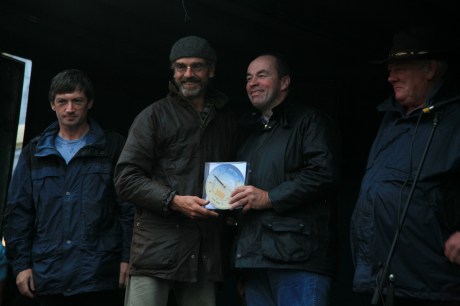
Ballydehob Summer Festival 2009 Opening

Ballydehob Summer Festival 2009
 Jeremy Irons
The mystery voice on our climate change video is none other than Jeremy Irons. Showing his support, Mr. Irons stated:
“It’s time to recognise the devastating impact that climate change is already having on people living in poverty. We must make it clear to our leaders that they have to act now and deliver a global deal that supports developing countries in their efforts to cope and adapt. I encourage you to join Oxfam Ireland’s campaign today and together, we can send a strong and clear message that now is the time for action on climate change.”
Vodpod videos no longer available.








 jeremyirons.net


 jeremyirons.net
You must be logged in to post a comment.