
Jeremy attends a Tribute to Ian Fleming

————————————————————————–
Jeremy Irons at Tribute to Ian Fleming


————————————————————————————-
Sunday 5 October 2008

Bonds past and present attend Ian Fleming tribute

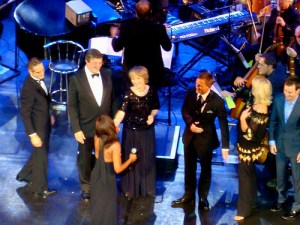
James Bonds past and present paid tribute to creator Ian Fleming at London’s Palladium theatre last night. Current incumbent Daniel Craig (with his arm in a sling) and 007 veteran Sir Roger Moore, both of whom are interviewed in November’s GQ, took part in The Story Of James Bond: A Tribute To Ian Fleming, a star-studded event hosted by Stephen Fry and former Bond girl Joanna Lumley. Other Bond girls including Rosamund Pike and Quantum Of Solace’s Gemma Arterton also put in a welcome appearance, while Jeremy Irons and onetime Bond villain Toby Stephens read extracts from Fleming’s memoirs and novels respectively. Fellow literary types Sebastian Faulks, who wrote new Bond book Devil May Care, and Charlie Higson, author of the young Bond novels, also attended. Guests were kept well lubricated with Bond’s champagne of choice, Dom Pérignon.

from http://www.gq-magazine.co.uk

—————————————————————————-

A first-hand account of the event from www.timpollard.com

Wow.

My partner and I had the very great pleasure of attending the ‘The Story of
James Bond – A Tribute to Ian Fleming’ concert last night at the London
Palladium, a charity gig for the British Heart Foundation and it was an
absolute tour de force. One night only, full of Bond alumni from both
literary and cinematic productions and certainly worth every penny of the
admission price – I’d seen the show mentioned here a while ago but only made
an effort to buy a pair of tickets last week, hoping to get a couple of the
cheap seats, sadly when I rang they’d all gone and they only had expensive
single seats left, but whilst I was debating what to do a pair of (quite
expensive) returns came in slap bang in the middle of the front stalls and
so I thought ‘sod it, you only live… er… once!’ and snapped them up!

We arrived at the Palladium by taxi and were mildly surprised to find
outselves being escorted out of it by policemen as the entire street was
full of press, paparazzi and onlookers, so we felt prettty special before it
had even started – then we made our way into the theatre for the show, and
here’s a brief run-down of what happened…

The curtain raised to feature an orchestra on stage playing a medley of the
Bond themes before Lucy Fleming came onstage to introduce the hosts, Stephen
Fry and Joanna Lumley. The format of the show was eclectic and interesting,
Fry and Lumley sitting just in front of the orchestra narrating the history
of Fleming’s life whilst Jeremy Irons (to the left) played the part of
Fleming himself, reading letters and quotations
and Toby Stephens (to the
right) reading extracts from the Bond books themselves. Overhead a large
screen showed clips from films, stills and other images.

Interspersed between these readings were Bond themes sung by Beverley
Knight, Tony Hadley, Mica Paris, Lemar and even Lee Mead amongst others –
all of which were very nicely done, and the West End cast of Chitty Chitty
Bang Bang sang a couple of numbers from that show too. There were video
messages from Duran Duran and Paul McCartney and the orchestra played some
more themes and
incidental music from the movies and there was even a performance of Noel
Coward’s ‘Don’t Let’s Be Beastly to the Germans’!.

There were more readings from (amongst others) Samantha Bond, Christopher
Casenove, Joely Richardson, Harriet Walter, Gemma Arterton and Rosamund
Pike. Sebastian Faulkes read from Diamonds are Forever too, but sadly
Christopher Lee and David Gilmour weren’t in attendance (although they were
listed in the programme), their parts being performed by other members of
the cast.

Of course there had to be Bond girls too and onstage we saw Shirley Eaton,
Caroline Munnro, Maryan D’Abo, Zena Marshall, Eunice Grayson, Madeleine
Smith and Tanya Mallet and there was a HUGE round of applause as Roger Moore
came onstage – and more after a Sir Sean look-alike tried to muscle in and
was bundled offstage by a Royal Marine Commando who abseiled down from the
roof! Sir Rog made a very nice sppech about Cubby Broccoli and then
introduced Barbara Broccoli and Michael G. Wilson, who we were surprised to
find were sitting just a couple of seats behind us!

Charlie Higson gave an amusing talk on the history of Bond media pre-Connery
(Holness and Nelson) and all of this was topped by a sneak preview scene
from QoS before Daniel Craig (arm still in a black sling) appeared onstage
and the place just erupted – he read the eulogy from Fleming’s funeral and
then everyone trooped back onstage to take a huge standing ovation – it was
a fabulous night (although my partner’s night had already been made when I
pointed out we were also sitting just two seats away from Daniel Craig for
most of the show and he’d given her a very appreciative glance)! I have no
idea whose tickets I’d picked up, but as I mentioned we were right in the
middle of the celebs – Charlie Higson was in front of us (and was very
pleasant and courteous), Caroline Munro and many of the other Bond girls to
our right and Simon Williams almost on top of us for most of the evening. It
was a great and at times very moving tribute to Ian Fleming and everyone
performed brilliantly – and I’ve been told that the show was being recorded
for later broadcast by BBC Radio 2, so hopefully (if that’s true) you’ll be
able to hear some of it yourselves.

Top fun!


Regards

Tim Pollard
www.timpollard.com

—————————————————————————-

Jeremy Irons speaks plainly, if elegantly

Jeremy Irons speaks plainly, if elegantly

Talking As a kid, living on the Isle of Wight off the southern coast of England, Jeremy Irons played cowboys and Indians and watched “The Cisco Kid” on television. I’m hearing this as I sit with my recorder in a suite at Toronto’s Royal York hotel, across from the 60-year-old Oscar-winner, and the information does not jibe with the man before me: a professorial-looking fellow curled up in a chair shoved next to an open window, so that the tiny skinny little brown cigarettes he smokes can waft directly back into the room.
Irons wears big owlish specs and a courtly air, and when he thinks about a question before answering, he’ll let a full 12 seconds pass before unrolling his answer.

Irons was in Toronto last month promoting “Appaloosa.” The movie is director, co-writer and co-star Ed Harris’ adaptation of a novel set in the lawless late 19th Century New Mexico territory town of the title. Irons plays a juicy supporting role, Randall Bragg, a rancher whose reign of violence meets a couple of formidable adversaries new to the region: Harris’ marshal, and the marshal’s sidekick, played by Viggo Mortensen.

“I think Ed wanted an actor who gave the feeling that he’d come from somewhere else—the foreigner, the stranger, the man not from there,” Irons says of his involvement in the project. “Which I don’t think I really gave it, because I don’t think that was terribly useful direction.”

So, he says, “I tried to play him as a good guy. Which we all think we are.” He smiles. He knows Bragg isn’t anyone’s notion of a good guy. He kills three innocent citizens point-blank in the opening scene. Anyway, he says, “it’s nice to have a chance to play that sort of character.”

The making of “Appaloosa” took place near Las Vegas, N.M. Irons acknowledged that working with a director who was also a co-star had its challenges. “Every actor sees the story from his point of view, and however clever the director is at separating himself from his role as actor ... it’s difficult.” He adds that “even Viggo would probably admit that one felt slightly hidebound by the fact that the director was also an actor.”

That said, Irons adds, Harris acquitted himself well. Quickly Irons mentions that the one time he directed himself (in a 1997 television project, “Mirad,” co-starring his wife, Sinead Cusack), his performance was “crap.”

It’s refreshing to hear someone talk about his work this way, as if the nearest studio handler were a million miles away. Irons is a gracious man, quick with the niceties (“May I offer you some fruit?”), gossipy about one of his cherished loves, the theater (“Weren’t the Tonys bad this year?”).

He returns to Broadway for the first time in decades, in next spring’s production of a new play co-starring Steppenwolf Theatre Company associate Joan Allen. It’s called “Impressionism,” written by Michael Jacobs and directed by Jack O’Brien, and it deals with a photojournalist’s relationship with a New York gallery owner.

He has high hopes, though you never know, he says: Take “Reversal of Fortune.” Irons won an Oscar for his ripe, witty portrayal of suspected killer and aristocratic rotter Claus von Bulow. “I never thought that film would work,” he says. “It was difficult to get a feeling of whether or not we were hitting the mark. I remember saying to Glenn [Close] when we were shooting: ‘It’s only because we’re in this, and because we’re hot at the moment, that this won’t end up on television.’ Didn’t seem to be working at all. But Barbet [Schroeder, the director] did a fantastic cut eventually.”

What he’d really like, Irons says, is “Sean Connery’s last 20 years. He played some interesting roles and had a bit of fun in his 60s and 70s. One of my problems is I find the [filmmaking] process incredibly boring. And unless I’m having a lot of fun, I tend to close off a bit. But then the cameras turn.

“I’ve begun relaxing up on my work more. It took me a long time to learn that you can struggle to make something perfect, and be a pain in the ass, and [often] the work’s not very good. Or you can just have a good time, enjoy working with everybody, throw ideas about, and the picture has a sort of life to it.”

Jeremy on Ireland’s TG4 this Fall

Jeremy will appear on the TG4 programme “Faoi lán Cheoil “

Eight celebrities embark on a journey to learn a musical instrument over a period of 6 months under expert tuition of a renowned musician and each programme charts their trials and triumphs.  If necessary the tutors travel with their charges, including to a New Mexico film set, a Manhattan theatre and an English Premier Leagues soccer training ground to ensure they don’t forget to practice and improve ! The celebrity students also must prepare for a public performance which is particularly special to them. The line-up of aspiring fleadh winners is:

Sunderland and Republic of Ireland international soccer player Andy Reid – Banjo,

Award-winning Belfast playwright Marie Jones – Accordion,

RTÉ Radio Presenter (and Fáilte Towers winner) John Creedon – Flute,

Oscar winning film actor (and West Cork resident) Jeremy Irons – Fiddle,

Stage, film tv actor (Ros na Rún) Macdara Ó Fátharta – tin whistle,

IFTA nominated actor/comedian Paddy Courtney – Bodhrán,

Film, Stage and TV actor and director Adrian Dunbar – Traditional Singing,

Riverdance Dancer Dearbhla Lennon – Concertina.

(10.30pm Wednesday from 29th October)

see Jeremy in a TV commercial for the programme here:

http://www.tg4.ie/bearla/clar/fomh/clip.asp?CID=4

‘Appaloosa” ReelzChannel Interview

Interview with Appaloosa Star Jeremy Irons

from http://www.reelzchannel.com

ReelzChannel sat down recently with Jeremy Irons to talk about his role as the corrupt rancher in Appaloosa.

ReelzChannel: This character, Randall Bragg, it’s all in the name — conceited, he lives by no rules.

Jeremey Irons in Appaloosa

Irons: No, his own rules. We all have rules. He was born on the cusp — the earlier Western travelers, there was no rules. There was no law. The gun was the law. But that changed once they had pushed out there, the law and followers some 50, or 40, years later. We see Bragg at the beginning of the film protecting his men against people who want to take him away — in a way, that’s how you behaved then. But then he discovered that actually things were changing and when he managed to get out, he comes back a different man using the new methods.


RC: Would you describe him as a Western version of a mobster?

Irons: No, I think he’s a Western version of a lot of businessmen today. They set their sights on how they’re going to earn their money and then go and get it. They play by the rules. And they play as close to the edge — and over the edge — and they get in trouble. I think the American economy is full of men like Randall Bragg.

RC: Ed Harris directed the film along with starring in it. Did this mean you had to act as a bigger support system than normal?

Irons: No. Obviously you see that your leading actor is very busy, he’s got a lot, and you support him as much as you can to help him get the vision he has in his head. He’s an actor — allows you the latitude to find your character and to do what you think your character would do.

RC: A lot of British actors are attracted to Western roles. Do you think it’s because of the genre or because of the characters?

Irons: I think it must be partly the genre. We were all brought up on Westerns. I’ve always wanted to do a Western. But I have to say, if this was about industrial espionage in 1980…I probably would have come and done it. So it was just nice it was a Western.

‘Appaloosa’ 411

Here’s an excerpt from a review of Appaloosa on http://www.411mania.com” with rave comments about Jeremy:

“…The best thing about this film is Jeremy Irons’ scene chewing performance as Randall Bragg, our story’s lead antagonist. Irons seems to relish his role as a viciously cold pack leader, consistently throwing a wrench into Virgil and Everett’s plans. Randall is both cool and collective, and it seems to come quite naturally to Irons. He gives the film life (he’s the only one who appears to be having any fun) and when he wasn’t on screen, my interest waned. Sadly, he isn’t given enough to do …”

Read the entire review here:

http://www.411mania.com/movies/film_reviews/86162/Appaloosa-Review.htm

Joan Allen on Impressionism

Here’s an excerpt from an interview with Joan Allen in which she mentions Impressionism and her upcoming co-star Jeremy Irons.

from www.movies.ie
Q. But from one extreme to another, you’re set to go back to the Broadway stage with the play Impressionism...

I am going back to the stage for the first time in ages. It will be 19 years next year.

Q. You’ve already won a rack of theatre awards. Why go back now?

I read a play that I could not say no to. It was as simple as that; I really was not intending to go back to Broadway. Years ago I worked with this wonderful director called Jack O’Brien and he called me out of the blue a couple of months ago saying, ‘Darling, I have this new play. It’s gorgeous. It’s the most beautiful play I’ve read in years. You have to do it with Jeremy Irons and me. You have to!’ He was standing there with the script and I said, ‘A play, Jack? It’s been a long time.’ I wasn’t looking to do one. He told me to read it, which I did, and I was shaking and crying. It is a beautiful play.

Q. In which case why did you take such a long break from the stage?

[…]I read this play, it’s a limited run, it’s Jeremy Irons, it’s a beautiful story. I’m exhilarated by this and feel I can maintain that exhilaration pretty much for four months.

Official Appaloosa Website

http://welcometoappaloosa.warnerbros.com/

Jeremy goes to jail…but he’s not in Irons

from the Daily Mail UK

As if they haven’t suffered enough, the inmates of Wormwood Scrubs are about to receive a visit from arch luvvie Jeremy Irons.

Unlike its last high-profile guest – rock star Pete Doherty, who served 29 days of a 14-week drug-related sentence – the Lolita star will be there entirely voluntarily.

Irons is among 200 guests who have paid £35 each to see a performance of poetry and music by a dozen of the inmates, after which he will be the master of ceremonies at an auction to raise money for the Phoenix Trust, which provides yoga classes throughout prisons in Britain.

Says organiser Sandy Chubb: “Yoga and meditation have been proven conclusively to reduce criminal behaviour.

“We are also launching a new yoga book for prisoners during the evening – it contains only pictures because it’s for prisoners who can’t read.”

Jeremy Interviewed on The Zaz Report!

from http://www.nationallampoon.com

__________________________________________________________________________

Exclusive Interview: Jeremy Irons for “Appaloosa”

Exclusive Interview: Jeremy Irons for “Appaloosa”
By Paul Fischer
Friday, September 19th 2008 12:09am
image Oscar winning Brit Jeremy Irons is very picky when it comes to leaving one of his many British homes [and Irish castle] to take on a Hollywood role, but the idea of playing the antagonistic cattle baron in the Ed Harris-directed western, “Appaloosa”, was clearly too good to pass up.In a Toronto hotel room, in between puffs of a cigarette, Irons chatted exclusively to PAUL FISCHER.

Question: Was it irresistible to do something that kind of reminded you of why you might have become an actor in the first place?

Irons: Yeah. I’ve always ridden horses and like most people, I was sort of brought up on Westerns, and Westerns were movies., but I never thought I’d ever be in one. They don’t make many now and although Clint Eastwood had asked me to do Unforgiven–

Question: Which, the Richard Harris part?

Irons: Yeah. And I said, “No.” I think – I’d read the script, and I thought, “I think I’m too young for this. I don’t think I’m right for this. You should ask Richard Harris,” which he did. Of course, Richard made a great success of it and I think was a lot better than I would have been. So, I had another opportunity to do one. But, you know, when Ed asked me to do this, I’d just finished doing a play in London, and was feeling like doing a movie. I thought it would be a lot of fun. I could see that he had this dream to make this picture and Viggo was on board, and Renee was on board. And I thought, “Oh, we’ll have fun. It’s a nice bunch of actors, nice script.” And it was a real pleasure to be able to say yes to it.

Question: How do you humanize a character like this?

Irons: I mean, you give him his back story. We know that he worked with Chester Arthur in the New York Customs House, which you know was pretty rife with venality. You know, import-exports, and people creaming off everywhere you could look. I see him as a man who didn’t like the city that much, although he had been a city boy. And he thought, “I’m going out West. I’ve heard about this copper mind.” So he comes out to this little hick town. And discovers that they have given away the rights to a company out of Chicago to do it. So he thinks, “I’m just going to have to bully them.” So he lets his men run riot on the place, waiting for the time when he can go to the mayor, and say – and the council, and say, “Listen. If you want me to pull them off, let me have the mine.” And this is upset by the lawmakers coming to town.

You know, this was at a time when the law was just coming out to the Far West. The railroads had come. As soon as the railroad came, then the law followed. But for the original guys who went out there, they ruled by the gun. And if someone walked onto your land, which you’d staked, and said they want to take some of your men, you say, “No.” And then if they insist on doing so, you’d shoot them. I mean, you know, that was the way of it. But he’s caught on the cusp. Things are changing. So he gets – he gets out of it using influence, using people he’s used before. Gets back to New York. Says to Chester Arthur, “Jesus, it’s bloody terrible out there. I mean, there’s these guys going around making the law, and there are no witnesses to this, and they say I did this.”

So Chester Arthur, who was an old mate, said, “Well, I’ll give you a pardon.” He then gets backers, goes back out there and buys it. He says, “I’ll do it with cash.” And starts behaving in exactly the same way that I reckon 75 of the CEOs in America behave now. You know, you buy out the competition. But of course, in our story, he oversteps the mark. He starts courting a lady who is not his, and gets killed for personal reasons. But had he not done that, had he not put his hand on the back of that girl’s neck, and had Hitch not seen that, and Hitch not realized that Cole, now injured, so not able to be a lawman, really, wants to settle down, and that his life will be ruined because the girl will go with the stud stallion. Who is going to be Bragg. So Hitch, out of friendship, gets rid of him.

Question: Could you identify with Bragg at all?

Irons: Yes. I try and identify with everyone – I mean, there is an element of the rogue in me.

Question: Really?

Irons: In all of us, I think. And – playing a hard game, I can identify with anyone who does that, plays by the apparent rules. I don’t say he’s a great guy, but I can identify with him.

Question: What do you look for in a project? I remember a couple years ago, there was a time when you would do something like – and I dare not mention it – the last time I mentioned the movie’s name, you kind of scoffed at me. But, you said you did Dungeons and Dragons because it represented yet another brick in your Irish castle. Do you have such pragmatic attitudes now, or do you really have to be passionate about something?

Irons: No, I need to earn my wages. I try not to – I mean, Dungeons and Dragons was a sort of anomaly for me, in that I was spending a lot of money on the castle, and they offered me a lot of money to do the picture. And I thought, “Yeah, come on.” What I hadn’t realized was that the director of that picture was very inexperienced, and therefore it wasn’t going to really work. But I’m afraid I had my palm crossed with silver. And so there’s an element of pragmatism. But I’ve always tried to – I’ve never wanted to work to support my lifestyle. But I do find that your lifestyle just tends to grow without you realizing. I have a lot of properties. None of which I rent, which surround the place in Ireland.

Question: Throughout Great Britain? Throughout the UK?

Irons: Well, I have two in England. And five in Ireland. So it’s sort of crazy, you know?

Question: What do you do with them all? You can’t live in them all.

Irons: Well, sometimes.

Question: Really?

Irons: We have a place in Dublin, because my wife has a Dublin son, grandson, she likes to get over and see, and wants to have a home there. I have the castle down in West Cork, which I did up over six years, which I adore. I have a little cottage where we used toil before, which at the moment I have a brother-in-law living in while we do up a farmhouse that he’s going to live in, that’s also half mine. You know, I love property. I love doing up property. And that’s tended to be where I put my money. But, of course, property –

Question: You don’t sell it. You just hold it.

Irons: Yeah. Because it’s – I find these wonderful places, and can’t bear to get rid of them.

Question: How do you have time to act?

Irons: Well, you mean get there and act.

Question: Right. And do all of that.

Irons: Well, the great thing about filming is that – you know, you have these gaps. You go off and you work for four months, and then you can afford to – you know, do nothing the next four months.

Question: But it’s important to you to still do theatre.

Irons: I’ve gone back to do theatre. But actually, that’s – really, that’s over the last two years. And I’ve been looking for a new play. In the last three years, rather, I’ve done two new plays. But really, that’s because I haven’t found the compelling work in film.

Question: Why is that?

Irons: I think – I don’t know. I think it’s something to do with getting older. You know, there are a lot of us chasing the roles. If you think of people like Bill Hurt, Kevin Kline, Dustin Hoffman. They don’t work that often, because there aren’t that many roles around, which they really, really want. You know, in your 30s and your 40s, that’s when you’re really powering it. That’s when the roles come. Now, I think also it’s because I live in England. And I’m not a – when I’m not working, I’m not part of the community. Film community. I think that is a slight disadvantage, because out of sight, out of mind, a little bit. But I don’t know. I’m going off to do another play in New York, on Broadway, in January.

Question: Oh, really? Which one?

Irons: It’s a new play. It’s called Impressionism.

Question: And who else is in it with you?

Irons: Joan Allen is the leading lady.

Question: Ah. Well, that’s a pretty formidable –

Irons: It’ll be nice, yeah. I’m looking forward to it. And Jack O’Brien is directing it, who’s a good director. I mean, we’ll see. I like doing new plays, because you want to see how – if you can make them work.

Question: And nobody has any preconceptions of character, either.

Irons: That’s right. Yeah.

Question: Did they offer you cameo to do the Brideshead movie?

Irons: They asked me originally to play Lord Marchmain and I couldn’t get Larry out of my head. I thought, “No, it’s not a good idea.” And I said to them I’d play Charles’ father, because I think that’s quite wishy. Now, that script, the one they asked me – it was about two years ago. And I don’t think it’s the script they actually filmed. I think it metamorphosized, and maybe they got another writer in. I think it was Andrew – the guy who does all the British adaptations, who I’m not very keen on. Anyway. I think his script was the one that eventually was made. But they said, “No, we feel you’re too upper-class for Charles’ father. We think he should be – we’re making a bigger class difference between Sebastian and Charles, and we want to see that in their parents as well.” And I thought, “Well, that’s a bit odd. But, anyway.”

Question: Have you seen the film?

Irons: I haven’t.

Question: Have you finished any other films since you’ve done this?

Irons: No, I haven’t. I went back from this to do a play at the National Theatre. Never So Good, playing Harold McMillan, which we had a great success with. And I finished that in August so I hope to film this autumn, although the two or three projects – I don’t know which one is going to go, and which one isn’t?

Question: British or American?

Irons: They’re all American. I think people are very nervous about whether the strike’s going to happen, and all of that.

Question: Wouldn’t it have happened by now, if it was going to happen? You would think.

Irons: They say it will be – they’ll know by the end of September. I think it’s the worst time for actors to strike. I think it’s a terrible time. You know, the whole business is changing so much.