Jeremy Irons calls for owners of abandoned buildings to be prosecuted

Jeremy Irons has called for owners of abandoned buildings to be prosecuted for vandalism to British heritage.
Jeremy Irons calls for owners of abandoned buildings to be prosecuted

Jeremy Irons calls for owners of abandoned buildings to be prosecuted Photo: GETTY

The actor has given his backing to a campaign group which seeks to protect old pubs and hotels in west Dorset.

One of the properties is the long derelict Three Cups Hotel, a Grade II-listed Georgian building in Lyme Regis, Dorset, which featured in the film The French Lieutenant’s Woman. The film has a shot of Irons looking out of the first floor bow window of the hotel.

In a message to the campaign group, Irons said: “It seems to me that owners leaving a building abandoned for a long period of time, when that building is part of the local community, should be prosecuted for vandalism to our built heritage.

“I cannot believe that the local authorities do not have the power of compulsory purchase in such a case and I hope they may be prompted into using such power on behalf of the people of Lyme Regis and all of us who value our irreplaceable architectural heritage.”

JRR Tolkein stayed at the Three Cups on several occasions and he wrote part of TheLord of the Rings in the hotel. GK Chesterton was also a guest at the hotel which has been unoccupied for nearly 20 years.

John Grantham, the leader of the campaign group, Community Alert on Pubs, said he approached Irons for support and was surprised to receive a reply.

Mr Grantham said the hotel was suffering from general decay.

He said: “Clearly many pubs these days need to close because of low customer demand in places, but where you have an iconic hotel in the centre of a town with great heritage they should surely be very well preserved and used if possible.

“One suggestion from the Lyme Regis Development Trust is that the Three Cups could become a Jurassic study centre, attracting visitors from all over the country and the world. It is currently a blot on the town and there is a substantial loss of income to the town from the building being unused.”

The Three Cups is owned by the brewers JC and RH Palmer who said they had been unable to do anything with the building until the area behind it had been stabilized, following some land slippage.

This had now been done as part of the Lyme Regis coastal protection scheme.

Palmers said it was unable to proceed further, however, in the current economic climate.

Daryl Turner, who represents Lyme Regis on West Dorset district council, said: “I have raised the question of compulsory purchase (of the hotel) on several occasions. But there is a limited budget for this type of action.”

Vulture Visits Jeremy Irons’s Impressionism Dressing Room

Vulture Visits Jeremy Irons’s Impressionism Dressing Room
4/8/09 at 5:15 PM

dressingroom1 dressingroom2 dressingroom4 dressingroom6 dressingtable

Photo: Wendy Goodman

Last week, the legendary Jeremy Irons invited us into his dressing room at Broadway’s Schoenfeld Theatre, where he’s currently starring in Impressionism with Joan Allen. His current backstage alcove is the exact same one he had in 1984 when he starred with Glenn Close in The Real Thing, for which he won a Tony. He spoke with us about the room’s paint job (tomato red) and its other previous occupants, and what he does in between performances.

Can you tell us about your history with this dressing room?
Well, this is the room I had 25 years ago with The Real Thing, and that is the door that I met, I mean everybody. The door would open and there would be Paul Newman, or Bette Davis. My autograph book [takes it out and shows it to us] has all their signatures. There we are — Rosemary Harris, Louis Malle, Candice Bergen, January 5, 1984. There we are.

How was the room when you had it in 1984?
It wasn’t this color. This is the color I asked them to paint it this time, because when I came back it had been turned into an office. And I said, “Do you need that office?” And they said they didn’t need it, and I said, “Well, could I have it back as my dressing room?” So they took all the cupboards and the shelves out, put it back as it was, and painted it this color, which I think is a nice warm color, and gave me a couch that I can sleep on, and a table.

Can you tell us about that painting? That I borrowed from a friend, although it is actually a painting of my castle in Ireland. She was given it by someone else, and she wasn’t hanging it so I said, “Well, I’ll put it in my dressing room.” So that’s why that is there, to remind me of home.

Do you stay here between the matinee and evening performances?
I often do. I often do my fan mail, have a sleep, have a bit of a read. I nip out and have something to eat, but I usually do stay here.

What’s the most important thing about a dressing room for you?
What I love is that I can open that door and everybody going up to their dressing rooms, or coming down, I can talk to, I see on the stairs, so I am not cut off. I am really in the middle of things, I love that. I have a window, I can see the street. I like that. It is not too big. It is just big enough, because I like boat-sized things, and it is a good size in that way. And I have a shower and a loo, which is all you need. I have a window that opens so that I can keep it cool. It just has a nice feel and it also has a memory. Amazing people have been here. One of the original occupants of this dressing room, someone was telling me the other day, a producer who had worked with her … not Bette Davis … Who was it who said, “Is that a gun in your pocket or are you excited to see me?”

Mae West!
Mae West! Mae West had this dressing room! Which was fantastic, and a lot of great people had this dressing room. There is a great spirit in here, and I love that sort of feeling of continuity.

Photo: Wendy Goodman
By: Wendy Goodman

Jeremy Irons refuses to engage with us – from W Magazine

blog_irons.jpgAfter a 24-year hiatus, Jeremy Irons has brought his poetic, weather-beaten face back to Broadway in Michael Jacobs’ new play, Impressionism. The actor shares the stage with Joan Allen, playing a photographer dealing with his fractured, emotionally stunted past while looking really handsome. Mr. Irons, who has inhabited both Franz Kafka and Scar from The Lion King with very little apparent effort, is obviously a serious minded individual, so perhaps we should have realized that he wouldn’t respond to our (admittedly silly) questions with witticisms of his own. Still, it’s not everyday you can get love advice from Mr. Irons, so here goes:

What about Impressionism lured you back to Broadway after such a long absence? Is it because you enjoy dressing up as an international photojournalist and wearing dashing scarves?
No, it wasn’t the clothes. Most of them are mine anyway. But a new play is always a challenge, and one that deals with adult love and the barriers we put up to protect ourselves seemed a good subject.

In Impressionism, you play a mincing English man bowled over by a strident American woman. Why do you think there are so many plays, movies and sitcoms about that particular dynamic?
So many of us who have been damaged by romantic or parental love put up a barrier, lest we be hurt one more time. Thomas, a damaged man himself, recognizes the gentle heart beating within the strident exterior of this particular lady, and patiently waits while he gets her trust, before exposing his feelings for her.

When American women happen to be strident, is it better for her male counterpart to be diabolical or mincing (as you have played both)?
I think cities are, paradoxically, a difficult place to find a partner. Stridency is a manner many people find they are compelled to adopt, just to survive in the rat race. But patient, careful love will eventually triumph.

You have been in a lot of period mini-series. Do you miss them? Do you feel as if you have a particularly period face?
I suspect I have a face that will play any period. There are so many great stories that need more than a feature’s length to play themselves out, and many of those are set in the past. These are ideally suited to the mini series. One of the sad effects of having so many television channels is that the advertising revenue is now spread so thinly amongst them all that it becomes harder for any one channel to afford the investment required to make a series such as Brideshead anymore.

What could I, and all of us, do, to revive the age of the period mini-series? Must we protest?
I don’t know how we can alter perceived market forces except by as many of us as possible watching the good work when it is aired. Perhaps the most effective method of encouraging these shows is to support public broadcasting channels such as PBS and cable networks such as H.B.O.

See? We told you.

Irons’ good Impression – from IrishCentral.com

Irons’ good Impression

Oscar winning actor Jeremy Irons and Tony award winning director Jack O’Brien talk to IrishCentral about their Irish backgrounds and working together on Broadway in the new play “Impressionism”


Oscar winner Jeremy Irons’ voice, which is famously rich and resonant, is known to every child in America who’s grown up in the past 15 years as the shake-in-your-shoes voice of Scar, in Disney’s “The Lion King”

But Irons, 60, is more famous for his grown up portraits in classic series like “Brideshead Revisited” and his unforgettable Oscar winning turn in “Reversal of Fortune,” where he portrayed Claus Von Bulow, the man eventually acquitted of his society heiress wife’s murder. (Sunny von Bulow lived almost 28 years in a persistent vegetative state until her death in a New York nursing home on December 6, 2008).

These days, between the acting stints that he says in recent years had lost a lot of their appeal, Irons has worked on the restoration of Kilcoe Castle, his 15th century castle in Cork, on which he has reportedly spent a million pounds bringing up to shape. If that wasn’t enough he then decided to paint the entire building an eye-catching pale pink, which has made it a must see curiosity on the local tourist trail.

“I’ve never told anybody how it cost to restore but it was a fair amount. That was a great project,” Irons told IrishCentral.com.

“I got to a stage where I was getting a little bored with the work I was doing in movies. I wanted something that scared the pants off me basically and I looked at the castle which I knew to be a ruin. I thought someone should really do it up.”

The castle, which was built in 1450 by the Irish McCarthy clan, was sacked by the British Army in 1603, so there was a certain irony in an Englishman and his Irish wife taking it upon themselves to restore a colonial spoil to its former glory. The Celtic Tiger economy suggested to Irons that someone would probably get there before him, so he decided to start the project before someone else did.

“I restored both the interior and the exterior. The structure itself was still basically sound, but the top had been knocked off and all the carved stone windows had either been knocked out or ground down by the wind,” he says.

“All the woodwork was gone –- the way castles are built means that alternate floors are wood. We had a basic skeleton to go on and we worked from the outside, put a lid on it, plumbed it for water, heating and electricity and made it good. It was a big job,” he says laughing.

As for the irony of doing it in the first place he says, “It seemed right.”

Irons is one half Irish, which he can now say with complete conviction, having taken the trouble to research his ancestors. To his great surprise, it turned out that many of them had lived and died very near the castle itself.

“My ancestors came to the north in the linen industry and then eventually came south to Innishannon in Co. Cork, near to where my castle is situated. One of them married a Cork girl. That was the main connection,” he says.

“It’s fascinating to me because Innishannon is a place I come into on my way through Skibbereen to Cork and my ancestors grew their flax there, which they sent to the mills in Skibbereen. It’s a very close geographical connection to where I feel very instinctively at home now.”

To express his affinity for all things Irish, on St. Patrick’s Day Irons wore a green carnation on stage in his new play Impressionism, currently playing on Broadway. A homage to both St. Patrick and his fellow Irishman Oscar Wilde, it delighted the audience and the actors on stage.

“It amused me and a few other people, and I think it’s nice to mark an occasion when we can. I didn’t parade and I didn’t drink –- well, not more than normal –- so it’s nice to remember that day when you’re away from home.”

Long before he had even visited Ireland Irons found himself attracted to its music and literature. Soon he became aware of formidable Irish women, too.

“Years before I met Sinead I thought to myself, you know with my blood and my background I really need some Celt. I really need an Irish wife. My friend at school had married a red headed Irish girl and I remember thinking that’s a very sensible thing to do.

“I was thrilled when I had the chance to marry Sinead,” he adds. “It also brought me into the fold of her Irish acting dynasty. For me Ireland and the Irish have allowed me to focus on my wildness, on my romanticness, that is what Ireland is, it’s the way I see it. It’s less buttoned down than what I’ve come from. Think of its great literary tradition and its musical tradition.”

In Impressionism, in which he stars alongside actress Joan Allen (best know for her roles in the Bourne Identity movies) Irons gives a generally admired performance in a difficult, underwritten new play. But taking a chance on a new script makes his job interesting, a risk worth taking, he says.

“Basically you’re looking to pay the bills, but you’re also looking to find interesting characters to play. I’ve been gravitating toward new plays that I find interesting to see whether they work,” he says.

“After this I shall be filming in the autumn. I’ll always keep those balls rolling. I started off in the theater, although I spent 20 years in the middle of my career hardly doing anything at all. But new plays always up the stakes for an actor.”

Director Jack O’Brien, who has won three Tony Awards since 2000 for “Hairspray,” “Henry IV” and “The Coast of Utopia” (starring Brian F. O’Byrne) first came to prominence in San Diego where he worked as artistic director at the Old Globe Theatre.

“My own family has Kilgannons on one side and O’Brien’s on the other,” says O’Brien. “My father was born in Jackson, Michigan and I grew up there.

“But I recently uncovered my own Cork connections. I’m guided by Edna O’Brien, the Queen of Ireland. God knows I’m Irish, though –- I don’t shut my mouth. I like to have fun and I’m terribly funny in the way that the Irish are funny, and I can’t really stop it or help it or apologize for it.”

Working with Irons on “Impressionism,” which the critics roundly slated, shows both the challenges and shortcomings of untested new work. But O’Brien is philosophical and delighted he had the opportunity to work with Irons.

“He’s another crazy Irishman. I knew Sinead first and so he was disposed to like me. But he’s thorny, he’s no pushover,” O’Brien says.

“He’s a very wise and very smart guy who does not suffer fools lightly. The smart thing I did was invite him up to my place for the weekend, and I cooked the food and set up the liquor and we just screamed with laughter.”

Another testament to O’Brien’s Irish pride stems from a discovery he made late in his career.

“I’ve never been able to make Irish plays work in San Diego. I began to wonder, what is it with Southern California and the Irish? And I left immediately thereafter.”

“Impressionismis now playing at the Gerald Schoenfeld Theatre, 236 West 45th Street, New York, N.Y. For tickets call 212-947-8844.

Men’s VOGUE Spring 2009 Scans!

Here is every page that Jeremy is on in the Spring 2009 issue of Men’s Vogue. The issue, attached upside down to the back of Women’s VOGUE, is a subscriber only issue.

To see them even larger and in higher resolution, click on the “More Photos” flickr link in the left column of the home page.

The article is the same as what appears on the Men’s VOGUE style.com website.

spring2009mensvogue1 spring2009mensvogue21 spring2009mensvogue3 spring2009mensvogue4 spring2009mensvogue51 spring2009mensvogue6 spring2009mensvogue7 spring2009mensvogue0

Jeremy attends AIPAD show

The Association of International Photography Art Dealers (AIPAD) had their annual photography show at the Park Avenue Armory last weekend (March 28-29). It’s the longest running international show of fine art photography.

Jeremy Irons was there too.

Check out this blog for a first-hand account and even a photo of Jeremy at the event:

Quite All Right: Sunday Photo Overload

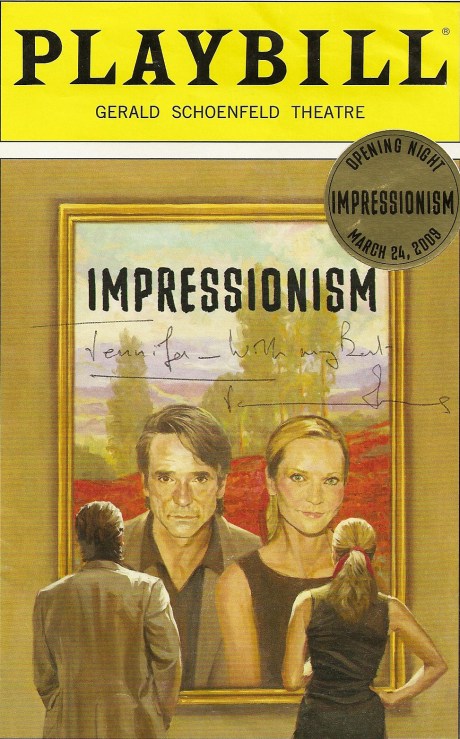
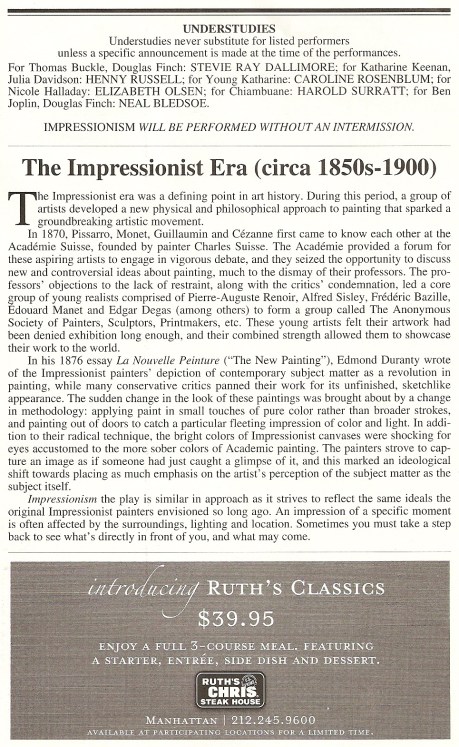
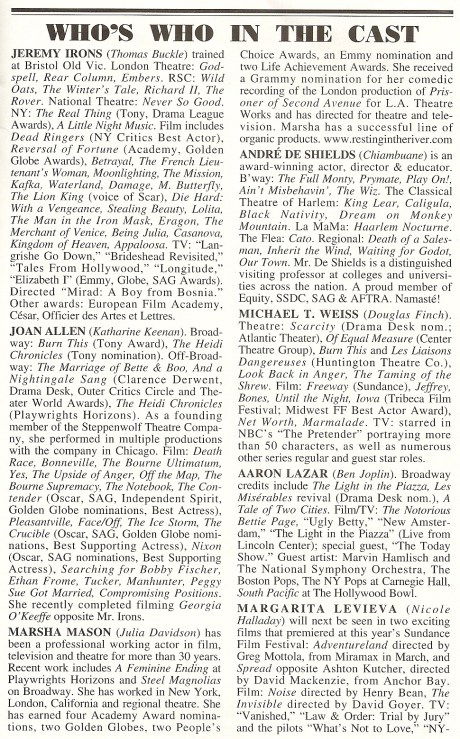
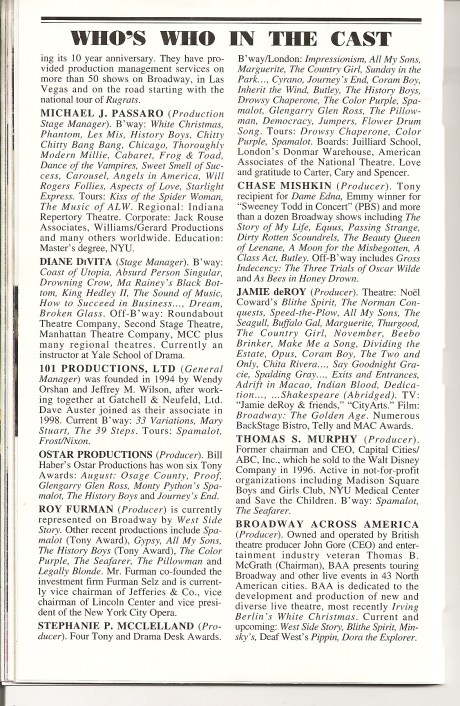
Impressionism PLAYBILL Scans

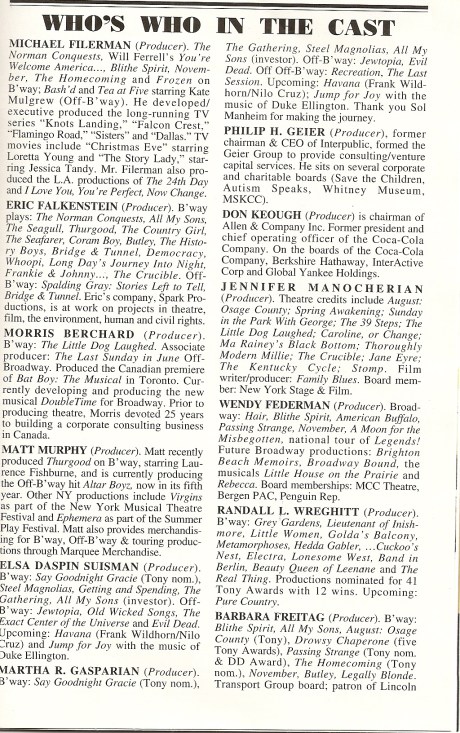
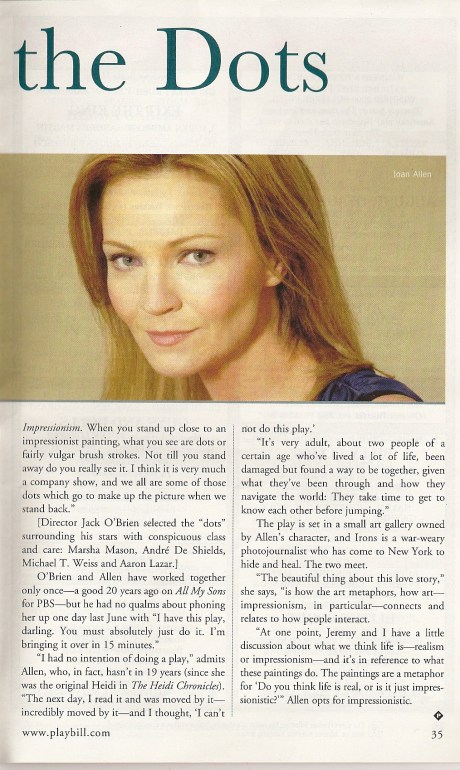
impressionismplaybillcover impressionismplaybill1 impressionismplaybill2 impressionismplaybill3 impressionismplaybill4 impressionismplaybill5 impressionismplaybill6 impressionismplaybill7 impressionismplaybill8 impressionismplaybill9 impressionismplaybill10 impressionismplaybill11 impressionismplaybill121 impressionismplaybill13 impressionismplaybill14 impressionismplaybill15 impressionismplaybill16 impressionismplaybill17

WABC speaks to Jeremy and Joan on Broadway Backstage

Follow this link to watch the video on Saturday night:
WABC speaks to Tony Award winners Jeremy Irons and Joan Allen, who are starring on Broadway in the romantic new play IMPRESSIONISM.

WABC-7 TV PRESENTS
“BROADWAY BACKSTAGE: SPRING PREVIEW”

SATURDAY, MARCH 28 at 7:30PM-8:00 PM

Hosted by WABC-7 News Anchor Lori Stokes and
Tony Award winner & ACCENT ON YOUTH star
David Hyde Pierce

Tune in to WABC on Channel 7 for a sneak peek at
Broadway’s hottest shows including:

33 VARIATIONS, ACCENT ON YOUTH, EXIT THE KING, GOD OF CARNAGE, IMPRESSIONISM, MARY STUART, THE NORMAN CONQUESTS, THE PHILANTHROPIST, WAITING FOR GODOT

Sophie Dahl sits down with Impressionism’s Jeremy Irons – from Men’s VOGUE

As Jeremy Irons glides onto Broadway, the elegant actor talks about art, Brideshead Revisited, and pushing his motorcycle to the limit. By Sophie Dahl.

Photographed by Norman Jean Roy.

Let me preface this by telling you that Jeremy Irons is a family friend and that I remember him in a childhood context: as a tree-house builder, a cricket player in the garden, and a smoky-voiced teller of stories drinking gallons of tea at the kitchen table of his house in Oxfordshire. The palpable chemistry between him and his wife—the actress Sinéad Cusack, with whom he has two sons, Sam, a photographer, and Max, an actor—was of ceaseless fascination to us all as children, further cemented by the exotic fact that he called her by a name that wasn’t her own: Janie.

Another useless fact: He owned a domestic rat, neatly christened Miss Ratty, who lived solo in a sprawling cage by the swimming pool, and who one day (immaculately, so it seemed), spawned a dozen wriggling rat babies. The mystery was answered one night by the sighting of a wild Mr. Ratty, to whom Miss Ratty was wantonly offering herself through the bars of her spinster cage.

The Wolseley, Piccadilly, is a favorite haunt of Irons’s, so much so that when I arrive at the café and say I’m meeting Irons for breakfast, I’m ushered to a quiet table in the side barroom, in case, they whisper, he brings his dog, which apparently he often does.

I see him before he sees me, out the window, flying down Piccadilly on his BMW motorbike (sans dog), all in leathers. I watch him park and cross the street, pushing his salt-and-pepper hair out of his eyes, rendering a group of women giggling and flustered as he sails past them, unaware.

“Why do you call your wife Janie?” I ask after he has spooned himself into the banquette and ordered a cappuccino.

“Because it’s the English for Sinéad,” he says, laughing at my disappointed face.

We are not here, however, to talk through my rose-tinted-spectacles childhood version of events. We are here to talk about his career, including his turn in Impressionism, the Michael Jacobs play in which Irons is starring as a photojournalist, alongside Joan Allen as a New York gallery owner, at the Gerald Schoenfeld Theatre in New York. (The show opened March 12.) Irons—who has not appeared on Broadway since Tom Stoppard’s The Real Thing in 1984—is flustered because he thought he would be getting to know Allen in rehearsals but had recently been offered the part of Alfred Stieglitz to Allen’s Georgia O’Keeffe in a Lifetime Channel biopic of the painter. “I’m slightly nervous,” Irons says, “because I was looking forward to the process of getting to know her—and getting to know the character—when we did the play, and now, of course, I will know her already.” He makes an “Oh, well” sort of face.

But this must be an occupational hazard, I counter, when you are an integral part of a small pool of prolific actors and have been working for 30-plus years. For starters, he has acted with his wife three times, including in the films Waterland and Stealing Beauty. “It’s difficult, working with someone you know that well. We had to sort of try to batten down our relationship, put it away, and create this new one.” I ask whether there was anything sexy about it. “It was, quite,” he says, smiling at the memory. “Quite.”

Irons has an impressive cast of leading ladies he’s worked with repeatedly, among them Meryl Streep, with whom he has starred in both The French Lieutenant’s Woman and The House of the Spirits, which costarred another longtime collaborator, Glenn Close. Irons and Close first appeared together on Broadway in The Real Thing, but it was with 1990’s Reversal of Fortune, in which Close played the ill-fated Sunny to Irons’s complex Claus von Bülow, that the actor won an Oscar.

Irons does not shy away from playing shadowy types. If anything, he has wholeheartedly embraced them, including the sinister Mantle twins in Dead Ringers, the fallible Dr. Stephen Fleming in Louis Malle’s Damage, and that most erudite of pedophiles, Humbert Humbert, in the 1997 remake of Lolita. Even in animation, it seems, Irons can’t help being bad: He’s just drawn that way. Take, for instance, Scar, the villainous feline in Disney’s The Lion King. Irons talks of these iffy characters with warmth and empathy, finding something redeemable in all of them.

Born on the Isle of Wight on September 19, 1948, Irons was privately educated at a boarding school in Dorset. Postschool and pre-Bristol Old Vic Theatre School, where he trained, Irons made money as a busker, singing Dylan on the pavements of London. He met Cusack during a stint in Godspell, in which he was an unlikely John the Baptist. They married in 1978, and just after this he landed the role that was to cement his place in the hearts of England’s womenfolk, as the perennially floppy-haired Charles Ryder in Granada Television’s adaptation of Evelyn Waugh’s Brideshead Revisited. I ask him whether he has seen the recent film remake.

“No. It’s a bit like being asked to go and meet one’s ex-wife’s new man,” he says with a low laugh. “Think I’ll pass on that one, but so glad she’s happy.”

The lovely thing about Irons is for all of his accolades, he’s infinitely happier praising his wife, speaking of his sons and their passions, and waxing lyrical on his membership in the Guggenheim Motorcycle Club, cofounded by Thomas Krens, the museum’s former director. (Fellow riders include Dennis Hopper and Lauren Hutton.)

“It’s always tied up with the art,” Irons explains. “We went from Los Angeles through Death Valley to an exhibition in Vegas. I love it because when you ride a bike, there’s so much danger about it that all your instincts come right to the surface, all your senses. And that’s a wonderful way to see art. So when you go to the gallery, you’re really tingling. I think art should be dangerous and uncomfortable and surprising and all those things motorcycle riding is.”

Irons collects art, mostly British and Irish oils. He has also recently restored an ancient African sculpture, but he’d like to make something clear. “It’s not just sculpture,” Irons says. “It’s magic. It was an object of reverence of a man and a woman sitting on a stool; the legs of the stool are their children. It was a bit wormy and broken, and I bought it and brought it home and did this really careful restoration on it—oiled it up and apologized to the forebears and said, Listen, it’s going to remain a revered object. And it’s terribly important, especially with anything that’s spiritual. You have to revere it.”

Equally revered—and restored—is the castle he owns in County Cork, Ireland, which he worked on for six years. “I did the castle because I was getting very bored with my film work, and I thought it was showing,” Irons says. “So I wanted to do something that galvanized me, where there was risk and danger, and so I did the castle. After that, I worked up an appetite to go back to filming. But I’m finding at the moment that the theater is all-consuming.”

He is just beginning to tell me more when something quintessentially English happens: A jocular gentleman of a certain age comes bounding up to the table and says to me, “I’m terribly sorry. I think I’ve seen you on television. Have I?”

Irons responds with deadpan timing, “You see everyone on television these days, don’t you?”

The man then does a comic double take and says, somewhat suspiciously, “You look like a film director. Are you a film director?” Irons shakes his leonine head patiently.

“I have directed, but, no, I’m not known as a film director.”

“What are you known as?” Jocular persists.

“I suppose I’m known as an actor.” Irons smiles at him. His long fingers are tapping on his coffee cup, and he has kicked me under the table.

“Easy Rider” has been edited for Style.com; the complete story appears in the April 2009 issue of Men’s Vogue.

Jeremy attends opening night of “God of Carnage” – Photos!

NEW YORK – MARCH 22: Jeremy Irons attends the opening night of ‘God of Carnage’ on Broadway at the Bernard Jacobs Theatre on March 22, 2009 in New York City.