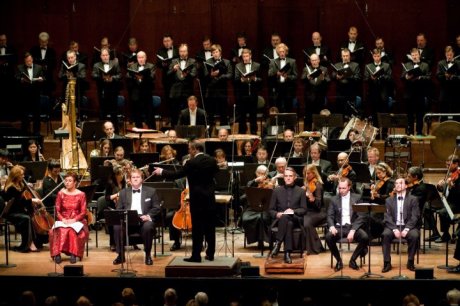
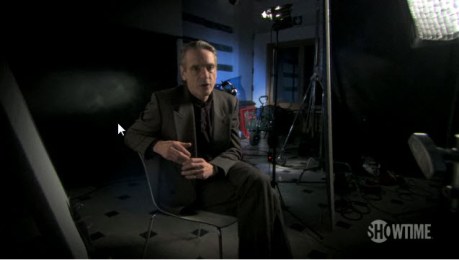
Jeremy Irons delivers a ‘sharp dramatic reading’ for the NY Philharmonic


Three More Stravinsky Faces

from ConcertoNet.com

New York
Avery Fisher Hall, Lincoln Center
04/28/2010 – & April 29, 2010
Igor Stravinsky: Zvezdolikiy (Le Roi des Etoiles or Star-Face – Violin Concerto in D – Œdipus Rex

Leonidas Kavakos (Violin), Waltraud Meier (Mezzo-Soprano), Anthony Dean Griffey, Alexander Timchenko (Tenors), Ilya Bannik, Mikhail Petrenko (Basses), Jeremy Irons (Narrator)
Chorus of the Mariinsky Theatre, Andrei Petrenko (Principal Chorus Master), New York Philharmonic Orchestra, Valery Gergiev (Conductor)

Nobody would be surprised if the Avery Fisher Hall concert stage was to collapse one of these nights. In bringing forth–like Venus from the Waves–more than a dozen Stravinsky works these weeks, Valery Gergiev has not gone easy on the forces at his command. Of course the Mariinsky Choir, the complete New York Philharmonic (which seemed to be expanded), soloists a-plenty, percussion to the rooftops, four pianos…

The audience itself has been pretty well filled as well. Probably half last night came to hear Jeremy Irons as the narrator in Œdipus, some came for the Violin Concerto. A rare few were anxious to hear the one piece of Stravinsky almost never played, Star-Face (not to be confused with Brian de Palma’s Scarface. Why did it have to wait three decades before its first performance? Why did its dedicatee, Claude Debussy, say that this “music for the planet…would be lost in the abyss if performed on earth?”

More important, why was this the first performance I can ever remember in New York?

Part is practicality. It’s only 53 measures, lasts less than seven minutes, and needs an explosively good orchestra and chorus. Partly because the words by Konstantin Balmont are, at least in English, mystical, garish, resembling a Byzantine painting from the End of the World.

Still, this was fascinating music erupting from the composer, just prior to Rite of Spring. The latter was pagan and primitive. Star-Face engenders the heavy incense and dark candles of Ivan IV’s Russian Orthodox Church. If the choral sounds are both dissonant and religious at the same time, they also resemble those rare Russian Orthodox chants prior to the 18th Century, before Russia “discovered” Europe. Those incantations too were characterized by medieval scales, by tones next to each other, edging each other out. No orchestra was used, of course, but Stravinsky’s huge orchestra here was singular, actually echoing a huge organ. Not the blurred orchestral organ of a Saint-Saëns or a Bruckner, but a cathedral organ with all the stops pulled out.

The Mariinsky chorus again proved that they have a volume and precision under Gergiev which is rare even in New York choruses, while the New York Phil themselves pulled out all the stops.

What the following “classical period” Violin Concerto lacks in musical audacity, it possesses in jollity. The opening is less toccata than circus music, the ending is pure Russian, and the middle is not very memorable, still-born slow movement.

The Greek violinist, Leonidas Kavakos, bears the name of the great Spartan king, and Mr. Kavakos himself played with laconic pleasure. One could say the reading was effortless, taking the difficult treble-stringing as easily as the jumpy end. I doubt if many soloists can give the Stravinsky much gravitas, but he tried.

Gravitas, though, was the word for Œdipus Rex. It is one of the most powerful, dramatic, emotional operas (yes, an opera!!) ever written by Stravinsky. Given a choice of Rake’s Progress or Œdipus, anybody in their right mind would prefer this gorgeous hodgepodge more than W.H. Auden’s all too perfect Rake.

Linguistically, it’s a hodgepodge. The libretto is a Latin translation of a French drama taken from an English translation of the original Greek. The narration is in English (much against Stravinsky’s original desires), and this English translation of Jean Cocteau’s French was written by none other than the poet E.E. Cummings.

As an opera, Œdipus probably has its shortcomings, since most of the characters are static. But my heavens!! Under Gergiev’s direction, with a sharp dramatic reading by Jeremy Irons, this was a work with greater dramatic sharpness than Stravinsky could ever imagine.

We listened, horrified, as Anthony Dean Griffey sung out, with an Irish tenor resonance, his oath to find the man causing the plague. In Jocasta’s aria, Stravinsky produced an aria which could have come from Trovatore, including the choral harmonies. The ending, with Mr. Irons gritting his teeth as the murderer is found, was almost shocking.

The other works last night (and tonight) are questionable, problematic. But Œdipus, like the opening night’s Noces, is amongst the most powerful stage works of the 20th Century, And Valery Gergiev gave it all the intensity it deserved.

Harry Rolnick

Jeremy Irons contributes to the RHS Tree of Knowledge

Jeremy Irons contributes to the RHS Tree of Knowledge – original article at the Royal Horticultural Society’s website

Celebs sign up to the Tree of Knowledge

Jeremy Irons, Greg Wise, Julian Fellowes and Nicki Chapman have been the first to share ideas on the RHS Tree of Knowledge.

We are calling on the nation to share ideas to support biodiversity in the garden and the 50 best ideas will feature on the Tree of Knowledge at the RHS Chelsea Flower Show.

Great ideas for our Tree of Knowledge

Actors Jeremy Irons, Greg Wise and Julian Fellowes were first to support the initiative and TV presenter Nicki Chapman has created a list of tips for people with limited spare time.

Jeremy Irons advised; “Every time you see a plant or tree you haven’t seen before, ask permission, take a cutting and put it in your garden and don’t keep your garden too tidy”.

Greg Wise wrote a poem to feature on the tree:

“Be less Tidy!
Have a corner of your life that isn’t neat…
Let things rot.
Embrace decay…
We’ll all be doing it one day.”

Greg’s own garden is a great example of supporting biodiversity. The actor says it is a relatively small space, but includes; a pond, rotting pile of logs, dead tree, compost heap, leaf-mould bin, wormery, tubes full of mason bees, water butt, nest boxes for birds, insect boxers, feeders and a hedgehog house!

Nicki Chapman said: “It’s so important we all try and make a difference regarding Biodiversity,” and provided the following tips:

  • Grow trees that complement each other (helping to cross pollinate)
  • Grow plants that would thrive in your local soil ( to attract the insects that would naturally be there)
  • Encourage Birds – by providing the right feed for ‘city birds’
  • Hedgehogs – providing meal worms rather than milk and bread
  • Sedum roofs (attracting wildlife, plus great insulation for your property)
  • Not using pesticides on the beds or strong detergents to clean the tiled and hard landscaping parts of the garden that might harm the bio-sphere

Julian Fellowes is also a keen supporter of garden biodiversity and stated: “An odd anomaly of the modern, fast-changing world, is that private gardens have become vital protection zones for a good deal of our natural wildlife… the shelter of our animals, plants and insects has really become a duty, and will hopefully soon be a tradition if it isn’t already, for British gardeners…”

Tree of Knowledge at Chelsea

The RHS Tree of Knowledge complements the Continuous Learning RHS Biodiversity Display, which will highlight the role gardens can play in slowing down the global decline of biodiversity. The RHS gardening advice team will also be nearby to help visitors with gardening, and especially wildlife gardening.

Jeremy Irons attends launch of Sli Eile Farm Project

A better way to mental health

Joan Hamilton with Jeremy Irons and Harry Gijbels at the launch of fundraising for Slí Eile farm project. Photograph: Michael Mac Sweeney/Provision

From The Irish Times 27 April 2010

by ROSE DOYLE

A decade of hard work has come to fruition for Joan Hamilton with the establishment of the Slí Eile farm project

IT’S TAKEN 10 full-on years – longer if you count the heartbreaking years of a daughter’s illness – but Joan Hamilton’s dream of a residential, farming community where people with mental health difficulties can work to rebuild their lives is about to become a reality.

A force of nature when it comes to getting things done, Hamilton is the woman behind the Slí Eile farm project, behind Villa Maria (the Slí Eile pilot venture running in Charleville, Co Cork for three years now) and behind the venture’s vision of “an Irish society which accepts people’s mental illness and confusion and supports their unique journey to recovery”.

The Slí Eile farm fund was launched last week by the project’s patron, actor Jeremy Irons. Speakers at the event included Healthplus columnist Tony Bates, Prof Ivor Browne and Carmel Fox of the Cork County Development Board.

Irons, in a heartfelt speech, spoke of everyone’s right to self-respect and a sense of worth, about the importance of mental healthcare, his belief that Slí Eile Farm was both “terribly important and made sense” and his conviction that it would succeed “because of our fantastic leader, Joan Hamilton”.

Similar farm communities in Massachusetts and Ohio have been guiding influences in the development of the Slí Eile model. There is support, too, from Jersey in the Channel Isles, where Joan Hamilton was born and lived until she met Gerry Hamilton, the Irishman she married and came to live with in the Co Cork village of Dromina more than 40 years ago.

She spoke about it on a recent sunny day at Villa Maria, where the pilot project is now providing accommodation for five tenants and one support staff. The cared-for gardens were ready to bud if not bloom, tenants were engaged in the daily schedule of work (including baking bread and scones which are supplied to the local community) and the house cat was stalking this reporter.

When did she start, and why? “I set up a lobby network group around 2000. The why had to do with a lifetime watching my daughter Geraldine’s steady deterioration in the traditional psychiatric system. Figures from the mental health inspectors show that three out of four psychiatric admissions are readmissions – soul destroying for the person as well as for her/his family. I’d been banging on doors forever and felt helpless, frustrated and that there had to be another way, a better way.” She smiles. “A Slí eile.”

The germ of the idea goes back even further. Geraldine is the third of Joan and Gerry Hamilton’s six grown children and her mental health difficulties began as a teenager in the 1980s.

“Her situation, in the traditional system, was pretty appalling at times,” her mother says with gentle understatement. “I didn’t think things could get worse, so I went public and did an interview with RTÉ Cork and that connected me to like-minded souls and that, basically, is how it started.”

In 2001, as co-founder of Cork Advocacy Network, she organised a stake-holders conference entitled Is There Another Way? in Cork city. “Vincent Browne chaired the day and more than 700 people turned up. It was a great success. From a reading of Toxic Psychiatry by Peter Breggin I’d learned about therapeutic communities, so the idea took root, but I didn’t know how to go about setting one up.

“I’d studied choice theory/reality therapy with the William Glasser Institute and what I learned came together in therapeutic community ideals of respect for one another and regaining control of lives lost. I returned to adult education in UCC, studied community development, disability studies, interpersonal communications and applied social studies. It all helped me see how others worked to bring about change and gave me real belief in the possibility that those with mental health difficulties could both recover and regain control of their lives.”

She set about the difficult task of getting funding for social housing. “Villa Maria was achieved after a series of abortive attempts due to problems caused by the stigma and attitudes to those with mental health difficulties.

“But it happened,” she smiles again, “and Villa Maria has been successfully running since 2006. The present five tenants are all growing in self-sufficiency, self-knowledge and self-worth. Everyone’s responsible for their own medication and the role of staff is to help tenants regain life skills.”

With a larger community, “something that’s going to continue long after me” in mind, she spent two weeks last year working as a volunteer at Hopewell community farm in Cleveland, Ohio.

“I saw how it was set up and how it worked. I loved the sense of calm, the reality of structures impacting on people’s lives. I saw the evidence before my eyes of lives recovered and being lived. I came back energised and enthused.”

There’s been the recent, added momentum of enthusiastic support from Gould Farm in Massachusetts too, a community which dates from 1913 and is the oldest such in the US.

Slí Eile farm will provide a supportive living environment for up to 16 people with mental health difficulties. Everyone will be involved with the daily running of the farm, which will provide housing for at least two residential staff, four volunteers, a residential events venue and farm shop. Allotments will be available to families in the area, all of which will make for social interaction and revenue.

The Slí Eile farm fund aims to raise money for the purchase of 80-100 acres as well as for staff, buildings and more.

Joan Hamilton has developed and managed her own food processing business, been involved with local tourism, small businesses and administered EU Leader funding. As executive director and founder of Slí Eile farm she projects it will break even by 2014. The projection that it will bring hope and inspiration to the area of mental health care in Ireland is a given.

The Borgias: Rattlesnake

Vodpod videos no longer available.

Share

Jeremy Irons to participate in WWII Commemoration Gala

WWII Commemoration Gala – Marking the 65th Anniversary of the End of The War in Europe

Monday 10 May 2010 – 7:30 PM

Presented by:

This dazzling gala concert, which commemorates the end of the Second World War in Europe, features a spectacular line-up of international stars and Russia’s top musical talent.

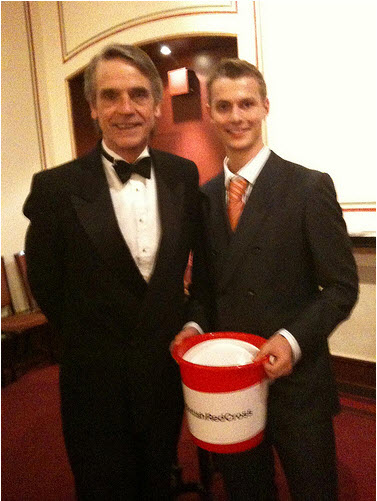
The concert will raise money for British Red Cross – the humanitarian organisation which helps people in need all over the world.

A programme of popular classics and war time favourites will transport the audience back to that long-awaited spring of 1945 when peace returned at last, set against an atmospheric backdrop of specially-created pictures and images. Alongside all the nostalgia, there will be plenty of contemporary entertainment to enjoy too, paying tribute to the Allies’ great  victory in a fusion of music and culture.

The line-up will include performances by the world-renowned Alexandrov Red Army Choir, folk-diva Nadezhda Babkina, one of the most popular singers across the former USSR Tamara Gverdsiteli, Russia’s very own Frank Sinatra – Iosif Kobzon,  rock star Alexander Marshall, the young but already acclaimed Kvatro group, the animator Ksenia Simonova (famous for creating unique installation of sand live on stage); and other very special guests. The programme will also feature performances from some of the UK’s biggest rock acts, Jethro Tull and Rick Wakeman who boast combined record sales of over 100 million, as well as ‘The People’s Tenor’ Russell Watson and actor Jeremy Irons.

This event not only marks the achievements of the Allies and their resistance movements 65 years ago, but also pays tribute to the special relationship between the British Red Cross and Russia – and to the vital role played by the Red Cross at the end of the war in helping and supporting Soviet families who had lost relatives during the fighting.

For combined concert and VIP reception tickets please contact Ensemble Productions on 0208 832 7424 or email: info@ensembleproductions.co.uk

Supported by: http://www.ensembleproductions.co.uk/events2010.html

Share

The Borgias: Power – new video clip from SHOWTIME

All video and images property of SHOWTIME.

Vodpod videos no longer available.

more about “The Borgias: Power“, posted with vodpod

Share

Irons backs Sli Eile Farm Project

Irons backing Sli Eile E-mail
Written by Christine Allen
Thursday, 15 April 2010
Multi-award winning actor Jeremy Irons will this week offer his support to the launch of a €3 million housing project for people with mental health difficulties.

Image

The plan to extend the Sli Eile Farm Project, a housing project that helps people using psychiatric services to regain independence, will be launched by the celebrity patron on Friday 23 April at 11am at the Charleville Park Hotel.According to the project’s founder, Joan Hamilton, three out of four of all admissions to psychiatric services remain re-admissions. “The experience of psychiatric breakdown affects a person on many levels,” she said. “Most of all, people say they feel vulnerable and cut off from normal relations with family, friends and the wider community.”

Breakdown

Following the first breakdown of her own daughter at the age of 16, Ms Hamilton established the organisation in 2001 to help people with mental health difficulties to have control of their lives within an accepting and supportive living environment.

//
//

“We, her family, witnessed her many admissions and steady deterioration over many years and I felt their had to be another way, that what was needed was a living environment where a person was accepted and supported in their journey to regain their place in society, to achieve whatever they want to achieve,” she said. As part of the project, residents participate in weekly rotas, with each tenant paying just €60 weekly for everyday costs of shopping, heating and maintenance.

Future

The founder said that the Slí Eile project is now ready to expand and proposes to establish a community farm of 80 to120 acres under the National Mental Health Policy Document Vision for Change.

“It will provide a supportive living environment for 16 people who are experiencing mental health difficulties and the tenants will participate in the daily tasks of community farm life which will provide a structure that offers support for people working to regain control of their lives,” said Ms Hamilton.

She told the Cork Independent that the private project would be relying on donations but had benefited from the high profile of Jeremy Irons. “He has a house in West Cork and we were delighted that he accepted our offer to come onboard last January,” she said.

Share

SHOWTIME First Look at The Borgias – Screencaps

[All video and images property of SHOWTIME. No copyright infringement intended.]

Vodpod videos no longer available.

Share

The Reunion: Brideshead Revisited

Listen to the Brideshead Revisited Reunion radio programme – now on BBC iPlayer!

Share

Jeremy Irons to narrate NY Philharmonic event!

Full details on Jeremy’s appearances with the New York Philharmonic

CONCERT DESCRIPTIONS/DATES:

Wednesday, April 28, 2010, at 7:30 p.m., and Thursday, April 29, at 7:30 p.m.

The second program, on Friday, April 30, 2010, at 8:00 p.m., and Saturday, May 1, at 8:00 p.m.

Avery Fisher Hall
10 Lincoln Center Plaza, New York, NY 10023
(212) 875-5656

Valery Gergiev, Conductor
Jeremy Irons, Narrator
Waltraud Meier, Mezzo-Soprano (Jocasta)
Anthony Dean Griffey, Tenor (Oedipus)
Mikhail Petrenko, Bass (Tieresias)
Alexie Tanovitski, Bass (Creon)
Alexander Timchenko, Tenor (A Shepherd)
Mariinsky Theatre Chorus

STRAVINSKY: Orpheus
STRAVINSKY: Oedipus Rex

World-renowned Valery Gergiev, arguably the most exciting interpreter of Stravinsky’s music, leads this all-Stravinsky program.

This evening’s concert features the stories of two great myths: Orpheus, a lush and highly descriptive score portraying a distraught musician who seeks his beloved Eurydice in the underworld; and Oedipus Rex, a powerful opera-oratorio which utilizes vocal soloists, a large chorus and orchestra.

Actor Jeremy Irons will be the narrator for Oedipus Rex!