Jeremy Irons has brief appearances in two of the special features clips on the DVD of Appaloosa. He is in the “Bringing the Characters of Appaloosa to Life” and “Historic Accuracy of Appaloosa” featurettes. He is also featured in the deleted scene “Town Hall Meeting.”
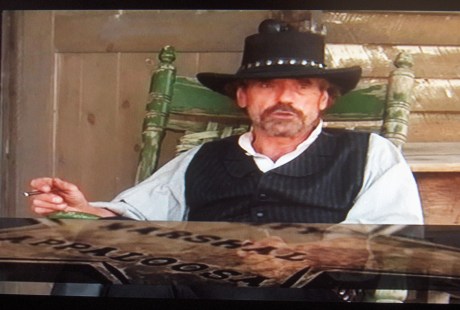

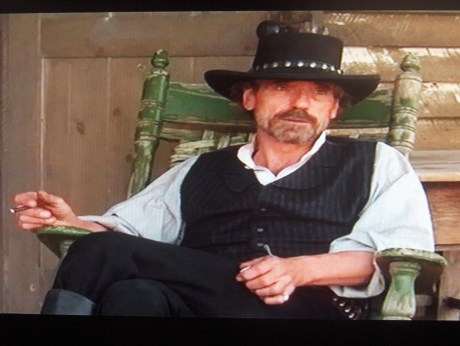
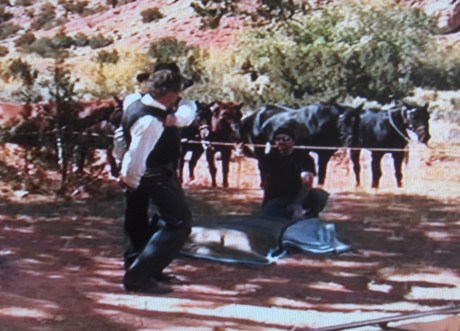
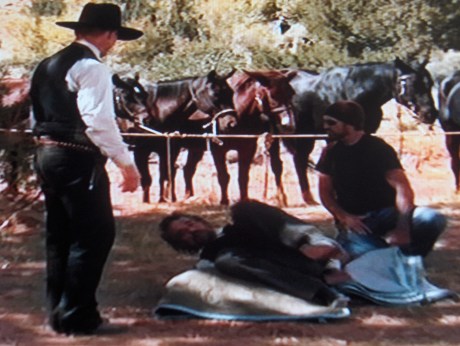

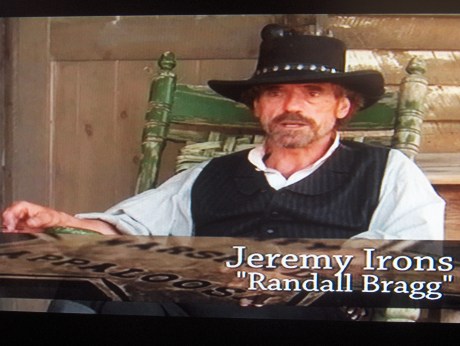
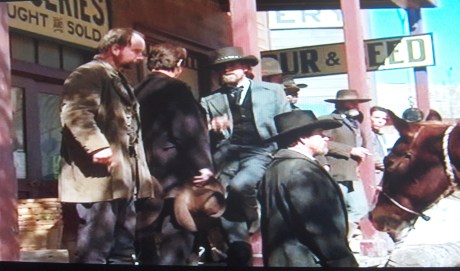


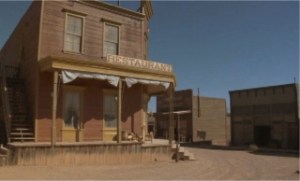
Appaloosa special features screen-caps
Jeremy Irons attends wife Sinead’s opening night performance of The Cherry Orchard
The Cherry Orchard, has a new, streetwise, adaptation by Tom Stoppard, directed by Sam Mendes (husband of Kate Winslet, who attending the opening) at the Brooklyn Academy of Music.
It’s the first Bridge Project effort, a UK (Old Vic)/US (BAM) intermingling of splendid actors and repertory, a caravan of itinerant talents and projects (Next up: Winter’s Tale).
Sinead Cusack (another famous spouse–Jeremy Irons was sitting just a few rows away from Kate Winslet) is Madame Ranevskaya, the spend thrifty lady whose orchard is being sold off for debts.
Read more at: http://www.huffingtonpost.com/patricia-zohn/culture-zohn-the-cherry-o_b_158239.html


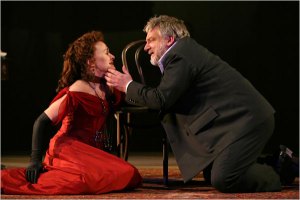


First seven photos taken by Sara Krulwich/The New York Times
Read the New York Times review of The Cherry Orchard opening:
http://theater2.nytimes.com/2009/01/16/theater/reviews/16orch.html
Appaloosa now on DVD
Appaloosa

New Line // R // January 13, 2009
List Price: $28.98
Review by Randy Miller III from http://www.dvdtalk.com
Ed Harris’ Appaloosa [2008] continues the trend nicely: based on Robert Parker’s 2005 novel of the same name, this tale of shotguns, survival and sacrifice serves up familiar Western elements with respect and admiration. Within the genre’s confines, Appaloosa plays is relatively straight: the bad guys are bad, and the good guys…well, they simply do what it takes to get the job done. Our heroes are Virgil Cole (Harris) and Everett Hitch (Viggo Mortensen), two partners who have worked together for an unspecified number of years. The bottom line is that they’re very good at what they do: keeping the peace, even if it means creating their own laws to do it. Peace is just what the southwest town of Appaloosa needs, especially after a marshal and two deputies turn up missing. Cole and Hitch are quickly hired by the desperate town leaders, who agree to their terms and practically sign over collective authority in a matter of minutes. The suspected murderer is Randall Bragg (Jeremy Irons), a nearby rancher with a substantial following and a history of stirring up trouble. Cole’s situation is complicated further by the arrival of Miss French (Renee Zellweger); he’s quickly attracted to the mysterious woman, but a normal relationship would prove difficult in such dangerous times. Appaloosa’s listed running time is 115 minutes, but this slow-burning tale feels much longer.
The story’s somewhat unconventional format—thanks in part to an abrupt change in direction roughly halfway through—often leads to a more episodic feel, but that’s hardly a complaint. Harris’ capable direction keeps things flowing quite nicely, while Dean Semler’s excellent cinematography ensures that plenty of terrific sights will be seen along the way. A strong emphasis on detail and accuracy, from costume design to weaponry, ensures that Harris’ adaptation is anchored squarely in a 19th century atmosphere. Simply put, Appaloosa follows more Western traditions than most other recent genre efforts, strictly favoring reverence over revision. Even so, a few key elements prevent Appaloosa from reaching greater heights. Little to no background information is given for several major characters; this may actually be favorable to some viewers, but the one-dimensional nature of Bragg feels more predictable than it ought to. Miss French’s arrival and subsequent role is also a bit confusing: it’s tough to believe that a man as dedicated as Cole would pursue a relationship during such unfavorable times. Instead of creating an easy target for Bragg’s henchmen to aim for, perhaps Cole should’ve completed his job before chasing after a personal life. Luckily, the performances of Bragg and Zellweger are strong enough to hide some of these glaring faults, but such elements create a more convenient story than what audiences actually deserve. Even so, Appaloosa does much more right than wrong: it still shines brightly as a strong period piece and a genuinely rousing adventure.
Presented on DVD by New Line Home Entertainment, Appaloosa arrives in near-record time after a short theatrical run. There’s good and bad news here, but this one-disc package should still please most fans of the film. Boasting a decent technical presentation and a handful of low-key but appropriate bonus features, it’s a strong package that defies the film’s modest box-office receipts. Simply put, those even mildly interested in the film should consider Appaloosa a worthy effort on DVD. Let’s take a closer look, shall we?
Quality Control Department
Video & Audio Quality
Presented in its original 2.35:1 aspect ratio and enhanced for 16×9 displays (NOTE: a pan-and-scan version is also included on the same side), Appaloosa looks very good from start to finish. The inclusion of both versions on this dual-layer disc leads to a few mild compression artifacts along the way, though other digital problems are kept to a minimum. The film’s muted, dry color palette has been preserved nicely, black levels are typically solid and image detail is generally consistent. Fans shouldn’t find too much to complain about overall, though New Line’s continued support of pan-and-scan is quite irritating. In the audio department, Appaloosa hardly disappoints as well. The Dolby Digital 5.1 Surround mix does its job perfectly; though dialogue carries most of the film, atmospheric effects and occasional bursts of action fill the rear channels nicely. The dynamic range is also excellent, while music and other sounds rarely fight for attention. English captions and Spanish subtitles have been included during the main feature only.

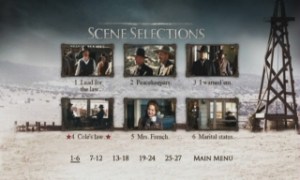
Menu Design, Presentation & Packaging
Seen above, the plain-wrap menu designs are basic and easy to navigate. The 115-minute main feature has been divided into 27 chapters, while no obvious layer change was detected during playback. This one-disc release is housed in a standard black keepcase and includes a Digital Copy promotional insert. The digital copy can only be played in Windows Media format. It is not compatible with Macintosh computers or iPods, unfortunately.
Bonus Features Leading things off is a feature-length Audio Commentary with director Ed Harris and screenwriter/producer Robert Knott; as expected, Harris does most of the talking. In fact, those who don’t hang on every word may not even be aware that Knott is present, though he adds an interesting dynamic during his brief spurts of participation. Harris is quite low-key himself, mainly limiting his comments to general production stories and pointing out some of the lesser-seen supporting characters. Overall, fans will find this commentary worth a listen, but it’s nothing to write home about.
Up next are four brief Behind-the-Scenes Featurettes, beginning with “Bringing the Characters of Appaloosa to Life” (7:33, below left). This light but entertaining segment features key members of the cast and crew (some in costume, even) briefly detailing their experiences on set. “Historic Accuracy of Appaloosa” (10:21) focuses on the costumes, weaponry, production design and overall attention to detail, while “The Town of Appaloosa” (5:08, below right) provides a quick tour of several key locations. Also here is “Dean Semler’s Return to the Western” (5:17), in which the famed cinematographer discusses his attraction to the film and shares a few techniques along the way.


Last but not least is a collection of Deleted Scenes (6 clips, 12:03 total), many of which were hinted at during the audio commentary. Most of these are minor character moments and were wisely trimmed from the theatrical cut, though they’re certainly worth a look. These scenes are also available with commentary by Harris and Knott; the former hints about their inclusion in a possible Director’s Cut of Appaloosa, which would probably be a step in the wrong direction. As a footnote, also included (but not advertised on the outer packaging) is a Digital Copy of the film…or at least a code for owners to download it manually. All bonus features are presented in non-anamorphic widescreen and 1.33:1 format, while no optional subtitles or captions have been included. It’s not a bad little spread of extras overall, though nothing really stands far above typical DVD fare.

It’s not every day that you get to fondle Jeremy Irons’s signed shoe


Eat your heart out Imelda Marcos
from http://www.torontoist.com
It’s not every day that you get to fondle Jeremy Irons’s signed shoe. Or sniff one of the sneakers that Michael Cera wore when he recorded some of the songs for Juno. But Thursday was Torontoist’s lucky day, and we got to gawk at the footwear of the rich and Torontofamous.
Yeah, yeah, we know: how trifling can one assignment get? Well, rest assured, concerned readers: our seemingly inane excursion was a little more legit than we let on. In truth, these shoes—once belonging to local “celebs” of both actual and purported renown—were put on display at Ron White’s flagship store in the Manulife Centre, signalling the advent of the Canadian shoe retailer’s thirteenth annual Shoe Drive For the Homeless.
The concept of the shoe drive is pretty simple: you bring in your old shoes to any Ron White location, and they’ll clean up your scruffy kicks and pass them along to those who really need them. (And a few household names attend the kick-off and pose awkwardly with their signed, slightly scuffed shoes.)
“When you’re in the shoe business, you look at people’s feet as much as you look at their face,” says the namesake and CEO of Ron White. So, thirteen years ago, when White saw too many feet clad in insufficient winter footwear (“I was walking up Yonge St. and I saw a homeless man with his toes hanging out of his boots—literally”), he started encouraging his clients to bring in their old boots when they bought new ones. Fast-forward a few years, and a few of White’s more “notable” friends decided to lend their names—and used shoes—to promote the campaign.
“It’s about ten years ago that I asked for some support from two of my clients—Jeanne Beker and Dini Petty,” says White. “Since then we’ve had support from so many talented people—Kurt Browning, Brian Orser, Chantal Kreviazuk… even Tom Cochrane.” This year’s “supporters” include Olympic medallist and champion kayaker Adam van Koeverden (pictured above, at left, with White, who donated the shoes he wore on the podium), singer Suzie McNeil (who donated the red boots she wore when she sang at the Grey Cup), and designer David Dixon (who, perhaps, didn’t get the “winter shoe/boot” memo, but nevertheless donated a pair of signed, strappy, hot pink stilettos of his own design).
So, short story even shorter: if Adam Van Koeverden can part with the shoes he wore as flag bearer during the ’08 Olympics, surely you can part with a pair or two, too. Right?
Photos by David Topping/Torontoist.
Photos of Jeremy at the Santa Fe Film Festival
Thanks to Gabriella Marks of www.triggerfinger.com for these photos of Jeremy Irons and Joan Allen at the Santa Fe Film Festival at the Annual Milagro Awards Ceremony on Saturday December 6th at 4:30 pm at the Scottish Rite Temple.
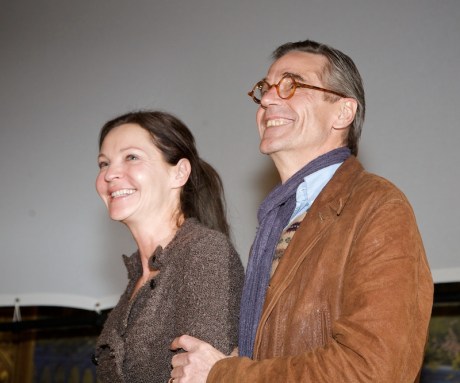


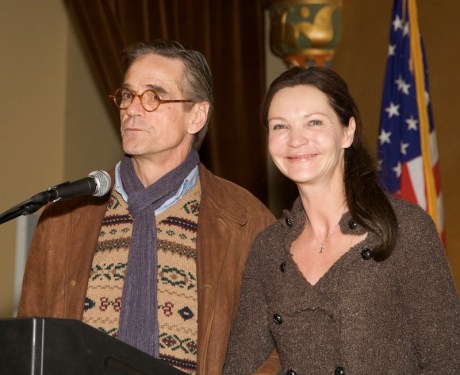
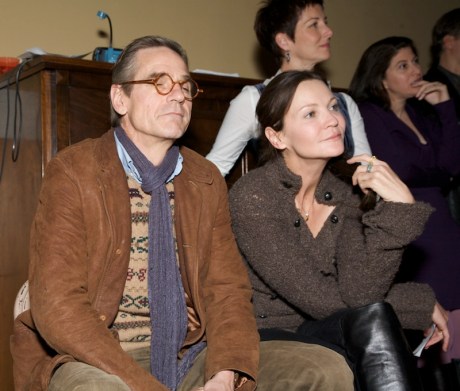
all images copyright Gabriella Marks 2008
used with permission
Jeremy Irons is guest of honor at Eurasia film festival
Jeremy Irons was the guest of honor at the Eurasia Film Festival in Kazakhstan in September 2008. Jeremy flew to Kazakhstan right after appearing at the Toronto Film Festival where “Appaloosa” premiered.

from guardian.co.uk
Monday 15 September 2008
After Borat: what the Kazak film industry did next
The Eurasia film festival is designed to showcase Kazakhstan’s modernity, prosperity and thriving cinema scene. Paul MacInnes made the trip to the Palace of Peace and Consent – and found himself watching an unsubtitled film about sick sheep.
It was perhaps the longest red carpet in the world. Trailing all the way from the street to the portico of a giant glass pyramid, the roll must have stretched for more than 400m. To amble down it proved a challenge that was half catwalk, half workout. For the uninitiated the carpet might even have seemed a touch grandiose, but not here. For this was the Eurasia film festival, a celebration of cinema held annually in Kazakhstan and, to be fair, they do things differently there.
During my stay in Astana, the country’s new capital and venue for the festival, I did not see one mankini. There were no best prostitute competitions, no horses and carts, no faded images of Pamela Anderson but, yes, there was a large sparkling synagogue right in the centre of town. In other words, there was not much Borat about the Kazakhstan I saw. That’s not to say, however, that it wasn’t thoroughly weird in its own way.
Take the opening gala. It was staged in a pyramid designed by Norman Foster, its official title the Palace of Peace and Consent. It is home to an opera hall, a non-denominational religious space and any number of photos of President Nursultan Nazarbayev, the beloved leader of 19 years and a man only faintly acquainted with the rigours of the democratic process. Inside, a crowd of VIPs in shiny suits and gowns sipped Johnny Walker and Georgian wines. Outside, lines of locals cheered on Uzbek movie producers, Kyrgyz directors and the odd British journalist (it’s fair to say I worked the crowd like a pro), all the while being almost entirely unaware of who anybody was.
It was at President Nazarbayev’s personal request (or at least that’s how it’s described) that the film festival was moved from its traditional home, the southern city of Almaty, to Astana, an oligarchic equivalent of Las Vegas built slap-bang in the middle of the steppe where nothing is more than 10 years old. That applies to grandiose buildings such as the Palace or the 97m tall Tree of Life, Kazakhstan’s answer to the Eiffel tower. But it also applies to everything else about the city, including its cultural and artistic scene.
So while the crowds gathered to welcome Timur Bekmambetov, director of Night Watch and Wanted and perhaps the most famous Kazakh after Borat, they didn’t follow up by attending the festival itself. And this despite (or perhaps because of) a late change in the festival’s raison d’etre which saw it dump an international competition in favour of concentrating solely on central Asian cinema.
There is a rich tradition of movie-making in this region. Its golden age came at the height of the Soviet era when directors such as the Kyrgyz Tolomush Okeev or Uzbekistan’s Ali Khamraev were first trained at the VGIK school in Moscow, funded by groups like Soviet TV, and allowed to flourish. Like so much else though, when the USSR collapsed so did the entire system by which films were made. Industries across the former Soviet republics shrank and cinema was no exception. It is only in recent years that it has even begun to recover.
So it was with great excitement that the Eurasia film festival was able to open with a gala screening of Tulpan, a Kazakh movie that claimed the Un Certain Regard prize at Cannes this year. It was an excitement only marginally dimmed when, in front of an international audience in the Palace, the film played with absolutely no subtitles whatsoever. Most guests chose to persist with the movie all the same and, uncomprehending though they were, left touched by cinematography that brought out the bleak beauty of the Kazakh landscape not to mention the dramatic birthing of a little black lamb. Conversations about what the hell the thing was about, however, were entertaining to hear.
Controversy over Subtitle-gate continued into the next day as westerners berated officials for their failure, ascribed by organisers to a wonky cable. But while subtitles might matter to guest critics it didn’t explain the absence of Kazakhs themselves at the festival.
Some of it might be to do with money. While Forbes lists Kazakhstan as being home to six billionaires (two of whom are Nazarbaev’s daughter and her husband), GDP per capita remains at about $11,000 (compared with $35,000 in the UK). For all the luxurious mega malls, there are very few people who are well off enough to shop in them.
It might not just be for reasons fiscal that punters stayed away from the film festival though. Central Asian cinema has a compelling back catalogue and a crop of talented directors. But these directors struggle to get their films seen. Try, if you can, to spot a copy of Chouga, the latest film by Kazakhstan’s most celebrated director Darezhan Omirbaev – you’ll struggle.
What you will find on the screen at the Eurasia film festival, however, as well as in competition, are films such as Uzbekistan’s The Others, a huge hit domestically, but 90 minutes of sub-soap that make you wish for broken subtitles so you could at least invent your own plot. (Actually, the subtitles were probably the most interesting thing about this tale of rich girl meets poor boy, seemingly crafted by an Uzbek recently relocated to Brooklyn: “You’re two douche bags!” “Give it here! Now jet!” “You wear your heart on your sleep!”).
If you’re not trapped in the class struggle of Tashkent it’s difficult to see how a film like The Others could possibly appeal and a less than half-full auditorium seemed to support such an assertion.
“The biggest problem for central Asian cinema is that there is no development,” says Jean Philippe Tessé of Cahiers du Cinema, a man familiar with the world’s more obscure film festivals. “Someone will make a film like The Others, but will have no idea of what is wrong with it. There is no system to help them improve and no one willing to tell them that what they are doing is bad! My belief is that the organisers of the Eurasia film festival would be better off spending their money on that, rather than trying to attract stars to the festival. I mean, Steven Seagal in Almaty… it just seemed a little out of place.”
That said, there was no shortage of good cinema at the festival; a retrospective of the Kazakh new wave (which took place 25 years after the French one, Jean Paul Belmondo replaced with rock star Viktor Tsoi) was enlightening and the out of competition screenings were lively and varied.
Neither was there a shortage of cineastes. One of the festival’s Guest Service volunteers, Regina Shepetya flew up from Almaty and spent the next two nights getting what sleep she could on airport benches as she waited to greet visitors. She did so because she is a film student who wants to get into the business. But also, she loves cinema and loves to talk about it too.
Jeremy Irons at Eurasia 2008 Jeremy Irons was guest of honour
“Paul, do you like the films of Peter Greenaway?” she would ask and wait patiently as I tried to summon up a half-way intelligent opinion on The Cook, the Thief, His Wife and Her Lover. Most of the time she carried with her a thick tome The 1001 Greatest Films. Her plan was to discuss the Lion King with guest Jeremy Irons. If it happened, it might well have been the most considered conversation on the subject he had ever had.
* guardian.co.uk © Guardian News and Media Limited 2009
-

-

-

-

-

-

-

-

-

 jeremyirons.net
- Jeremy Irons Speaks About Rembrandt’s Lion
- Jeremy Irons at the Mayor of Kensington and Chelsea’s Christmas Carol Concert
- Jeremy Irons Interviewed by Brendan O’Connor
- Jeremy Irons Breaks Down His Most Iconic Characters for GQ
- Jeremy Irons to Play Villain Opposite Henry Cavill in “Highlander” Amazon MGM Remake
- Jeremy Irons’s Walk of Fame – The New Yorker
- Jeremy Irons Joins the Cast of AppleTV’s ‘The Morning Show’
- Jeremy Irons to Star in Neil Jordan’s ‘The Well of Saint Nobody’
- Jeremy Irons and Glenn Close to Star in ‘Encore’
- Jeremy Irons LIVE at The Hollywood Bowl for The Lion King 30
 jeremyirons.net
You must be logged in to post a comment.