Jeremy Irons calls for owners of abandoned buildings to be prosecuted

Jeremy Irons has called for owners of abandoned buildings to be prosecuted for vandalism to British heritage.
Jeremy Irons calls for owners of abandoned buildings to be prosecuted

Jeremy Irons calls for owners of abandoned buildings to be prosecuted Photo: GETTY

The actor has given his backing to a campaign group which seeks to protect old pubs and hotels in west Dorset.

One of the properties is the long derelict Three Cups Hotel, a Grade II-listed Georgian building in Lyme Regis, Dorset, which featured in the film The French Lieutenant’s Woman. The film has a shot of Irons looking out of the first floor bow window of the hotel.

In a message to the campaign group, Irons said: “It seems to me that owners leaving a building abandoned for a long period of time, when that building is part of the local community, should be prosecuted for vandalism to our built heritage.

“I cannot believe that the local authorities do not have the power of compulsory purchase in such a case and I hope they may be prompted into using such power on behalf of the people of Lyme Regis and all of us who value our irreplaceable architectural heritage.”

JRR Tolkein stayed at the Three Cups on several occasions and he wrote part of TheLord of the Rings in the hotel. GK Chesterton was also a guest at the hotel which has been unoccupied for nearly 20 years.

John Grantham, the leader of the campaign group, Community Alert on Pubs, said he approached Irons for support and was surprised to receive a reply.

Mr Grantham said the hotel was suffering from general decay.

He said: “Clearly many pubs these days need to close because of low customer demand in places, but where you have an iconic hotel in the centre of a town with great heritage they should surely be very well preserved and used if possible.

“One suggestion from the Lyme Regis Development Trust is that the Three Cups could become a Jurassic study centre, attracting visitors from all over the country and the world. It is currently a blot on the town and there is a substantial loss of income to the town from the building being unused.”

The Three Cups is owned by the brewers JC and RH Palmer who said they had been unable to do anything with the building until the area behind it had been stabilized, following some land slippage.

This had now been done as part of the Lyme Regis coastal protection scheme.

Palmers said it was unable to proceed further, however, in the current economic climate.

Daryl Turner, who represents Lyme Regis on West Dorset district council, said: “I have raised the question of compulsory purchase (of the hotel) on several occasions. But there is a limited budget for this type of action.”

Vulture Visits Jeremy Irons’s Impressionism Dressing Room

Vulture Visits Jeremy Irons’s Impressionism Dressing Room
4/8/09 at 5:15 PM

dressingroom1 dressingroom2 dressingroom4 dressingroom6 dressingtable

Photo: Wendy Goodman

Last week, the legendary Jeremy Irons invited us into his dressing room at Broadway’s Schoenfeld Theatre, where he’s currently starring in Impressionism with Joan Allen. His current backstage alcove is the exact same one he had in 1984 when he starred with Glenn Close in The Real Thing, for which he won a Tony. He spoke with us about the room’s paint job (tomato red) and its other previous occupants, and what he does in between performances.

Can you tell us about your history with this dressing room?
Well, this is the room I had 25 years ago with The Real Thing, and that is the door that I met, I mean everybody. The door would open and there would be Paul Newman, or Bette Davis. My autograph book [takes it out and shows it to us] has all their signatures. There we are — Rosemary Harris, Louis Malle, Candice Bergen, January 5, 1984. There we are.

How was the room when you had it in 1984?
It wasn’t this color. This is the color I asked them to paint it this time, because when I came back it had been turned into an office. And I said, “Do you need that office?” And they said they didn’t need it, and I said, “Well, could I have it back as my dressing room?” So they took all the cupboards and the shelves out, put it back as it was, and painted it this color, which I think is a nice warm color, and gave me a couch that I can sleep on, and a table.

Can you tell us about that painting? That I borrowed from a friend, although it is actually a painting of my castle in Ireland. She was given it by someone else, and she wasn’t hanging it so I said, “Well, I’ll put it in my dressing room.” So that’s why that is there, to remind me of home.

Do you stay here between the matinee and evening performances?
I often do. I often do my fan mail, have a sleep, have a bit of a read. I nip out and have something to eat, but I usually do stay here.

What’s the most important thing about a dressing room for you?
What I love is that I can open that door and everybody going up to their dressing rooms, or coming down, I can talk to, I see on the stairs, so I am not cut off. I am really in the middle of things, I love that. I have a window, I can see the street. I like that. It is not too big. It is just big enough, because I like boat-sized things, and it is a good size in that way. And I have a shower and a loo, which is all you need. I have a window that opens so that I can keep it cool. It just has a nice feel and it also has a memory. Amazing people have been here. One of the original occupants of this dressing room, someone was telling me the other day, a producer who had worked with her … not Bette Davis … Who was it who said, “Is that a gun in your pocket or are you excited to see me?”

Mae West!
Mae West! Mae West had this dressing room! Which was fantastic, and a lot of great people had this dressing room. There is a great spirit in here, and I love that sort of feeling of continuity.

Photo: Wendy Goodman
By: Wendy Goodman

Jeremy Irons refuses to engage with us – from W Magazine

blog_irons.jpgAfter a 24-year hiatus, Jeremy Irons has brought his poetic, weather-beaten face back to Broadway in Michael Jacobs’ new play, Impressionism. The actor shares the stage with Joan Allen, playing a photographer dealing with his fractured, emotionally stunted past while looking really handsome. Mr. Irons, who has inhabited both Franz Kafka and Scar from The Lion King with very little apparent effort, is obviously a serious minded individual, so perhaps we should have realized that he wouldn’t respond to our (admittedly silly) questions with witticisms of his own. Still, it’s not everyday you can get love advice from Mr. Irons, so here goes:

What about Impressionism lured you back to Broadway after such a long absence? Is it because you enjoy dressing up as an international photojournalist and wearing dashing scarves?
No, it wasn’t the clothes. Most of them are mine anyway. But a new play is always a challenge, and one that deals with adult love and the barriers we put up to protect ourselves seemed a good subject.

In Impressionism, you play a mincing English man bowled over by a strident American woman. Why do you think there are so many plays, movies and sitcoms about that particular dynamic?
So many of us who have been damaged by romantic or parental love put up a barrier, lest we be hurt one more time. Thomas, a damaged man himself, recognizes the gentle heart beating within the strident exterior of this particular lady, and patiently waits while he gets her trust, before exposing his feelings for her.

When American women happen to be strident, is it better for her male counterpart to be diabolical or mincing (as you have played both)?
I think cities are, paradoxically, a difficult place to find a partner. Stridency is a manner many people find they are compelled to adopt, just to survive in the rat race. But patient, careful love will eventually triumph.

You have been in a lot of period mini-series. Do you miss them? Do you feel as if you have a particularly period face?
I suspect I have a face that will play any period. There are so many great stories that need more than a feature’s length to play themselves out, and many of those are set in the past. These are ideally suited to the mini series. One of the sad effects of having so many television channels is that the advertising revenue is now spread so thinly amongst them all that it becomes harder for any one channel to afford the investment required to make a series such as Brideshead anymore.

What could I, and all of us, do, to revive the age of the period mini-series? Must we protest?
I don’t know how we can alter perceived market forces except by as many of us as possible watching the good work when it is aired. Perhaps the most effective method of encouraging these shows is to support public broadcasting channels such as PBS and cable networks such as H.B.O.

See? We told you.

Irons’ good Impression – from IrishCentral.com

Irons’ good Impression

Oscar winning actor Jeremy Irons and Tony award winning director Jack O’Brien talk to IrishCentral about their Irish backgrounds and working together on Broadway in the new play “Impressionism”


Oscar winner Jeremy Irons’ voice, which is famously rich and resonant, is known to every child in America who’s grown up in the past 15 years as the shake-in-your-shoes voice of Scar, in Disney’s “The Lion King”

But Irons, 60, is more famous for his grown up portraits in classic series like “Brideshead Revisited” and his unforgettable Oscar winning turn in “Reversal of Fortune,” where he portrayed Claus Von Bulow, the man eventually acquitted of his society heiress wife’s murder. (Sunny von Bulow lived almost 28 years in a persistent vegetative state until her death in a New York nursing home on December 6, 2008).

These days, between the acting stints that he says in recent years had lost a lot of their appeal, Irons has worked on the restoration of Kilcoe Castle, his 15th century castle in Cork, on which he has reportedly spent a million pounds bringing up to shape. If that wasn’t enough he then decided to paint the entire building an eye-catching pale pink, which has made it a must see curiosity on the local tourist trail.

“I’ve never told anybody how it cost to restore but it was a fair amount. That was a great project,” Irons told IrishCentral.com.

“I got to a stage where I was getting a little bored with the work I was doing in movies. I wanted something that scared the pants off me basically and I looked at the castle which I knew to be a ruin. I thought someone should really do it up.”

The castle, which was built in 1450 by the Irish McCarthy clan, was sacked by the British Army in 1603, so there was a certain irony in an Englishman and his Irish wife taking it upon themselves to restore a colonial spoil to its former glory. The Celtic Tiger economy suggested to Irons that someone would probably get there before him, so he decided to start the project before someone else did.

“I restored both the interior and the exterior. The structure itself was still basically sound, but the top had been knocked off and all the carved stone windows had either been knocked out or ground down by the wind,” he says.

“All the woodwork was gone –- the way castles are built means that alternate floors are wood. We had a basic skeleton to go on and we worked from the outside, put a lid on it, plumbed it for water, heating and electricity and made it good. It was a big job,” he says laughing.

As for the irony of doing it in the first place he says, “It seemed right.”

Irons is one half Irish, which he can now say with complete conviction, having taken the trouble to research his ancestors. To his great surprise, it turned out that many of them had lived and died very near the castle itself.

“My ancestors came to the north in the linen industry and then eventually came south to Innishannon in Co. Cork, near to where my castle is situated. One of them married a Cork girl. That was the main connection,” he says.

“It’s fascinating to me because Innishannon is a place I come into on my way through Skibbereen to Cork and my ancestors grew their flax there, which they sent to the mills in Skibbereen. It’s a very close geographical connection to where I feel very instinctively at home now.”

To express his affinity for all things Irish, on St. Patrick’s Day Irons wore a green carnation on stage in his new play Impressionism, currently playing on Broadway. A homage to both St. Patrick and his fellow Irishman Oscar Wilde, it delighted the audience and the actors on stage.

“It amused me and a few other people, and I think it’s nice to mark an occasion when we can. I didn’t parade and I didn’t drink –- well, not more than normal –- so it’s nice to remember that day when you’re away from home.”

Long before he had even visited Ireland Irons found himself attracted to its music and literature. Soon he became aware of formidable Irish women, too.

“Years before I met Sinead I thought to myself, you know with my blood and my background I really need some Celt. I really need an Irish wife. My friend at school had married a red headed Irish girl and I remember thinking that’s a very sensible thing to do.

“I was thrilled when I had the chance to marry Sinead,” he adds. “It also brought me into the fold of her Irish acting dynasty. For me Ireland and the Irish have allowed me to focus on my wildness, on my romanticness, that is what Ireland is, it’s the way I see it. It’s less buttoned down than what I’ve come from. Think of its great literary tradition and its musical tradition.”

In Impressionism, in which he stars alongside actress Joan Allen (best know for her roles in the Bourne Identity movies) Irons gives a generally admired performance in a difficult, underwritten new play. But taking a chance on a new script makes his job interesting, a risk worth taking, he says.

“Basically you’re looking to pay the bills, but you’re also looking to find interesting characters to play. I’ve been gravitating toward new plays that I find interesting to see whether they work,” he says.

“After this I shall be filming in the autumn. I’ll always keep those balls rolling. I started off in the theater, although I spent 20 years in the middle of my career hardly doing anything at all. But new plays always up the stakes for an actor.”

Director Jack O’Brien, who has won three Tony Awards since 2000 for “Hairspray,” “Henry IV” and “The Coast of Utopia” (starring Brian F. O’Byrne) first came to prominence in San Diego where he worked as artistic director at the Old Globe Theatre.

“My own family has Kilgannons on one side and O’Brien’s on the other,” says O’Brien. “My father was born in Jackson, Michigan and I grew up there.

“But I recently uncovered my own Cork connections. I’m guided by Edna O’Brien, the Queen of Ireland. God knows I’m Irish, though –- I don’t shut my mouth. I like to have fun and I’m terribly funny in the way that the Irish are funny, and I can’t really stop it or help it or apologize for it.”

Working with Irons on “Impressionism,” which the critics roundly slated, shows both the challenges and shortcomings of untested new work. But O’Brien is philosophical and delighted he had the opportunity to work with Irons.

“He’s another crazy Irishman. I knew Sinead first and so he was disposed to like me. But he’s thorny, he’s no pushover,” O’Brien says.

“He’s a very wise and very smart guy who does not suffer fools lightly. The smart thing I did was invite him up to my place for the weekend, and I cooked the food and set up the liquor and we just screamed with laughter.”

Another testament to O’Brien’s Irish pride stems from a discovery he made late in his career.

“I’ve never been able to make Irish plays work in San Diego. I began to wonder, what is it with Southern California and the Irish? And I left immediately thereafter.”

“Impressionismis now playing at the Gerald Schoenfeld Theatre, 236 West 45th Street, New York, N.Y. For tickets call 212-947-8844.

Men’s VOGUE Spring 2009 Scans!

Here is every page that Jeremy is on in the Spring 2009 issue of Men’s Vogue. The issue, attached upside down to the back of Women’s VOGUE, is a subscriber only issue.

To see them even larger and in higher resolution, click on the “More Photos” flickr link in the left column of the home page.

The article is the same as what appears on the Men’s VOGUE style.com website.

spring2009mensvogue1 spring2009mensvogue21 spring2009mensvogue3 spring2009mensvogue4 spring2009mensvogue51 spring2009mensvogue6 spring2009mensvogue7 spring2009mensvogue0

Jeremy attends AIPAD show

The Association of International Photography Art Dealers (AIPAD) had their annual photography show at the Park Avenue Armory last weekend (March 28-29). It’s the longest running international show of fine art photography.

Jeremy Irons was there too.

Check out this blog for a first-hand account and even a photo of Jeremy at the event:

Quite All Right: Sunday Photo Overload

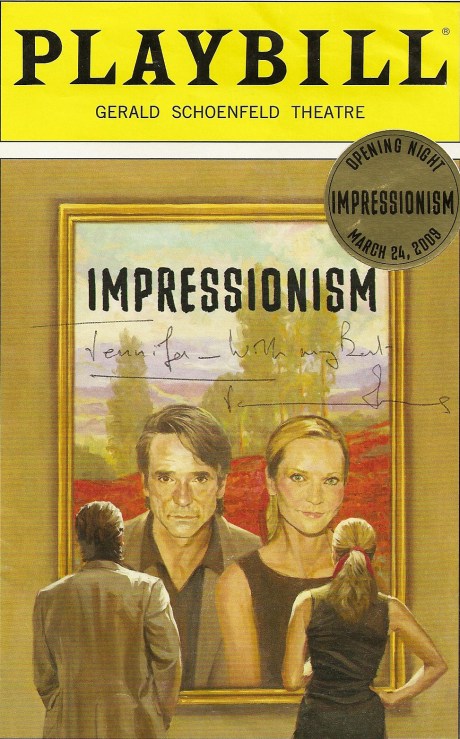
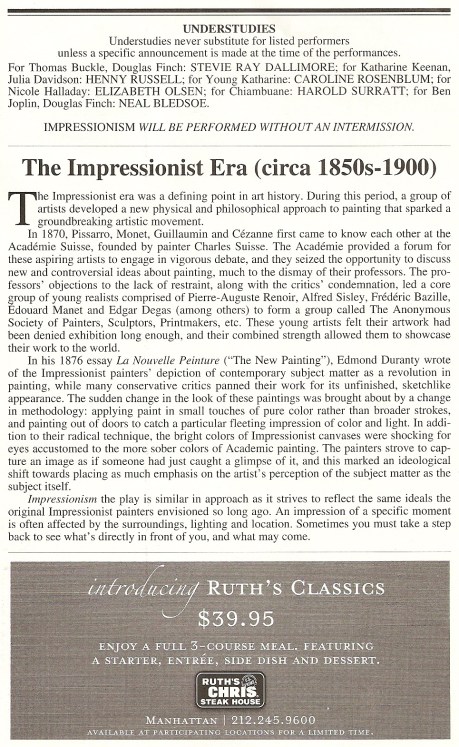
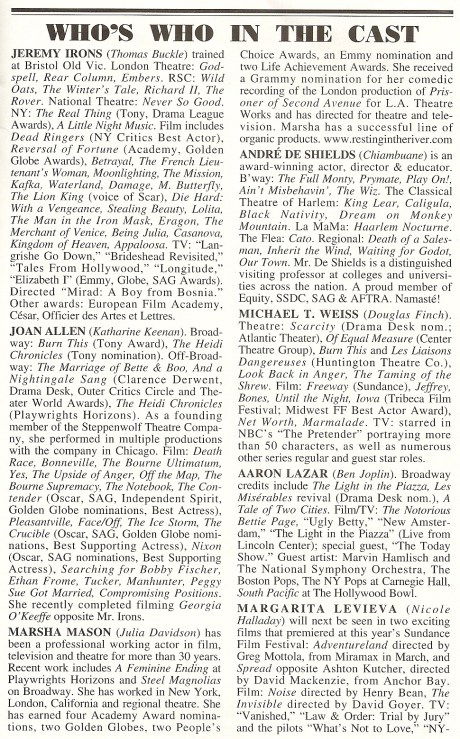
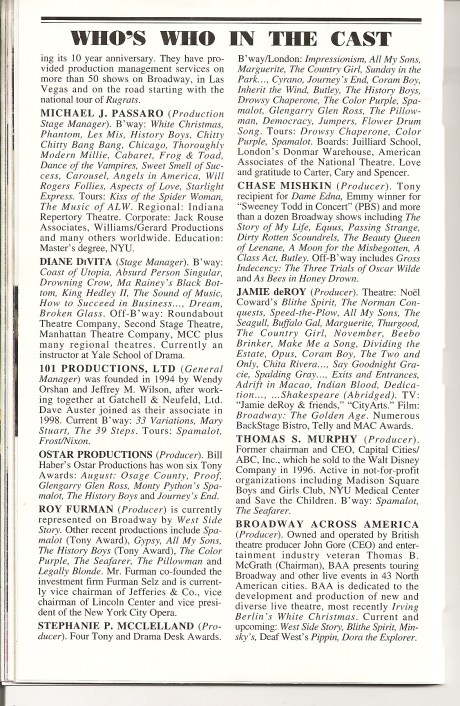
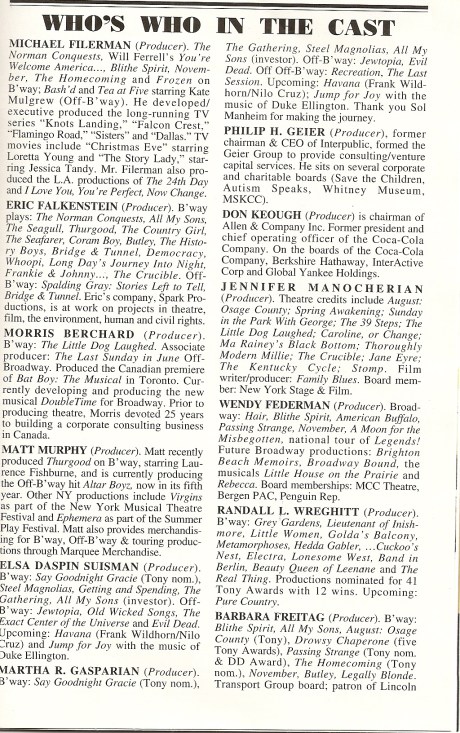
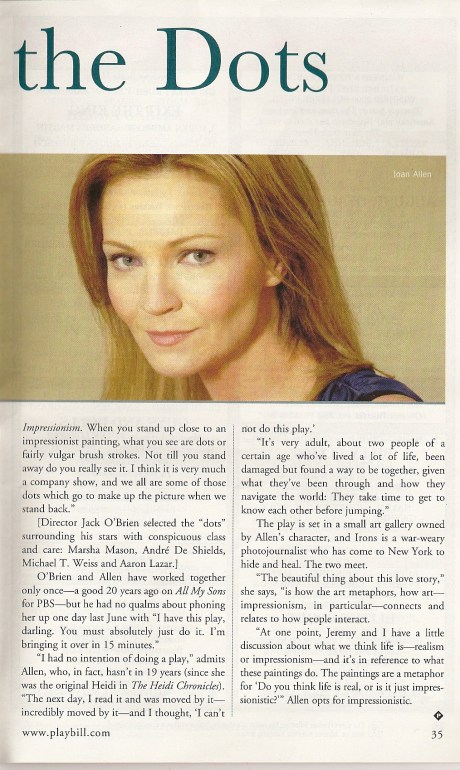
Impressionism PLAYBILL Scans

impressionismplaybillcover impressionismplaybill1 impressionismplaybill2 impressionismplaybill3 impressionismplaybill4 impressionismplaybill5 impressionismplaybill6 impressionismplaybill7 impressionismplaybill8 impressionismplaybill9 impressionismplaybill10 impressionismplaybill11 impressionismplaybill121 impressionismplaybill13 impressionismplaybill14 impressionismplaybill15 impressionismplaybill16 impressionismplaybill17

Impressionism Video Preview (BroadwayWorld.com)

This video takes a short while to load…

Vodpod videos no longer available.

more about "Impressionism Video Preview (Broadway…", posted with vodpod

WABC speaks to Jeremy and Joan on Broadway Backstage

Follow this link to watch the video on Saturday night:
WABC speaks to Tony Award winners Jeremy Irons and Joan Allen, who are starring on Broadway in the romantic new play IMPRESSIONISM.

WABC-7 TV PRESENTS
“BROADWAY BACKSTAGE: SPRING PREVIEW”

SATURDAY, MARCH 28 at 7:30PM-8:00 PM

Hosted by WABC-7 News Anchor Lori Stokes and
Tony Award winner & ACCENT ON YOUTH star
David Hyde Pierce

Tune in to WABC on Channel 7 for a sneak peek at
Broadway’s hottest shows including:

33 VARIATIONS, ACCENT ON YOUTH, EXIT THE KING, GOD OF CARNAGE, IMPRESSIONISM, MARY STUART, THE NORMAN CONQUESTS, THE PHILANTHROPIST, WAITING FOR GODOT

Impressionism Reviews…

PLAYBILL ON OPENING NIGHT: Impressionism — The Arty and the Smarty

By Harry Haun
March 25, 2009

My first-night impression of Impressionism on March 24 — from the “unique” vantage point of Row AA on the far right of the Schoenfeld Theatre, almost eye-level to the stage — was that I would dearly love an opportunity to follow the good advice which playwright Michael Jacobs kept handing his characters: You have to step back from a painting (and, metaphorically, the travail of life) in order to see the whole picture.

From where I sat, there seemed to be some dazzling projections (from Elaine J. McCarthy) and lighting effects (by the great Natasha Katz) splashed across the scrim during the eight scene changes, but I couldn’t swear to it. (Less close is better for this experience, if you want to get an eyeful of the projected world-famous paintings.) However, I can attest to being star-struck by a center-stage Jeremy Irons and Joan Allen.

Irons represents the realistic view of life, a war-worn photojournalist pretty shot himself, back home to heal from all he has seen and recorded. Allen advocates the impressionistic view of life, a self-contained art-gallery proprietress holding on to her paintings at all costs (in psychobabble parlance, her art is her “baggage”).

The opposites attract and spend the rest of the play — between sales — falling in love and trying to convert each other to their different views of life. The classiest kind of parry and thrust is called for here — and gets it from two attractive, intelligent, stylish stars who haven’t been on the Broadway boards for a good two decades.

Sardi’s, which is also having something of a comeback this season, was the scene of a “celebratory cocktail reception” that followed the performance. (Sardi’s Party No. 4 is set for Exit the King on March 26.) Ordinarily, it’s a quick scoot to Sardi’s through Shubert Alley from 45th Street, but this time first-nighters found it a slow go because of the crowd clamoring for Angela Lansbury outside the Shubert after Blithe Spirit‘s early curtain — and La Lansbury graciously tends her fans (M-G-M training, y’know).

Impressionism began previews as a two-act and soon came down to one, causing a lot of Riedel-needling in the press. “Well, they’re never easy,” sighed the director, Jack O’Brien, when consoled. “The thing is, I made the big mistake to begin with by saying, ‘I think it should be in two acts’ — and, of course, it can’t be. The minute I put an intermission in, I realized, ‘Omigod! All the energy is going forward, and you can’t stop to think because you don’t have all the clues. You have to just keep going. It’s a play where you keep figuring things out as you go along.’ When I realized I confused people, I put it back together. I didn’t cut anything. I took out an intermission.

“I think this is a play for grown-ups. I think this is a play for those of us who have collected a lot of baggage and wonder whether we can ever, ever let it go and find something else, find something new. I think it is a play that is subtly witty and wise. It’s got a lot of wisdom in it. It’s funny and, at the same time, serious about picking yourself up and trying to find somebody else when you’re not a teenager. That’s a hard thing to do. You gotta get rid of the past before you can start all over again. And that’s what it’s about. It’s giving people a lot of courage and a really lovely evening.”

O’Brien can take a bow for cheerleading Allen and Irons back to the stage after all those salad days in cinema. He couldn’t get better spokespeople for the bloody-but-unbowed. “Oh, they’re glorious,” he exclaimed, “and, of course, they are polar opposites: He’s all fire, and she’s all cool. Together, they make such great chemistry.”

Allen recognized the sparks but couldn’t say how they got there. “You never know,” she shrugged helplessly. “I do enjoy playing with Jeremy very much. I love that I’m a Midwest girl and he’s a British guy. But I do think that there is just something culturally specific about us. Sometimes, it’s one of those things that just works.”

She was happy she made the big leap back to Broadway. “It was actually easier than I remembered,” she admitted, “and I am pleased with the way the play came off. Actually, I think it even went beyond that. Sometimes, you have something in your mind, and I even think this went beyond ‘pleased.’ I did it because I loved the play and I loved the director. I like the character, too. She’s someone I deeply recognize — one of the many strong, accomplished women in New York City still on their own.”

Irons, who won a Tony his only previous time on Broadway (in Tom Stoppards The Real Thing in 1984), seemed instantly at home again. “Oh, it’s wonderful to be back,” he declared. “New York audiences are very appreciative. They tell you whether they like you or not, and they seem to be liking this, which is good.”

Andre De Shields, a song-and-dance man (The Full Monty, Ain’t Misbehavin’) who has developed some serious acting chops (Prymate, Cato), here takes on two disparate characters — an African native named for the sweet potatoes he totes, and a Manhattan baker who plays a kind of head-clearing Polonius to his favorite client.

He won the evening’s only exit-applause as the latter. When someone asked him if he heard it off-stage, De Shields demurred, “I’m trying to focus on the characters.”

View the Entire Photo Gallery
Jeremy Irons
Photo by Aubrey Reuben

Although the characters occupy different worlds and cultures, De Shields sees them as one: “From my perspective, they are the same spirit. Chiambuane in Tanzania serves as a spiritual enabler for Thomas, the character played by Jeremy Irons, and then Mr. Linder serves as a spiritual enabler for Katharine, the character played by Joan Allen, in New York. So imagine a time previous to now and a time in the future. His spirit will spiritually enable whoever is in trouble, to liberate their hearts. So I think of it as an ageless specter — that’s the way the character came to me — so I help Thomas in Africa, so I help Katharine in New York, so I help Harry in Sardi’s.”

He was quite dry-eyed about the current, shortened state of Impressionism: “The only thing we lost was an intermission. When you remove 15 minutes, things change. You have to call the designers back in and set up the equipment again because in art, as in life, you change one thing and it affects everything else. When we were intending to open on March 12 — I mean, we were ready to open — what we discovered, with the two acts, is that we were giving the audience an opportunity to second-guess what was going to happen in Act II when indeed we tied it all up in a nice little bow. So, why even give them a chance to have the wrong impression?”


Buy this Limited Collector’s Edition

Aaron Lazar, another musical-theatre specialist (blasts at the barricade, a specialty), changes his tune here to no tune to play an altar-bound young romantic.

Why? you may rightly ask. “The play, the cast, and then Jack O’Brien. It was great fun. It was — the most — fun. It’s one of the best ensembles I’ve ever worked with.”

The two other customers of the gallery are in a considerably higher tax bracket and are played by Michael T. Weiss, in his Broadway bow, and by Marsha Mason.

Weiss already likes the sound of “Broadway actor,” he admitted. “I kinda love that. It has been a long time. I started out in theatre here and then got sucked into the Los Angeles film-and-television world. I’m so happy to be doing this now. It’s my favorite thing to do. I just needed a role in New York that I really adored.”

The role in question is a ridiculously rich art collector, and Weiss plays the part in a rather lighthearted vein. “He’s a very wealthy guy, but he has a good time with his money. Why not? Right? If I were worth $100 million, I’d be in a good mood.”

Mason’s character becomes a grandmother during the course of the play, prompting her to up her ante for a painting Allen personally identifies with. “She goes through a nice little arc,” said Mason, who’s a frequent date and actress of O’Brien’s. “This is our sixth project together. We go all the way back to the mid-’70s in San Francisco at A.C.T., and then in L.A. we did Mary Stuart and The Heiress, and then Jack directed The Good Doctor for PBS, and then I did Twelfth Night at the Old Globe in San Diego.”

First-night family gatherings included Lily Rabe and her mother, Jill Clayburgh, and her brother, Michael Rabe — as well as Liz Callaway and her husband, director Dan Foster, and her sister, pianist-composer-chanteuse Ann Hampton Callaway. The latter, of course, was ever-ready to improvise a song about the show. Also: “I’m going to do a benefit for the Jewish Alliance for a New World on my sister’s birthday, April 13 — she won’t be there, but we’ll be going getting drunk afterward — and I’ll be at Carnegie Hall for the centennial Johnny Mercer tribute. I forget the date of that.”

Other friends of the court: Sadie Friedman (Allen’s gorgeous daughter who’s thinking of taking up the family trade), Kenneth Welsh (who lost both Christine Baranski and Glenn Close to Irons in the original Mike Nichols production of The Real Thing) and Bob Balaban (who in December directed Irons and Allen in their first team-effort, a Lifetime film called, and about, “Georgia O’Keefe,” airing this fall).

Also: Karen Ziemba (back from rave reviews in San Diego for playing it straight: Stockard Channing‘s role in Six Degrees of Separation), Blythe Danner (about to follow up “Meet the Parents” and “Meet the Fockers” with “Little Fockers”), radio’s Joan Hamberg (whose screenwriter-son, John, created the Fockers), Elaine Stritch, chef Rocco DiSpirito, Pulitzer Prize-winning playwright David Lindsay-Abaire, Isiah Whitlock Jr. (who’s going to reprise Beau Willimon‘s Farragut North on the West Coast with the original Atlantic Theatre Company cast, sans John Gallagher Jr., who’s working on a musical with Green Day), Donna Murphy and Shawn Elliott, lawyer Mark Sendroff, John Lithgow, singer Christine Andreas, comedienne Nancy Opel (taking a night off her hilarious explosions in The Toxic Avenger that pounces on New World Stages April 6), Penny Fuller (still Dividing the Estate at Hartford Stage, between May and early July), Anne Kaufman Schneider and director Joseph Hardy.

<!–

–>

NY1 “Time Out” review of Impressionism by David Cote with video. It’s not a glowing review of the play, but there is great video of scenes from the play itself.

——————————————————————————————————————————-

Impressionism’ muddled, but Irons and Allen shine

March 26, 2009, 4:22 pm

NEW YORK (Hollywood Reporter) – It doesn’t take an art history major to predict that “Impressionism,” the new play starring Jeremy Irons and Joan Allen that opens on Broadway Tuesday, is going to use that groundbreaking style of painting as a metaphor for life. Michael Jacobs’ play can be said to resemble Impressionist works as well: The closer you examine it, the less moving it becomes.

Still, this gentle comedy/drama about the relationship between a brittle New York art gallery owner and her mild-mannered employee has its charms, which are accentuated by the winning presence of its lead performers, who have been absent from the Broadway stage for far too long.

In its early scenes, it appears as if the evening will be a slog. First we are introduced to Katherine (Allen) and Thomas (Irons), who engage in lengthy debates about subjects like the relative benefits of coffee cakes versus muffins when not showing various masterworks to such potential customers as a wealthy older matron (Marsha Mason) and a Modigliani-craving businessman (Michael T. Weiss).

The action then confusingly and tiresomely shifts between scenes set in the gallery and various flashbacks, including Katherine at age 6 interacting with her soon-to-be-divorced parents (played by Irons and Allen); Katherine at 30 posing nude for a womanizing artist (Irons); and Thomas during a recent trip to Africa where he was shooting photographs of an elderly fisherman (Andre De Shields) for National Geographic.

The play is not helped by its diffuseness — it has been shortened considerably since its early previews — or by its tonal shifts between sitcom-style comedy and sensitive drama. And the lengthy explications about the famous paintings projected on scrims slow the pacing considerably.

But the final scene, when the main characters let down their emotional guard and finally find a way to connect, is quite moving, making one nearly forgive the many missteps along the way.

The two stars — who are aging like fine wine — make middle-aged love seem very sexy indeed. Allen is as luminous onstage today as she was decades ago in “The Heidi Chronicles,” while Irons offers a wily, understated comic turn that should have the matinee ladies quivering.

Director Jack O’Brien has staged this problematic work about as skillfully as one could expect, and the rest of the cast, especially Mason and the scene-stealing De Shields, offer solid comic support.

————————————————————————————————————————-

Allen, Irons make more than a good impression

By BILL CANACCI
Staff Writer

from http://www.mycentraljersey.com

You can look at a painting or a photograph you love 1,000 times and still feel touched and inspired. And if you’re lucky, or maybe just open-minded, one of those times you will notice something new.

With “Impressionism,” Michael Jacobs has created a mature, intelligent and witty play about love and art. But it is also about seeing what’s in front of us, about what makes us love something or someone, and about the power of memory.

Set in Manhattan, “Impressionism” is the story of Thomas Buckle (Jeremy Irons), a world-traveling photojournalist, and Katharine Keenan (Joan Allen), a New York gallery owner. As the play begins, we do not exactly know what is going on between them. We do know this: The two are able to have the most entertaining conversations — the dialogue throughout the play is truly first-rate — about coffee cake and cranberry muffins.

But the play then takes us on a journey into the past — to explain why Katharine loves a painting in her gallery. The transition back in time is one of the joys of the play, and projection designer Elaine J. McCarthy is to be commended. Her work, combined with scenic designer Scott Pask and lighting designer Natasha Katz, make this play a visual delight. I’m hesitant to give away details because describing it would spoil the effect. But I will say this: It is unexpected and wonderful to smile and be moved during scene changes.

Allen, who won a 1988 best actress Tony Award for “Burn This,” has not been on Broadway in 20 years. Irons took home the 1984 best actor Tony Award for “The Real Thing” — so it’s taken 25 years for him to return to the Great White Way. And yet here they are — making magic together, as if they’ve been on stage together dozens of times.

Irons plays a few roles in the play, but he’s best as Thomas, a man who knows seemingly everything — and loves to tell stories about what he knows. But he is not arrogant or snobbish. Well, maybe a little snobbish, but the audience loves him because they know his heart is good.

Allen is equally impressive. Katharine is an educated woman who prides herself on her ability to read people. It’s fascinating to watch as her character develops — through memories as well experiences in the present at the gallery.

Deserving mention are Marsha Mason, who plays a woman who loves the same work of art as Katharine, and Andre De Shields as Chiambuane, who befriends Thomas while he is working in Tanzania. (My theater companion was a bit uncomfortable during this scene; he thought it bordered on racist. I would not go that far, but I can see how it may make some people a bit uncomfortable.)

Director Jack O’Brien, who won a Tony for his work on the mammoth production “The Coast of Utopia,” captures the pieces, or dots if you will, of the play: the dialogue, the love story, the art, the memories. There is a real flow from start to finish. He makes it seems effortless, when in reality it is a major undertaking.

In some ways, this play will remind people of “Sunday in the Park With George,” Stephen Sondheim’s brilliant musical. But it stands on its own.

And yet one song from that show, “Putting It Together,” seems particularly appropriate: “Piece by piece, only way to make a work of art/Every moment makes a contribution/Every little detail plays a part/Having just a vision’s no solution,/Everything depends on execution.”

————————————————————————————————————————————————————–

The A-Team

Actors trump material in the theatrical smackdown God of Carnage and the more muted Impressionism.


get_comment_count();

The first two-thirds of Michael Jacobs’s Impressionism are so indistinct and unfocused they make Monet’s water lilies look like photo-realism: Joan Allen plays Katharine, a Manhattan art-gallery owner who can’t part with her high-end merchandise, which symbolizes bits of her past she’s not yet ready to shed. Katharine’s employee, Thomas (Jeremy Irons), a photographer who used to shoot in Africa for National Geographic, is as even-tempered as she is high-strung. He’s also a coffee aficionado, and he shares his wisdom with Katharine; she reciprocates by singing the praises of a cranberry muffin by a local baker (played, marvelously, by André De Shields). They banter and brood cleverly and self-consciously, and in between, dramatized flashbacks show us the lives they led before they were trapped in a sleepy gallery. Customers—including one played by Marsha Mason—alleviate the tedium, but just barely.

And then, in the last half-hour of Impressionism’s single act, Katharine and Thomas’s world opens up like one of those Monet lilies. The play’s director, Jack O’Brien, has shaped it so that we can’t be sure what’s going on until the very end, when we step back from Katharine and Thomas’s daubed-on dots and dashes of conversation and see the broader pattern of their relationship to each other.

The material’s surprise revelation is more a handy way out of the characters’ incessant talkiness than a satisfying, believable conclusion, but at least it gives us something to hang on to. Allen works hard to make Katharine sympathetic; we can see that she’s wounded, not just self-centered and abrasive. But the performance is too finely calibrated: It clacks along efficiently but never breathes. As Thomas, Irons has the luxury of being relaxed and charming, even though his character, too, harbors painful secrets. Irons’s performance is comfortably rumpled and lived-in, an effect that requires meticulousness and discipline. His gift is that he makes hard work look like a shrug. –S.Z.

————————————————————————————————————————–

Impressionism opens on Broadway and proves art isn’t easy

by Suzanna Bowling  – NY Broadway Examiner
March 25, 1:06 AM

.examiners_body img{padding:5px;}


Joan Allen and Jeremy Irons

Like life art is an acquired taste and the same goes for Michael Jacobs Impressionism playing at the Gerald Schoenfeld Theatre. This particular play is my taste but for the life of me I can’t tell you why. There are times that you go to a museum or an art gallery and a painting that you didn’t think you liked, eats away at you. By the time you are able to turn your eyes away, you have been profoundly moved. There really are no words just vast amounts of feeling. Is the painting for everybody? Probably not, but is anything really for everybody?This is how Impressionism struck me. The play set in an art gallery, tells the tale of Katherine (Joan Allen) and Thomas (Jeremy Irons), lives through flash backs. How they evolved to who they are. What gives them their idiosyncrasies and how they finally find love. For those romantics out there and I am one, this is a chick flick brought to the stage. To look at this production is breathtaking. Monet’s, Chagall’s, Picasso’s, Cassatt’s and other masters are illuminated before our eyes. They shed light like tiny specks so we can see the bigger picture. Joan Allen is radiant as Katherine who fears abandonment and clings to her paintings. Jeremy Irons wraps his way into our hearts and by the end, like Katherine we fall in love with him.Marsha Mason shines in the small role of Julia trying so desperately to connect with her daughter. Andre De Sheilds embodies both of his characters with a great monologue about life and what love really is. Jack O’Brian’s staging is what I did have problems with. The flashbacks are hard to follow and as beautiful as the art is, it becomes distracting and at times too much. Impressionism proves “Art isn’t easy”, but it can and does touch our souls.

———————————————————————————————————————————————————————-