
Jeremy Irons’s Walk of Fame
The “Morning Show” actor strolls the theatre district, remembering his star turn in Tom Stoppard’s “The Real Thing” and recalling the way Mike Nichols always joked that he was Jewish.
By David Kamp
September 22, 2025
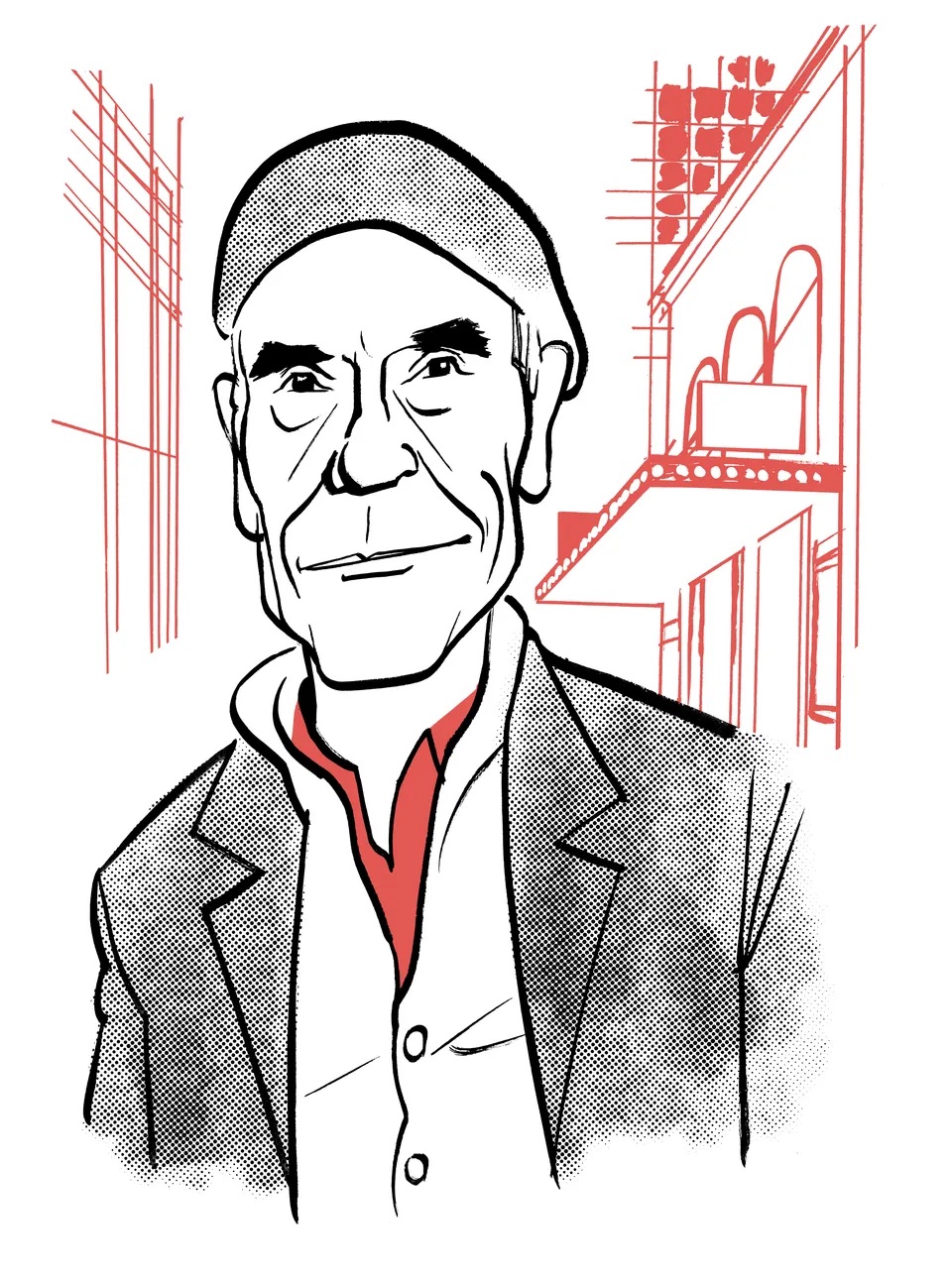
Illustration by João Fazenda
In Shubert Alley, which runs between West Forty-fourth and Forty-fifth Streets, Jeremy Irons, dressed in a tweed cap turned backward and three artfully arranged layers of European workwear, pointed to a patch of asphalt beneath the marquee of the Booth Theatre. “This is where I used to argue with the police that I should be allowed to park my motorcycle. But they made me put it in the damn car park up the street,” he said.
Irons was reminiscing about his Broadway début, in Tom Stoppard’s “The Real Thing” forty-one years ago. The production was mounted in the Plymouth, next door to the Booth, which is now the Schoenfeld Theatre. “That was my dressing room,” Irons said, pointing to a small window high above the stage door. Pointing to an even smaller window, he said, “That was my loo.” Motioning one flight up, he said, “And that’s where Glenn was.”
Glenn Close was Irons’s co-star in “The Real Thing.” It was a bravura production fired by star power, with Mike Nichols directing and the up-and-comers Christine Baranski, Peter Gallagher, and Cynthia Nixon in supporting roles. Stoppard had sought out Irons for the original London production, but he had already committed to a screen adaptation of Ibsen’s “The Wild Duck,” to be filmed in Australia. While there, he received a disquieting bulletin: “I heard that Meryl Streep and Kevin Kline had gone to see the London show. I thought, Well, fuck that. So I called my agent, Robby Lantz, and said, ‘If you don’t get me that role, I’m leaving.’ ”
Irons’s persistence was rewarded: he and Close both won Tonys in 1984, capping a glorious early-eighties run that also saw him achieve television stardom as the swoonsome Charles Ryder in the miniseries “Brideshead Revisited” and film stardom opposite Streep in “The French Lieutenant’s Woman.”
Irons still rates “The Real Thing” as his favorite acting gig. He seldom gets to New York anymore, dividing his time between houses in Ireland and England that he shares with his wife, the actress Sinéad Cusack. In the theatre district, he exulted in simply walking around and looking up at the marquees. “I’m sorry to have missed the Ava Gardner show,” he said, referring to “Ava: The Secret Conversations,” written by and starring Elizabeth McGovern.
Gardner, like Lana Turner and Barbara Stanwyck, did a lot of TV work late in her career, often on nighttime soaps like “Dynasty” and “Falcon Crest.”
“Sort of like me on ‘The Morning Show,’ ” Irons said with a mordant smile.He turned seventy-seven this month, concurrent with the return of Apple TV+’s drama about an a.m. news program. In the new season, its fourth, he plays the father of Jennifer Aniston’s tightly wound news anchor. His character, Martin Levy, is an imperious professor of law, not so different from John Houseman’s Charles W. Kingsfield, Jr., in “The Paper Chase,” albeit a bit more handsome and mean.
Although he is barely twenty years older than Aniston, Irons said, “I am accepting of where I’m put.” He went on, “You always feel twenty-two, and then you realize you’re not anymore. I knew the change was going to happen, from playing the lead to playing the dad parts. I’m happy with that.”
Martin Levy is also, by Irons’s reckoning, the first Jewish character he has played, although he does not infuse the professor with any particularly Jewish mannerisms. “He’s thoroughly assimilated,” he said.
However, thinking back to “The Real Thing,” Irons recalled that Nichols, who was Jewish, kept up a peculiar running shtick in which he maintained that Irons, raised in the Church of England, was also Jewish. When the play was in its Boston-tryout phase, Close told him a story about how she had enthused over his performance to Nichols during a car ride. Nichols responded, “Yeah, he’s wonderful, considering he’s Jewish.”
Years later, Nichols was developing the film “Wolf,” whose lead role ultimately went to Jack Nicholson. Irons recalled, “I said to Mike, ‘I’d really like to do that one,’ and he said, ‘You’re too Jewish.’ ”
From his coat, Irons retrieved a pouch of loose tobacco, brown cigarette papers, and a small mounted roller he uses to skin up his own smokes. Out of the roller came a slim cylinder that looked like a baby cheroot. He lit it and took a drag. Another memory returned to him: “Mike used to call me not Jeremy but Jerome. Which I loved.” ♦
Published in the print edition of the September 29, 2025, issue, with the headline “Mike Nichols’s Ghost.”










 jeremyirons.net
You must be logged in to post a comment.